The Upcoming Turkish Elections: Implications for Domestic and Foreign Policy
The Middle East Institute's Center for Turkish Studies is proud to host Mr.Taha Ozhan, Director General of the Foundation for Political, Economic and Social Research (SETA Ankara), for a discussion on Turkey's upcoming elections on June 12.
Turkey as an Alternative Democratization Model for the Middle East
The popular uprisings against authoritarian regimes in Tunisia, Yemen, Jordan and Egypt herald the beginning of a new political era in the Middle East. At the center of this new political order is a generation of young Arabs, educated, highly marginalized, and numerous. The members of the so-called Arab “youth bulge” are demanding neither the unification of the Arab world as espoused by the pan-Arabists of the 1960s, nor an Islamic state of the 1980s, but rather a dignified life, social justice, and freedom.
Few question the desirability of finding a political resolution to the Afghan conflict or doubt Pakistan’s pivotal role. The growing divide of opinion in this country is over how best to achieve that outcome. One camp led by our military strategists insists that various political agreements are likely to result from accumulated military successes, sustained by Afghan governance reforms and economic improvements. Visible counterinsurgency gains are expected to gradually wean fighters away from the ranks of the insurgency.
This Commentary first appeared in McClatchy News on January 5, 2011.
The assassination of Salman Taseer, the governor of Punjab, Pakistan's largest province, has illustrated the increasingly chaotic environment in that country, which only promises to get worse in the new year. Weeks before his death, Taseer had the courage to say what his fellow politicians were unwilling to: that Pakistan's blasphemy law must be repealed in order for Pakistan to enter the community of modern nations.
With Pakistan caught up in four wars during the past nine years — the Afghanistan war, the War on Terror, the insurgency in the tribal areas, and the wave of terrorism unleashed by the Tehrik-i-Taliban (TTP) and the Punjabi Taliban in the rest of the country — it has often been said that the country is facing an existential threat. If this was a cliché before, it is no more so after the catastrophic floods. Pakistan had been living dangerously in the past, but the wars and floods threaten to wash away its future.
Turkey's Dual Track Approach Toward the Kurdistan Regional Government
Turkey’s policy toward the Kurdistan Regional Government (KRG) in northern Iraq has undergone an important shift since 2009. Only a few years ago, Turkey did not recognize Iraq’s Kurdish Regional Government and refused to meet with its representatives in any official capacity due to its fear that recognition would embolden Turkey's own Kurdish minority to demand similar home-rule status.
The Middle East Institute is proud to host Mr. Habibullah Khan, current head of the Federally Administered Tribal Areas (FATA) Secretariat, to discuss the security, policy, and cultural challenges surrounding the integration of FATA into Pakistan's mainstream political system. In his talk, Mr. Khan will highlight the primary characteristics of life in the tribal areas and outline the present governance system.
Turkey’s professional military has been a force for modernization and progress throughout the nation’s history. As the constitutionally-appointed guardian of the Turkish Republic, however, the military has often intervened in political affairs, resulting in a constant, underlying tension between the government and the military establishment in Turkey.
This piece first appeared as a Commentary on McClatchyDC.com, August 24, 2010
It is hard to imagine a government that faces more existential threats to its people, state, and democracy than the current civilian government in Pakistan.
This Commentary first appeared as an op-ed on Foreign Policy's AfPak Channel, August 18, 2010.
The desperate plight of over 20 million Pakistani citizens displaced and dispossessed by the most ferocious flooding in the history of the young state is heartbreaking. Nature is extracting a cruel price on a population already racked by debilitating poverty and a brutal insurgency.
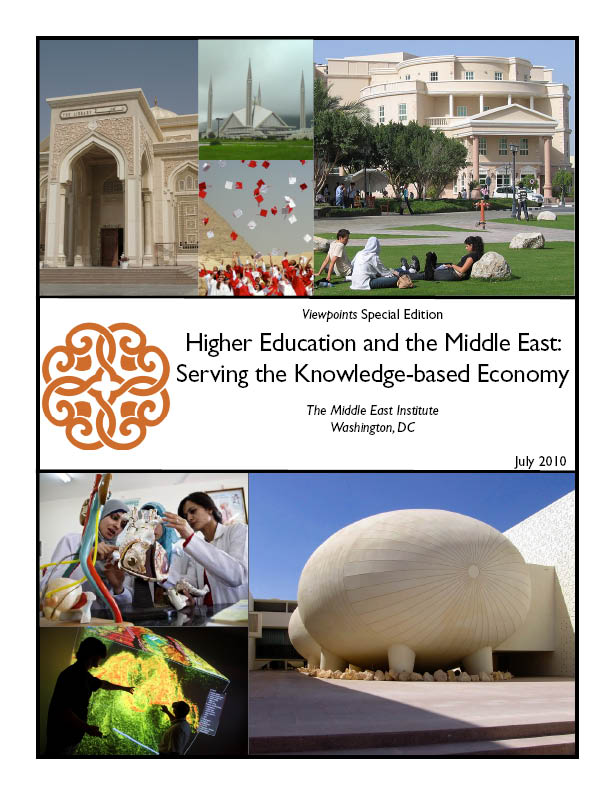
Higher Education and the Middle East: Serving the Knowledge-based Economy
This is the first of three volumes examining the internationalization of higher education and the Middle East. The 12 essays included in this volume explore some of the changes that are taking place and the challenges that lie ahead as Middle Eastern countries seek to build sustainable higher education systems and strengthen their economies. Within the dynamic global higher education landscape, is the Middle East a stagnant backwater or a center of creative initiative? What are, and should be the roles of foreign partners and providers?
United States Will Pay a Heavy Price for the Gaza Flotilla Incident
Asserting its need to be secure from future terrorism launched from Gaza, Israel used force last week to maintain a blockade that has been creating a humanitarian cataclysm for the people of Gaza. In the early days following the attack on the aid flotilla, the Israeli military interpretation of events dominated much of the popular media coverage in the United States. Gradually, though, attention shifted to the incident’s negative impact on Israel’s international standing and the security implications of continued international and regional uproar.