This Opinion piece first appeared in Frontline’s Tehran Bureau on January 19, 2012.
After months of frosty relations, Iran and Turkey are talking again. The ostensible reason for Turkish Foreign Minister Ahmet Davutoglu’s visit to Tehran two weeks ago was to try to jump start stalled nuclear talks with the so-called P5+1 group of nations. Davutoglu conveyed to Iranian chief nuclear negotiator Saeed Jalili the European Union’s invitation to resume the talks in Turkey that were suspended a year ago for lack of progress.
*This Opinion first appeared in the Huffington Post on December 13, 2011
The first free and by all accounts fair elections in Egypt mark a major turning point in the country's long history. In what is likely to be a tenuous and trying transition to democracy, Egypt's Islamists won a resounding victory, gaining two-thirds of the vote in the first round of Egypt's parliamentary elections. While many in the West fear that the Islamist victory in this first election will radicalize Egypt, in reality, the situation is far more complex and nuanced.
This Opinion first appeared in the Huffington Post on November 11, 2011
On November 28th, millions of Egyptians will finally breathe a deep sigh of relief as they gather at the polls to vote in the first phase of parliamentary elections following the ousting of the Mubarak regime.
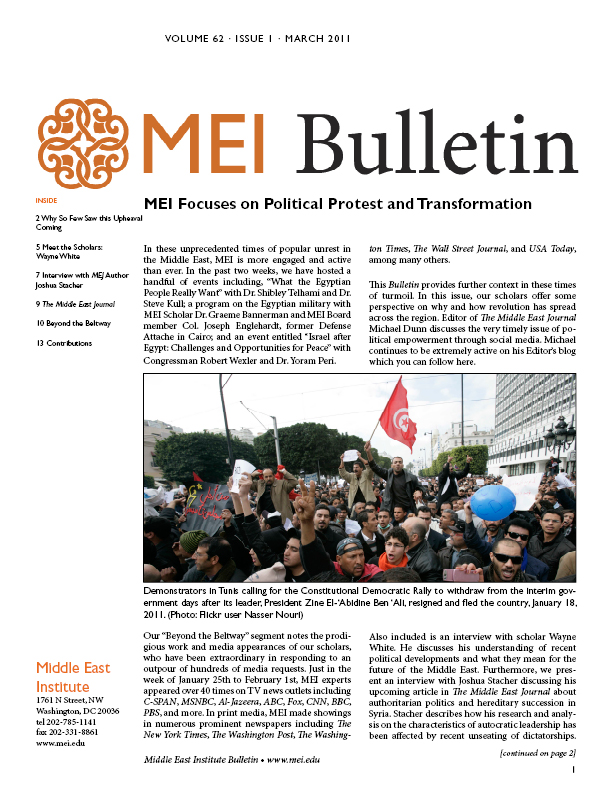
Amidst the historic turmoil sweeping across the Arab world, in the March 2011 Bulletin, MEJ editor Michael Dunn addresses political empowerment through social media, scholar Wayne White is interviewed on recent political developments, and Joshua Stacher previews his forthcoming article on authoritarian politics and hereditary succession in Syria.
In the wake of the August 31 drawdown of US forces and the formation of a fragile unity government after months of negotiations, the December 2010 Bulletin features an argument from Ambassador David Mack for sustained US assistance to the Iraqi government, interviews with MEI Scholar Charles Dunne the political situation in Iraq and with Katherine Blue Carroll on her forthcoming MEJ article, and a summary of MEI’s 64th Annual Conference.
Women, Shari‘a, and Personal Status Law Reform in Egypt after the Revolution
Like almost everything else during the uncertain period of the transitional government, the future of personal status law reform is at a crossroads in Egypt. The new constitution (assuming one will exist)[1] may technically have little direct impact on how the country’s laws affect women’s lives, but the legislative process that emerges thereafter most certainly will.
The Iraq-SAMHSA Partnership to Strengthen Behavioral Health Studies
Originally posted September, 2011
For nearly eight years — since May 2004 — the Substance Abuse and Mental Health Services Administration (SAMHSA) of the US Department of Health and Human Services (HHS) has partnered with the Iraqi Ministry of Health to help Iraq re-establish its behavioral health service system. HHS and SAMHSA have learned much from this effort about improving behavioral health services in the US, particularly for Muslim populations and for persons experiencing extended trauma.
Implications of the Iraq-SAMHSA Initiative for the Delivery of Behavioral Health Services in the United States
Through the collaboration between Iraq and the Substance Abuse and Mental Health Services Administration (SAMHSA) of the US Department of Health and Human Services (HHS), US providers have learned a great deal about improving behavioral health services, including trauma services, from their Iraqi colleagues since 2004.[1] Two of the many implications for US behavioral health services resulting from this partnership are directly relevant to shaping services for both returning veterans, and refugees and immigrants from the Middle East:
Governments in the Middle East and North Africa have long relied on repression to intimidate, harass, and punish political opponents. During the Arab uprisings, dictators under threat have all ordered and used violence against peaceful protestors as a way to maintain power. But this repression has had widely divergent effects on the course of the different conflicts.
Building an Addiction Workforce in the Middle East: A Counselor Training Program Partnership Between Kasr Al-Ainy and UCLA
Drug and alcohol problems know no borders. Annually, the United Nations World Drug Report documents that heroin, methamphetamine, cocaine, alcohol, and prescription drugs negatively impact public health, public safety, and social institutions in countries around the world.[1] In many parts of the Middle East, there is limited data on the nature and extent of alcohol and drug problems.
F. Stephen Larrabee, Distinguished Chair in European Security at the RAND Corporation, and Gonul Tol, Executive Director of the Middle East Institute’s Center for Turkish Studies, highlight the importance of drafting a new civilian constitution to solve Turkey’s Kurdish issue.