تمت ترجمة هذا النص بواسطة الذكاء الاصطناعي وقد يحتوي على أخطاء.
تخطي إلى المحتوى

Research & Commentary Results

تصفية حسب
1549 Results
Turkey and Iran Find Common Ground in Iraq
  • التحليل
  • Turkey and Iran Find Common Ground in Iraq

    This Opinion piece first appeared in Frontline’s Tehran Bureau on January 19, 2012.

    After months of frosty relations, Iran and Turkey are talking again. The ostensible reason for Turkish Foreign Minister Ahmet Davutoglu’s visit to Tehran two weeks ago was to try to jump start stalled nuclear talks with the so-called P5+1 group of nations. Davutoglu conveyed to Iranian chief nuclear negotiator Saeed Jalili the European Union’s invitation to resume the talks in Turkey that were suspended a year ago for lack of progress.

    Egypt: Islamists vs. Islamists
    معهد الشرق الأوسط
  • التحليل
  • Egypt: Islamists vs. Islamists

    *This Opinion first appeared in the Huffington Post on December 13, 2011

    The first free and by all accounts fair elections in Egypt mark a major turning point in the country's long history. In what is likely to be a tenuous and trying transition to democracy, Egypt's Islamists won a resounding victory, gaining two-thirds of the vote in the first round of Egypt's parliamentary elections. While many in the West fear that the Islamist victory in this first election will radicalize Egypt, in reality, the situation is far more complex and nuanced.

    December 13, 2011

    The New Dynamics of Egypt's Elections
    معهد الشرق الأوسط
  • التحليل
  • The New Dynamics of Egypt's Elections

    This Opinion first appeared in the Huffington Post on November 11, 2011

    On November 28th, millions of Egyptians will finally breathe a deep sigh of relief as they gather at the polls to vote in the first phase of parliamentary elections following the ousting of the Mubarak regime.

    November 11, 2011

    Center for Turkish Studies Second Annual Conference on Turkey
  • Video
  • Center for Turkish Studies Second Annual Conference on Turkey

    The 2011 Second Annual Conference on Turkey, entitled “Change Within and Beyond and Borders: Turkey’s Domestic and Foreign Policy Agenda,” was organized by the Center for Turkish Studies at the Middle East Institute on June 23rd, 2011 at the University Club. As the Conference coincided with recent important developments in Turkey, especially the general elections, about 300 participants from think tanks, universities, U.S. and foreign government officials as well as private sectors attended the Conference.

    October 31, 2011

    Troubled Triangle: The US, Turkey, and Israel in the New Middle East
  • Video
  • Troubled Triangle: The US, Turkey, and Israel in the New Middle East

    The trilateral relationship between Turkey, Israel and the United States has deteriorated in recent years as Israel's and Turkey's foreign policy goals in the Middle East continue to diverge. Despite repeated attempts, the United States has failed to reconcile these two important regional allies since the divisive Mavi Marmara incident in May 2010. MEI and The Stimson Center held a discussion of this critical yet troubled trilateral relationship in a time of unprecedented change in the Middle East featuring Prof. William B. Quandt, Edward R.

    October 18, 2011

    September 2011: Syria
  • التحليل
  • September 2011: Syria

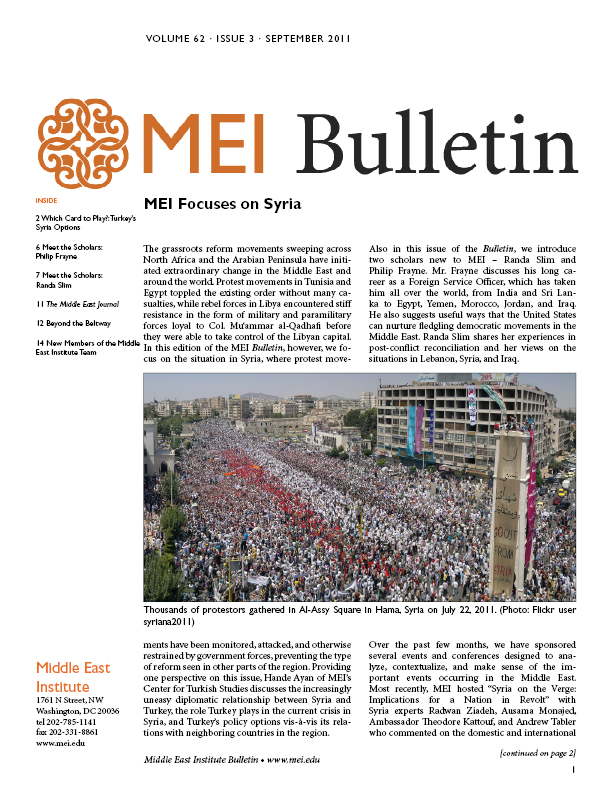
    Amidst ongoing violence against protestors in Syria, Hande Ayan of the Center for Turkish Studies discusses the uneasy diplomatic relationship between Turkey and Syria and Turkey’s role in the political situation there. The September 2011 Bulletin also introduces MEI scholars Philip Frayne, who speaks on his Foreign Service career and offers his insights on how the US can support democratic transitions in the Middle East, and Randa Slim, who is interviewed on her experience in post-conflict reconciliation.

    October 7, 2011

    March 2011: Political Protest and Transformation
  • التحليل
  • March 2011: Political Protest and Transformation

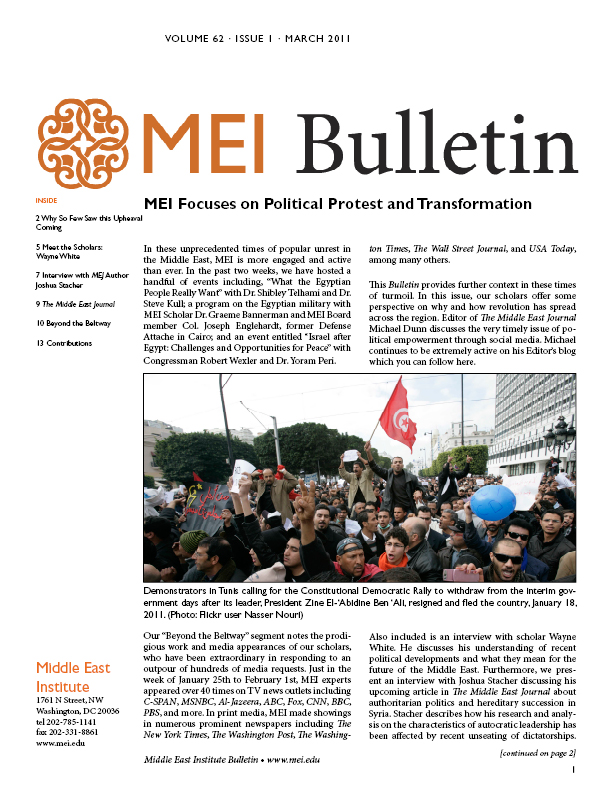
    Amidst the historic turmoil sweeping across the Arab world, in the March 2011 Bulletin, MEJ editor Michael Dunn addresses political empowerment through social media, scholar Wayne White is interviewed on recent political developments, and Joshua Stacher previews his forthcoming article on authoritarian politics and hereditary succession in Syria.

    October 6, 2011

    Women, Shari‘a, and Personal Status Law Reform in Egypt after the Revolution
    معهد الشرق الأوسط
  • التحليل
  • Women, Shari‘a, and Personal Status Law Reform in Egypt after the Revolution

    Like almost everything else during the uncertain period of the transitional government, the future of personal status law reform is at a crossroads in Egypt. The new constitution (assuming one will exist)[1] may technically have little direct impact on how the country’s laws affect women’s lives, but the legislative process that emerges thereafter most certainly will.

    October 1, 2011

    Erdogan's Arab Spring Tour
    معهد الشرق الأوسط
  • التحليل
  • Erdogan's Arab Spring Tour

    When President Obama met with Turkish Prime Minister Recep Tayyip Erdogan on Tuesday, the two discussed cooperation on Syria, counter-terrorism and supporting the Arab spring. But a central theme of the talks, and what most concerns the U.S. at the moment, is a sharply deteriorating Turkish relationship with Israel that the U.S. hopes to reverse. Conversely, this deterioration was the source of much acclaim when Erdogan visited Arab spring countries last week.

    Assessing Turkey's Moralpolitik
    معهد الشرق الأوسط
  • التحليل
  • Assessing Turkey's Moralpolitik

    The release of last week’s UN Palmer Report, assessing Israel’s attack on the Mavi Marmara and five other ships carrying aid to Gaza, sparked outrage in Turkey. Many criticized the report’s alleged bias, and claimed it failed to provide a credible legal analysis of the Mavi Marmara incident in which nine Turkish citizens were shot to death by Israeli commandos, some at close range and from behind.