In less than two decades, a string of offshore discoveries has turned the Eastern Mediterranean into a significant gas-producing region, making Israel an exporter, twice lifting Egypt into the ranks of liquefied natural gas (LNG) exporters, and giving Cyprus finds it has yet to bring to market. That gas lies in two offshore basins: the Levant Basin, which extends from Israel’s coast north past Lebanon and Syria and west to Cyprus, and the Nile Delta Basin off northern Egypt. First discovered in the late 1960s, gas in the Eastern Mediterranean has become a major opportunity for nations in the region to strengthen their energy independence and economic development as well as a source of considerable friction, as vital energy investments have been stymied by ongoing geopolitical tensions. As more critical deposits of natural gas were discovered beginning in 2009, the Eastern Mediterranean has taken on growing importance as an energy producer. Moving forward, energy consumers, especially European Union member states, may increasingly look to the region as they seek to diversify their LNG imports to partially reduce reliance on hostile powers such as Russia or on supplies from the Gulf states subject to conflict-related disruption. For countries in the Eastern Mediterranean, the harnessing of domestic natural gas deposits has provided an opportunity to become energy exporters and driven significant foreign investment.
Despite the Eastern Mediterranean’s considerable potential, with undiscovered, technically recoverable conventional resources of natural gas estimated at a mean of 286.2 trillion cubic feet (tcf) by the US Geological Survey in 2020, progress on bringing this energy to market has faced both political and structural challenges. Longstanding tensions with Turkey have complicated efforts by the Republic of Cyprus to fully develop its offshore natural gas assets and regional infrastructure projects. Israeli and Egyptian gas fields have faced intermittent disruptions from conflict in the broader Middle East, including following the October 7, 2023, Hamas attacks, fighting between Israel and Hizballah, and the 2026 war with Iran. Domestic pressures also played a role, most notably in Egypt, the only country in the region with liquefaction capacity, which has repeatedly paused LNG exports since 2023 amid declining production from its Zohr field and growing domestic demand for electricity. Such tensions have dampened enthusiasm for investment in the Eastern Mediterranean and created roadblocks for regional cooperation. In response to these challenges, the East Mediterranean Gas Forum (EMGF) was established in early 2019 to promote economic cooperation, create energy linkages, and foster security partnerships among its member states.
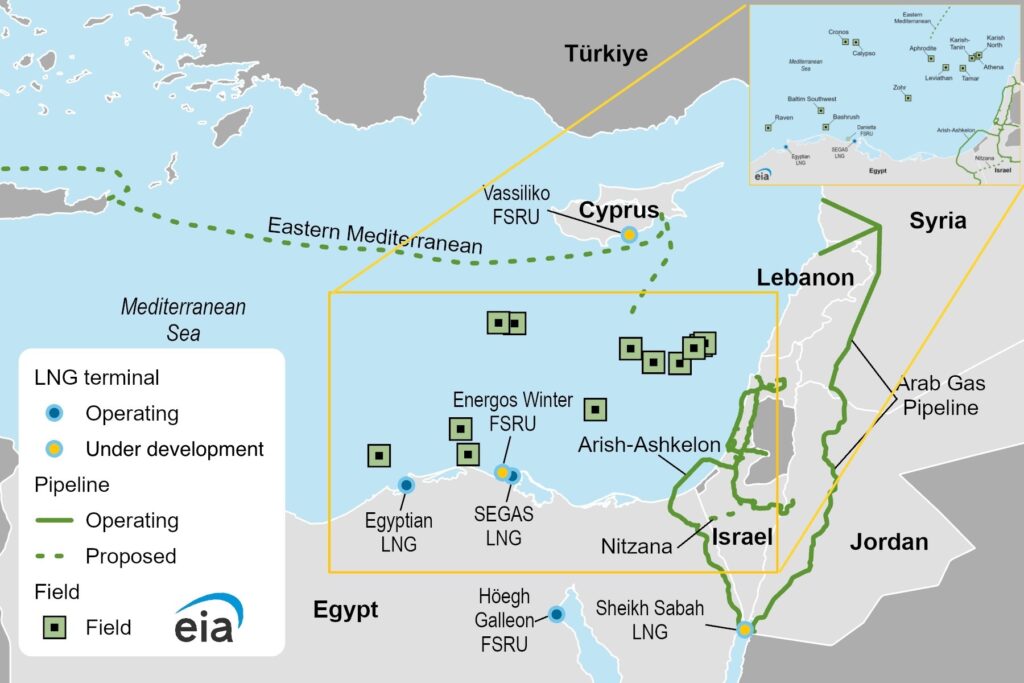
Map of the Eastern Mediterranean region. Source: US Energy Information Administration, Global Energy Monitor, Global Gas Infrastructure Tracker, and the World Bank Group, September 3, 2025.
History
Offshore natural gas resources in the Eastern Mediterranean were first explored off the coast of Israel and northern Sinai in the late 1960s and early 1970s. The first discoveries were made in Egypt with the offshore Abu Qir field in 1969, just two years after the Italian company Eni found the country’s first onshore gas field, Abu Madi, in the Nile Delta. Companies continued to explore the delta and its shallow waters through the 1970s and 1980s, before moving into deeper waters in the 1990s. Their finds made Egypt a gas exporter in the early 2000s, first through the Arab Gas Pipeline and then the LNG plants at Damietta and Idku.
Following decades of largely unsuccessful exploratory efforts offshore of Israel, the modest Noa and Mari-B fields were discovered in its waters in 1999-2000 by Noble Energy and its Israeli partner Delek. Mari-B began producing in 2004, marking the beginning of the country’s domestic natural gas industry. In 2009, the same two companies made a major breakthrough with the discovery of the Tamar Gas Field (11-13 tcf) off the coast of Israel, followed the next year by the much larger Leviathan field (22-25 tcf) in Israel’s exclusive economic zone (EEZ).
“Egypt’s struggles have profoundly affected the growth of its domestic natural gas industry as well as the development of the wider Eastern Mediterranean energy sector.”
Noble found the Aphrodite field (3.6-6 tcf) in Cypriot waters in December 2011, making it the island nation’s first such discovery, followed by the Karish field offshore of Israel in 2013. In 2015, Eni discovered the even larger Zohr natural gas field, with up to 30 tcf in place, providing a massive boost to Egypt’s domestic energy production. Zohr is the Eastern Mediterranean’s largest offshore gas field to date. Production at the new fields came online in the following years — Tamar in 2013, Zohr in 2017, Leviathan in 2019, and Karish in 2022 — and these initial discoveries spurred a wave of natural gas exploration in the region that continues to this day.
The importance of these newly discovered natural gas fields was quickly realized by both regional governments and international oil companies (IOCs). Energy giants, including Chevron (which acquired Noble in 2020), BP, Eni, and Shell, have played a significant role alongside national oil corporations (NOCs) in facilitating the discovery and exploitation of natural gas in the region. As output from these fields began to come online, natural gas production in the Eastern Mediterranean has soared, with annual output reaching 2.43 tcf in 2024 per US Energy Information Administration figures, up from 1.87 tcf in 2015. However, since peaking in 2021 at 3.08 tcf, annual production has slowly begun to decline. Numerous factors have contributed to this trend, including decreasing output from the Zohr field in Egypt and the natural depletion of the Mari-B field in Israel, temporary halts to production in Israeli fields during numerous military conflicts, and slowing regional investment from IOCs due to difficulties in establishing profitable operations in nations such as Cyprus and Egypt.
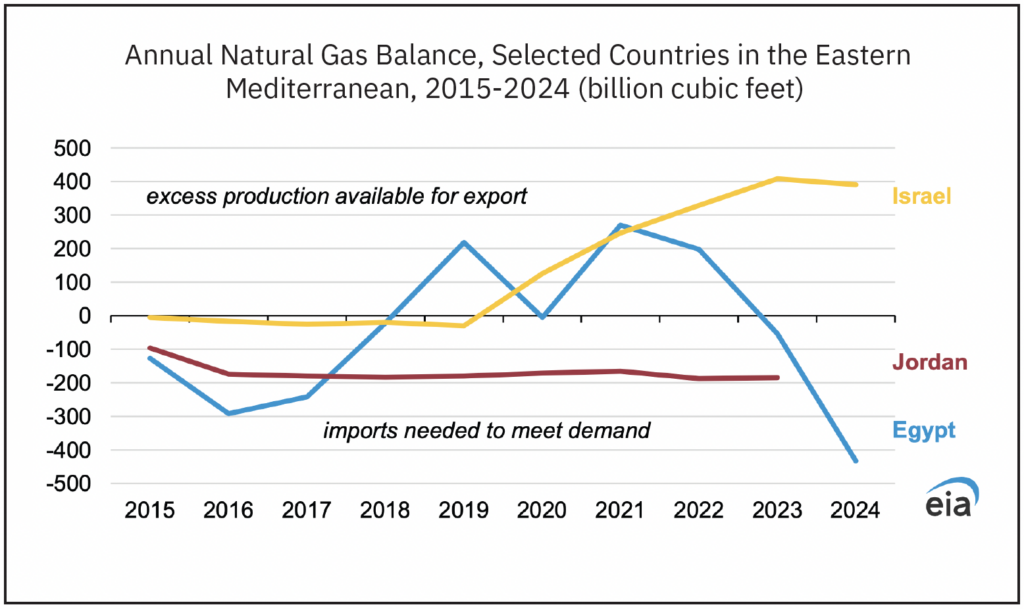
Source: US Energy Information Administration, September 9, 2025.
Key Regional Players
Egypt
As the largest gas producer and consumer and home to the only liquefaction terminals in the region, Egypt is a leading hub for energy in the Eastern Mediterranean. The country has an estimated 64.5 tcf of proven gas reserves, the fourth largest in Africa, behind Nigeria, Algeria, and Mozambique. However, despite its sizable reserves, Egypt has been unable to remain energy independent or consistently export gas. In addition to declining output from the Zohr field, a growing population, a changing climate, and alleged government corruption within the energy sector have contributed to making it a gas importer after previous periods as a net exporter in 2004-14 and 2018-22.
The majority of developed gas fields lie just off the Egyptian coast, including the West Delta Deep Marine (WDDM) fields, El Burg Offshore, and El Manzala Offshore, among others. However, Egypt’s largest producing field is Zohr, located roughly 190 kilometers north of Port Said, which Eni estimated had up to 30 tcf of gas in place when it was discovered in 2015. Egypt produced 40.8 billion cubic meters (bcm) of natural gas in 2025, and critically, it is the sole country in the Eastern Mediterranean that can produce and export LNG. It has two major export terminals at Idku (Egyptian LNG) and Damietta (SEGAS LNG), which have been functional since 2005. Built to monetize Egypt’s own Nile Delta gas and later seen as an outlet for Israeli and Cypriot production, both terminals have run intermittently. Damietta was idle from November 2012 until February 2021, while Idku cut back sharply from 2014, halted exports in 2015, and resumed limited volumes in 2016. Since 2023, both have repeatedly paused exports during the summer months, when domestic electricity demand peaks.
Egypt’s struggles have profoundly affected the growth of its domestic natural gas industry as well as the development of the wider Eastern Mediterranean energy sector. Energy shortages at home prevent it from exporting LNG to Europe and have even forced the country to import natural gas from neighboring Israel. Reliance on Israel is politically unpopular in Egypt and leaves the country vulnerable to supply shortfalls, such as when Israel paused gas production due to safety concerns after the 2023 attacks by Hamas and again at the beginning of the 2026 Iran war. Egypt’s energy troubles also dampen wider international interest and investment in Eastern Mediterranean gas. Foreign investors seeking to turn a profit by investing in Cypriot or Israeli gas extraction for sale in global markets are unable to do so, as a large portion of the exported gas is sold to the Egyptian power sector at fixed prices rather than being exported onwards. However, the development of renewable energy may help to change this. Massive investments in both solar and wind projects have put the country on track to meet its goal of generating 42% of its electricity via renewables by 2030, which may reduce the need to import gas and could enable the more profitable sale of Eastern Mediterranean gas to Europe.
“The discovery of major deposits of natural gas off the coast of Israel transformed a nation with no energy resources into the largest net exporter in the Eastern Mediterranean.”
Israel
The discovery of major deposits of natural gas off the coast of Israel transformed a nation with no energy resources into the largest net exporter in the Eastern Mediterranean. Since its establishment in 1948, Israel had relied on imports of oil and coal, despite a longstanding Arab energy embargo, to fuel a rapidly growing economy and population. This left the country spending up to 5% of its GDP on energy imports and reliant on fuel shipments to keep the lights on. After the discovery in 2000 of the Mari-B field, the country’s first commercially viable natural gas reservoir, Israel developed processing infrastructure and integrated natural gas into its power generation mix. In the past quarter-century, domestically produced gas has become critical to Israel, with its total natural gas consumption increasing from 1.19 bcm in 2004 to 13.6 bcm in 2025. As production from the Mari-B field declined before its eventual depletion in 2013, Israel briefly relied on imports from neighboring Egypt, but that dependency was soon relieved as production from the Tamar and Leviathan fields, discovered in 2009 and 2010 respectively, came online. Today, Israel uses domestic natural gas to power 79% of its electricity grid and has become an exporter to both Egypt and Jordan.
Despite becoming perhaps the most successful energy producer in the Eastern Mediterranean, Israel faces real challenges in the natural gas industry. In just the past three years, security concerns have led to multiple long pauses in production due to the threat of strikes by Hizballah and Iran. In March 2026, Iranian forces targeted several Israeli energy installations with ballistic missiles, while Hizballah has threatened attacks against any new developments of natural gas fields bordering Lebanese waters. Furthermore, Israel has so far not become a major exporter of natural gas to Western markets. Though it exports almost 49% of its natural gas production to neighboring Egypt and Jordan, Egyptian control over the only regional LNG terminals has made meaningful Israeli exports through the Sinai unlikely, as Israeli firms would only be able to use volumes left over after Egyptian requirements are met. Although Israel has explored the construction of offshore floating liquefied natural gas (FLNG) facilities, high construction costs and persistent security concerns remain major impediments. Additionally, the EastMed Pipeline, a planned natural gas route connecting Israel, Greece, and Cyprus, has failed to materialize due to ongoing tensions with Turkey and prohibitive construction costs.
Cyprus
The island of Cyprus, divided between the internationally recognized Republic of Cyprus and the breakaway de facto state of the Turkish Republic of Northern Cyprus (TRNC), has emerged as another rising player in the Eastern Mediterranean energy sector. The 2011 discovery of the Aphrodite gas field (3.6-6 tcf) within Cyprus’ EEZ upended assumptions that the island lacked resources and triggered a wave of IOC interest. Driven by this interest, exploration has uncovered five other significant offshore fields since 2011 (Calypso, Cronos, Glaucus, Zeus, and Pegasus). These discoveries have the potential to provide the island nation with a domestic source of energy to replace costly imports. However, setbacks abound, and no natural gas has yet been produced from Cyprus’ deposits.
Longstanding geopolitical issues between the Republic of Cyprus and Turkey have been a key hurdle to the sector’s development. Turkey has contested the delineation of the Republic of Cyprus’ EEZ, as well as any energy discoveries therein, and has continued to demand that the profits from any natural gas developments near Cyprus be shared with the TRNC, a condition that most in the Republic of Cyprus vehemently reject. Ankara has also shown a willingness to use force: in 2018 Turkish warships blocked drilling ships operated by Eni off the coast of Cyprus, before Turkey subsequently carried out its own drilling and surveying of the area in 2019. Additionally, Cyprus appears unlikely to construct an onshore LNG export terminal, meaning that any extracted natural gas must be transported via Egyptian terminals, significantly increasing costs. Despite these challenges, Cyprus is still pushing forward with natural gas development, notably bolstered by support from France. In June 2026, France and Cyprus announced a joint defense pact, which included the deployment of French troops to the island, likely to serve as a deterrent to further disruptions by Turkish forces. Cypriot ministers now estimate that the first LNG exports will be delivered to the EU in 2027 or 2028 via the Egyptian port of Damietta.
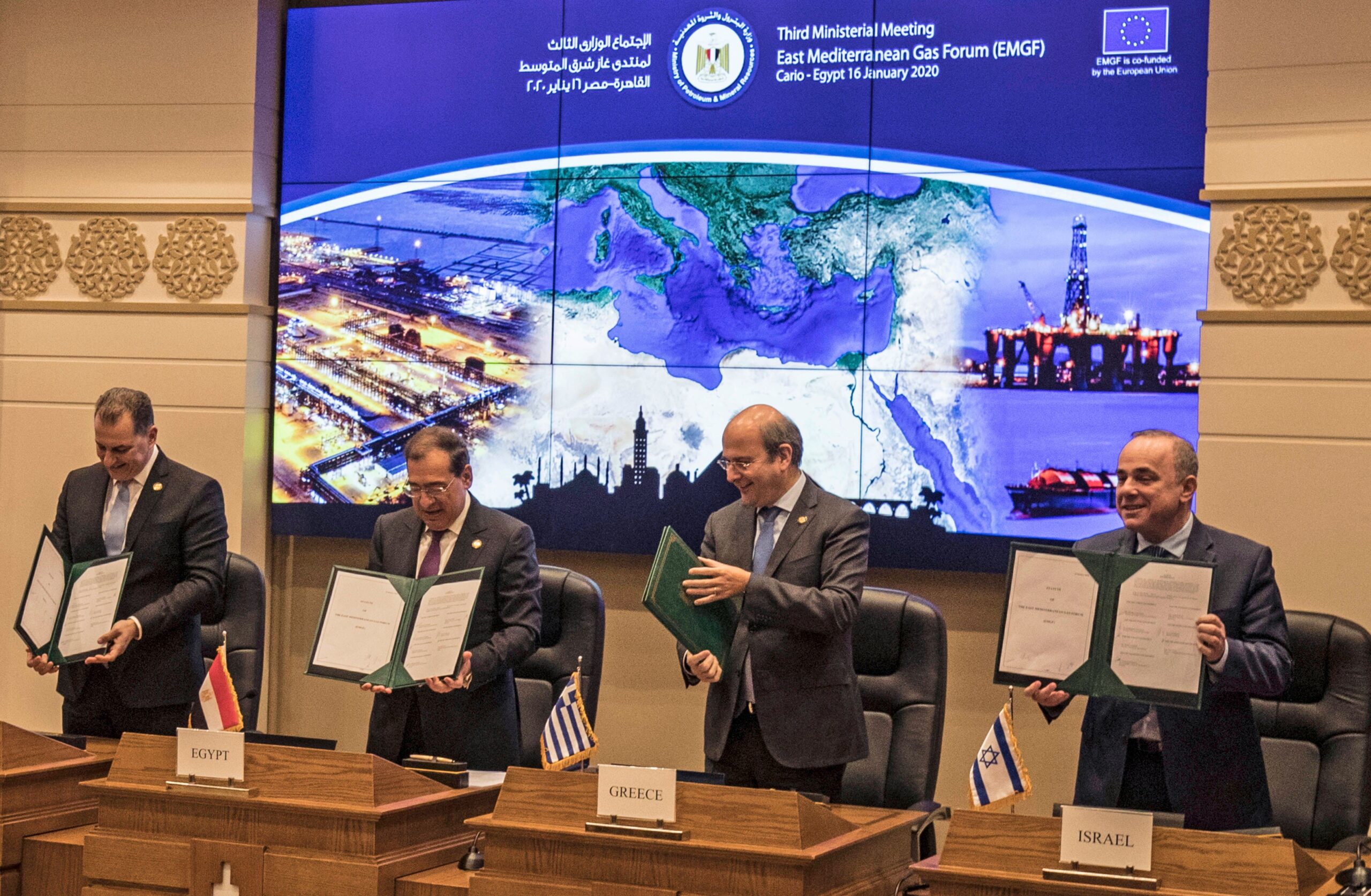
Energy ministers from Israel, Greece, Egypt, and Cyprus attend the Eastern Mediterranean Gas Forum on January 16, 2020, in Cairo, Egypt. Photo by Khaled Desouki/AFP via Getty Images.
The East Mediterranean Gas Forum
In the wake of major gas discoveries across the Eastern Mediterranean over the past decade, regional nations have grown increasingly aware of the need for coordination between gas producers, consumers, and transit countries. Egypt first proposed the EMGF in 2018. The forum was established at a ministerial meeting in Cairo in January 2019, its charter was signed in September 2020, and it became a full intergovernmental organization in March 2021. Its eight members are Cyprus, Egypt, France, Greece, Israel, Italy, Jordan, and Palestine, while the United States, the European Union, and the World Bank are observers.
Notably absent from the EMGF are Turkey and Lebanon. Turkey has conflicting maritime claims with neighboring Greece and Cyprus. Its November 2019 maritime agreement with Libya, which drew a direct sea boundary between the two countries, was rejected by Greece and Egypt as contrary to the United Nations Convention on the Law of the Sea (UNCLOS) and helped to spark the signing of an Egypt-Greece EEZ demarcation deal in August 2020. For its part, Lebanon declined to join the regional grouping due to Israel’s membership, although it did sign a US-brokered maritime border agreement with Israel in October 2022 and reached a maritime demarcation deal with Cyprus in November 2025.
“The work of the EMGF centers on regional integration, scientific and environmental cooperation, and private sector positioning with the objective of expanding the regional energy sector into a viable market for natural gas.”
The work of the EMGF centers on regional integration, scientific and environmental cooperation, and private sector positioning with the objective of expanding the regional energy sector into a viable market for natural gas. So far, the group has facilitated a 2022 agreement between the EU, Egypt, and Israel to export natural gas to Europe and has funded multiple studies on promoting economic growth by investing in natural gas in member states. However, the impact of the EMGF is limited by both political divisions and a lack of meaningful influence. In early 2021, Israel nominated the United Arab Emirates to be an observer state in the EMGF after the two nations normalized relations in the fall of 2020. In response to the nomination, Palestine exercised its veto power and denied the UAE’s entry. The veto reportedly came as a surprise to the rest of the EMGF’s members and reflected broad anger within Palestine over the increasingly close ties between Israel and the Gulf states. Additionally, due to the importance of IOCs in financing and initiating major natural gas projects, the EMGF’s overall role in shaping regional energy development is limited primarily to conducting studies and entering into cooperation agreements. The organization has no power to unilaterally order projects to go forward or resolve disputes between members. Despite deep divisions within the forum, the EMGF continues its work to promote ties and find common energy-based objectives for its participants.
The Future of Eastern Mediterranean Gas
Recent global conflicts, including the ongoing Russia-Ukraine war and the 2026 war between the US and Iran, have once again demonstrated to the international community the need to bolster energy security in an increasingly volatile world. Eastern Mediterranean gas may provide an answer for European nations seeking to diversify energy resources given the proliferation of geographic chokepoints and areas of instability. Consequently, nations in the region are actively trying to position themselves as important new suppliers of gas exports to European markets.
In June 2026, Egypt paid off $6.1 billion in debt owed to IOCs accrued due to falling natural gas output and a foreign currency squeeze within the country and subsequently announced a total of $19 billion in new investments from Eni, BP, ExxonMobil, and QatarEnergy. This money will be used to expand production and search for new gas deposits within the Nile Delta region. In Cyprus, plans are finally coming together to export gas from the Cronos and Aphrodite fields to Egypt for onward export to European markets. Even Israel, despite its ongoing combat operations, has sought to maintain energy extraction across major fields and is seeking to expand production.
Challenges to the development of the sector persist, however. Despite major discoveries within the Eastern Mediterranean, total production is far below that of leading natural gas producers like Qatar and Russia, due both to the smaller size of the Eastern Med’s gas deposits and the aforementioned geopolitical issues, ensuring that the area will face steep competition for market share from larger suppliers. Furthermore, both economic uncertainty and political instability have shaken investor confidence and slowed, but not halted, development. The enduring enmity between Turkey and Cyprus, large-scale domestic energy demands in Egypt and Israel, and repeated outbreaks of armed hostilities represent considerable obstacles to those seeking to promote the Eastern Mediterranean as an emerging natural gas hub.
Nonetheless, eyes continue to turn toward the Eastern Mediterranean. In the US, a bipartisan bill, the Eastern Mediterranean Gateway Act, calling for the support of regional energy projects, the provision of security assistance, and the development of the India-Middle East-Europe Economic Corridor (IMEC), was introduced in Congress in May 2025. In Europe, IOCs have framed the development of Eastern Mediterranean gas resources as central to the EU’s objective of fully phasing out Russian gas by 2027. As more nations look to the Eastern Mediterranean for energy security and as an alternative to traditional routes, it remains to be seen whether the region can live up to those expectations.
This backgrounder was researched and written by MEI 2026 Summer Intern Ian Sanders, with input from Senior Fellow Karen E. Young.
Top photo by Nicolas Koutsokostas/NurPhoto via Getty Images