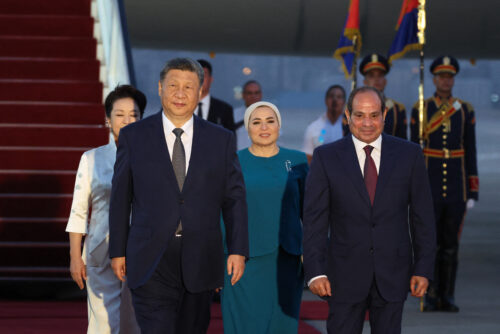
In an essay published in Egyptian newspapers immediately before his arrival, Xi described China and Egypt as two great civilizations and called on them to “take pride in who we are” while becoming an example of exchange and mutual learning. He pointed to exchanges between Chinese and Egyptian civilizations along the ancient Silk Road, while urging the two countries to protect cultural heritage and expand cooperation in archaeology, education, tourism and other areas, arguing that their ancient civilizations could help forge stronger bonds between their people.
The same theme carried into his meetings with President Abdel Fattah El-Sisi. According to the Chinese readout of the discussions, Xi called on the two countries to “promote people-to-people exchanges” and “comprehensively expand exchanges and cooperation in culture, education, science and technology, health, sports and other fields.”
This emphasis reflects something larger taking place in Chinese foreign policy. Xi increasingly sees culture not simply as a source of national pride, but as an instrument of international influence—and a way to reshape the narrative about China itself.
Photo by Mohamed Abd El Ghany/POOL /AFP via Getty Images
The Middle East Institute (MEI) is an independent, non-partisan, not-for-profit, educational organization. It does not engage in advocacy and its scholars’ opinions are their own. MEI welcomes financial donations, but retains sole editorial control over its work and its publications reflect only the authors’ views. For a listing of MEI donors, please click here.