MINURSO’s Future: What the Security Council’s Choice May Reveal
October 14, 2026
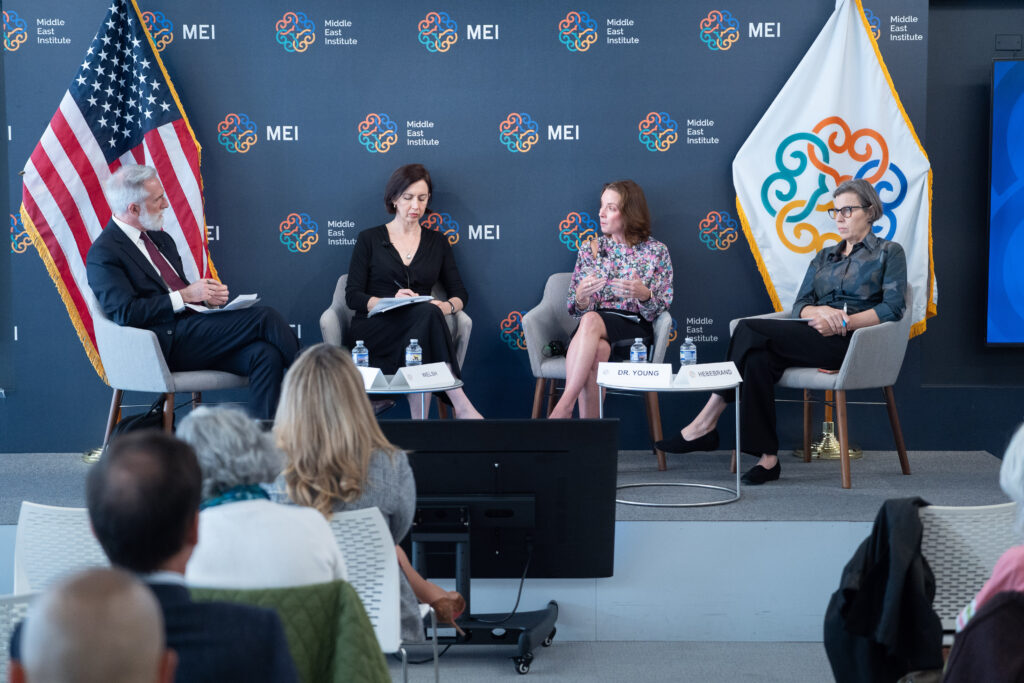
The Middle East Institute (MEI) convened a half-day hybrid conference on May 15, 2026, examining how the US-Iran war and the resulting closure of the Strait of Hormuz are threatening global food security. The event, entitled “The US-Iran War’s Threat to Food Security in the Middle East and North Africa,” brought together leading voices from the World Food Programme, the World Bank, the Center for Strategic and International Studies, the International Food Policy Research Institute, World Central Kitchen, and The Washington Post, with an audience drawn from government, the diplomatic community, think tanks, the private sector, and media, and additional participants joining virtually from Europe and the region.
Key Takeaways
Setting the Stakes
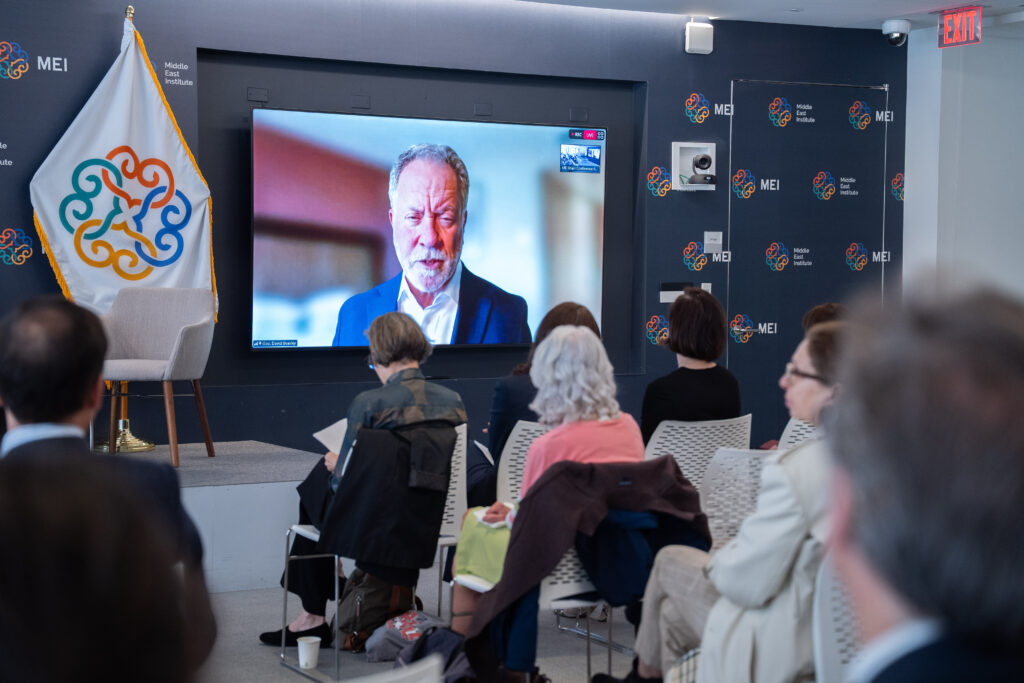
Governor David Beasley, former executive director of the World Food Programme and Nobel Peace Prize laureate, opened the conference with a call for urgency and strategic clarity. He described the current moment as the fifth major food crisis in 20 years, following the global food price shock in 2008, the Arab Spring in the early 2010s, the acute food crisis in Togo that began in late 2021, the Russia-Ukraine war in 2022, and now the Iran conflict. Each successive shock, he argued, builds on the previous one, leaving communities with fewer reserves and governments with less capacity to respond.
Governor Beasley was direct about the stakes. When food supply breaks down, instability follows — along with measurable increases in migration, exploitation, and the recruitment of vulnerable populations into extremist and criminal networks. Small farmers in conflict zones are among the most targeted by armed groups precisely because hunger is one of the leading pathways into radicalization. Addressing food insecurity at its source, he argued, is not only cheaper than managing its downstream consequences — it is a matter of national security. Strategic and effective aid stabilizes populations; its absence, compounded by cuts to foreign assistance, destabilizes entire countries. Long-term investment in food security pays off. The case for engagement is not just about altruism.
The Scale and Mechanics of the Disruption
The disruption linked to the Iran war is categorically different from previous food security shocks in both scale and complexity. The Strait of Hormuz handles roughly one-third of globally traded fertilizer, as well as refined petroleum products, natural gas, chemicals, and the precursor inputs on which fertilizer production depends. The closure has not simply disrupted a single commodity — it has simultaneously disrupted the entire chain of inputs on which modern food production rests.
Prices of nitrogen-based fertilizers have increased by twice as much as they did during the 2022 Russia-Ukraine war, and ammonia by five times as much. The closure of the Strait of Hormuz has had a major impact on supplies, with 30% of globally traded fertilizer currently stuck, while key fertilizer inputs are seeing significant disruptions as well, including urea (40%), sulfur (50%), and phosphates (30%).
What distinguishes this crisis from 2022 is the absence of workarounds. After the Russian invasion of Ukraine, pipeline alternatives existed for some gas flows. No such alternatives exist for ammonia and complex fertilizers, which must move by sea. The damage to Qatar’s liquefied natural gas (LNG) production facilities — which supply roughly 20% of global stocks — has ripple effects across every industry that depends on natural gas, including steel, aluminum, and the nitrogen fertilizer sector. Even if the Strait were to reopen tomorrow, the effects on shipping insurance, threat perceptions, and production capacity would linger for months, if not longer. The economic consequences of the current disruption, panelists agreed, are already baked in.
The Food System Transmission Mechanism
Energy and fertilizer shocks translate into food insecurity for households thousands of miles away from the conflict. This happens through several different channels simultaneously. Higher fertilizer prices are already changing planting decisions across the Northern and Southern Hemispheres. Farmers are switching from high-fertilizer crops such as wheat and corn to less input-intensive alternatives like soybeans — a substitution with significant long-term implications for global grain supply. Countries that import large shares of their fertilizer from the Gulf are facing a simultaneous hit to their fiscal positions from rising oil import bills, reducing the space governments for subsidize food prices or expand social protection.
Oil price disruptions are equally significant as fertilizer shortages from a food security standpoint, particularly in developing countries where energy costs affect every dimension of food systems, from transportation to production, processing, storage, and refrigeration. Higher energy prices slow economic growth, raise food prices, and reduce government capacity to respond, creating a compounding mechanism that links the energy shock directly to outcomes for the most vulnerable households.
The Countries Most Exposed
A tiered framework emerged from the discussion for thinking about which countries face the most acute near-term risks. Countries already experiencing active conflict — including Sudan, Yemen, Syria, and Lebanon — face the most immediate and severe exposure. There is no real buffer available in these countries, and the transmission of commodity price increases to households, affecting their food access, is already occurring. Yemen’s situation is particularly grave: Humanitarian operations there have been forced to scale back due to conditions that are no longer safe or sustainable for aid workers, creating a significant data gap on what may be the most acute crisis.
Countries in a second tier — including Egypt, Tunisia, and Iraq — are not in active conflict but carry historically heavy macroeconomic imbalances. These countries have some capacity to absorb shocks in the short term, but a protracted disruption will exhaust their fiscal capacity. The warning signs to watch for include pressure on exchange rate regimes, strain on state procurement systems, the emergence of two-tier markets, and intensifying black-market activity. And a third group of countries — including Jordan and Morocco — are comparatively buffered, though not immune to the longer-term effects.
What makes this crisis potentially more dangerous than previous shocks is the erosion of the regional safety net. The Gulf states have historically cushioned their neighbors during crises through aid and preferential trade. But fiscal space in the Gulf is itself under pressure from the conflict, meaning the informal buffers that softened previous crises may be less available this time.
The Geopolitical Dimension: Who Benefits?
The disruption of global commodity markets creates opportunities for actors willing to use food and fertilizer as tools of geopolitical influence. Russia demonstrated this playbook clearly after its 2022 invasion of Ukraine, delivering free grain and fertilizer to African countries in exchange for political support for its war and expanding its wheat export market to every region of Africa. The same dynamic could play out in the current crisis, as adversaries of the United States move to fill the space created by Western disengagement from aid and development programming.
China is already investing in green ammonia production in Africa, securing agricultural and political relationships for the long run. Countries that enter into long-term supply agreements with Beijing receive access to diesel, jet fuel, and other commodities they need. The implicit price is geopolitical alignment. The risk for the United States and its European partners is that this space, once ceded, is very difficult to recover.
On the Ground: What Humanitarian Response Looks Like
The downstream impact of the disruption on the people at the end of the supply chain is already evident. In active crisis zones the effects of the price shock have become all too clear. Food import costs for staple commodities such as rice, lentils, and meat have increased by 17-30% since the start of the Iran conflict. Oil price increases lag somewhat but eventually lead to rising transportation costs as existing contracts expire, ultimately translating into fewer meals reaching fewer people. In Lebanon, the displacement of large populations has simultaneously increased demand for food assistance and made it harder to meet, as prices rise and access routes become more constrained.
Gaza represents an extreme case that illustrates the limits of standard humanitarian approaches. It is a closed economic system with no internal economy, entirely dependent on outside food supply. Standard global approaches to food insecurity like local procurement, market-based interventions, and community resilience often do not apply in this context. The risk that borders could close entirely, cutting off all food supply to a population already in severe crisis, remains a constant operational concern.
Several themes emerged from the discussion of what more effective humanitarian response would look like. The traditional model of importing surplus food from wealthy countries can undercut local agriculture and depress the market prices that farmers depend on. This dynamic is documented in Haiti, where outside food aid damaged the local rice economy. A more durable approach involves procuring and hiring locally where possible, supporting cold storage and dehydration infrastructure so farmers can get food to market, and investing in the capacity of communities to grow their own food rather than depend indefinitely on external supply. With around one-third of food produced globally spoiling before it reaches the market, reducing food waste represents a significant and underutilized opportunity.
Structural Vulnerabilities and Long-Term Change
Discussion also focused on the structural dimension of the crisis — the underlying conditions that make the region so exposed to shocks of this kind, and what would need to change for future crises not to land with the same severity.
The geographic concentration of energy and fertilizer supply chains through a single chokepoint is the most obvious structural vulnerability, but it reflects deeper political and economic realities. Regional integration in the Middle East has historically imposed costs, particularly through exposure to shared geopolitical risks, without delivering the economic benefits that integration produces elsewhere. Every sector is affected by this issue. Addressing it in a meaningful way requires not just sectoral diversification but geographic diversification of supply chains, and progress on that front has been insufficient despite years of World Bank recommendations to that effect.
The absence of women from economic participation is an underappreciated structural drag on the region’s resilience. The Middle East has the lowest female labor force participation rates in the world, despite high levels of female education in many countries. Greater economic inclusion of women would not only increase the gross domestic product (GDP) but reduce many of the social vulnerabilities that make food crises so destabilizing.
On the technology side, the long-term trajectory points toward green ammonia and renewables reducing dependence on fossil fuel-based fertilizer production, but the transition is uneven and slow relative to the urgency of the current situation. Better application of fertilizers, including investment in agricultural extension services and education in developing countries, could meaningfully reduce waste and increase efficiency in the near term.
Lebanon was discussed as a particular case — a country where every problem of the Middle East is present in concentrated form, and where the ramifications of recovery or continued collapse are disproportionately large for the region. The destruction of south Lebanon’s agricultural sector, which accounts for 80% of that area’s GDP, represents both an acute humanitarian crisis and a long-term development challenge. The country’s greatest untapped asset, it was argued, is its diaspora — and finding ways to align the diaspora with the population remaining in the country represents the most plausible starting point for genuine reconstruction.
Intissar Fakir is a Senior Fellow at the Middle East Institute.
Athena Masthoff serves as the Senior Research Assistant in the Policy Center.
Photos from the Middle East Institute.