This individual is a guest contributor. MEI is not able to assist with contact requests.
Jean-Pierre Cassarino holds a professorship at the Robert Schuman Center for Advanced Studies (RSCAS/European University Institute, Florence) where he directs the Return migration and Development Platform (http://rsc.eui.eu/RDP/). He is also research associate at the Tunis-based Institut de Recherche sur le Maghreb Contemporain (IRMC). Since the mid-1990s, he has published extensively on international migration, particularly on return migration and has carried out numerous field surveys investigating returnees’ manifold patterns of reintegration. Selected publications include: (ed.) Unbalanced Reciprocities: Cooperation on Readmission in the Euro-Mediterranean Area, The Middle East Institute Press, Washington, 2010; (ed.) “Conditions of Modern Return Migrants”, International Journal on Multicultural Societies, Vol. 10, Issue 2, UNESCO, Paris, 2008; (ed.) Return Migrants to the Maghreb Countries: Reintegration and development challenges, RSCAS, European University Institute, Florence, 2008; Tunisian New Entrepreneurs and their Past Experiences of Migration in Europe: Networks, Resource Mobilisation, and Hidden Disaffection. Ashgate Publishers, Aldershot, 2000. Email: [email protected]
The Middle East Institute is proud to host Georgetown University professor Paul Pillar for a discussion about Iran and how best to address its nuclear ambitions. Pillar argues that the acceptable range of opinion on Iran has narrowed around the idea that all options, including a military strike, must be pursued to prevent the country from acquiring nuclear weapons. And yet, Pillar argues, if the combination of nuclear talks and sanctions do not yield the outcome the West and Israel seek, containment is preferable to war.
The 2001 destruction of the two giant Buddhas in Bamiyan is, by far, the most spectacular attack against the historical and cultural heritage of Afghanistan committed during the country’s recent period of turmoil.
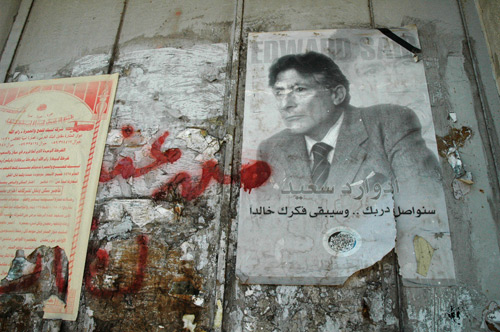
“I think one can say this almost without qualification,” writes Edward Said in Orientalism, as he reiterates some basic facts and moves toward a provisional conclusion (p. 204). Said had just explained that Orientalism is “a positive doctrine.” It is “an influential academic tradition,” as well as “an area of concern” (p. 203). As he implies here, and shows throughout his work, Orientalism is a great number of other things, too. It is the deployment of concepts regarded as always already universal such as race, religion, and fanaticism.