Syria has received some of its best economic news since the fall of Bashar al-Assad’s regime at the end of 2024: the United States has begun the process of removing the country from its list of state sponsors of terrorism. The change should unlock investment from firms that had been interested in Syria but unwilling to assume the legal and reputational risks. Its effects may be felt most strongly in banking, where US institutions will face fewer obstacles to reconnecting with Syrian banks, restoring basic financial services, and expanding financing for reconstruction.
As the volume of credit expands, the onus is now on Syrian policymakers to ensure that it reaches beyond the narrow political and commercial networks that have generally dominated Syrian finance. That will require a credit strategy aimed at sectors and regions historically excluded from formal finance. Syria’s specialized state banks offer an imperfect but ready-made mechanism to do so. Properly reformed and governed, they can complement private and foreign banks by extending credit to borrowers and sectors that commercial finance will likely continue to overlook.
The Case for Directed Lending
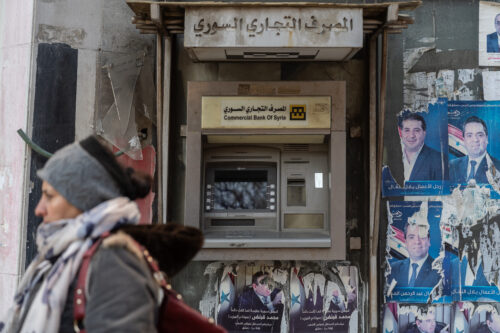
Syria’s banking system remains small, state-dominated, and geographically limited. It consists of six public banks and fifteen private banks, including eleven conventional and four Islamic institutions. Total banking assets were estimated at approximately $12 billion in 2024, of which the public banks held 69%, conventional private banks 19% and Islamic banks 12%. The sector’s geographic reach is similarly thin, with approximately four bank branches and five ATMs for every 100,000 adults.
Even these figures overstate the sector’s contribution to the economy. Bank balance sheets are saddled by years of accumulated losses, unpaid loans, and deteriorating asset quality. Publicly reported official figures placed nonperforming loans at approximately 42% of public-bank lending at the end of 2023, compared with only 4% in 2010. Customer loans now amount to just over 4% of GDP — an exceptionally low level of credit intermediation.
Major reforms are therefore unavoidable. Privatization, in particular, looms over the sector. A recent Oliver Wyman assessment reportedly considers three options for public banks: conversion into joint-stock companies, outright privatization, or partnership with Arab and international institutions.
Such reforms may strengthen balance sheets, but their underlying promise — that a more competitive, private financial sector might better expand access to credit — is not new. When Syria introduced private banks in the 2000s, the International Monetary Fund (IMF) and World Bank similarly argued that competition would improve credit allocation while reducing political interference.
Private banks, in reality, did little to expand lending before the war. They had captured roughly a quarter of private-sector deposits by 2006 but accounted for only 14% of private-sector credit. And the majority of the lending they provided flowed to the public sector. The prominence of politically connected commercial elites among their shareholders, combined with a preference for short-term, collateral-backed lending, left medium- and long-term productive investment largely unfinanced and small- and medium-sized enterprises (SMEs) without dedicated lending programs.
This pattern has persisted until today. By 2020, SMEs — which account for more than 99% of Syrian firms — received only 4% of loans issued by Syrian financial institutions. Roughly 90% relied instead on family networks or informal lenders. Farmers, start-ups, small manufacturers, and firms outside established commercial networks were largely excluded from formal finance.
Some of these problems will be naturally solved with better governance and a reduction in politically connected lending. But the problem extends beyond corruption. Syrian SMEs often lack audited accounts, reliable credit histories, and acceptable collateral. Before the war, some even reportedly maintained multiple sets of books to evade taxes in a system widely seen as arbitrary and unfairly enforced.
From the perspective of an individual bank, declining to lend to these types of firms is only rational. Assessing poorly documented firms is expensive, and an individual bank does not capture the system-wide value of identifying creditworthy borrowers and establishing their credit histories. The same is true of the wider benefits generated by lending, including restoring production of essential goods and supporting underserved regions.
If Syria were to rely on private and foreign banks alone, it would therefore face an undersupply of credit to activities with high social value but unattractive commercial risk profiles. Reaching smaller firms and underserved regions will require institutions willing to accept lower returns, longer horizons, and forms of risk that commercial banks are unlikely to bear.
A New Role for Syria’s Specialized Banks
One advantage Syria possesses is that it already has institutions designed for this purpose. After the Ba’ath Party came to power in 1963, the government expanded and reorganized a number of specializedstate banks dedicated to agriculture, industry, real estate, commerce, and more. These institutions were created to counter a private credit system that had historically favored large landowners and left much of the rural population dependent on extortionate moneylenders.
The Agricultural Cooperative Bank, for example, sought to channel credit directly toward marginalized farmers. The bank formed part of a broader package of agrarian reforms intended to weaken the power of rural intermediaries and expand access to capital among cultivators. The results were mixed. The bank’s collateral requirements favored wealthier farmers, and many peasants continued to rely on private moneylenders charging exorbitant interest rates. In his study of Syria’s political economy under Hafez al-Assad, Volker Perthes concludes that the broader reform package proved “generally advantageous to the rural middle class, less so to the lower classes.”
Over time, developmental lending also gave way to political discretion. By the 1990s, Syrian political economist Bassam Haddad argues, clear and consistently applied loan-processing rules were difficult to find. Because the Central Bank and specialized lenders remained subordinate to the executive, cabinet ministers and the prime minister could shape lending decisions by administrative fiat. Credit increasingly flowed to commercial elites “on easy terms, with no guarantees or collateral.”
Despite those mixed outcomes, the state-owned banks remain the largest in the country today, and initial steps have already been taken by the Ministry of Finance to bring back their lending capacity. Under Presidential Decree No. 70, issued in March 2026, borrowers who settled defaulted obligations at public banks could receive full or partial exemptions from accumulated interest and penalties. The decree does not recapitalize the banks, but it does begin to address large volumes of non-performing loans weighing on their balance sheets.
Their resumed lending could fill gaps left by commercial banks. In the process of lending, these institutions would also help close the severe information deficit Syria faces. Recent work on development banks argues that they “learn through lending:” by screening borrowers and working directly with firms, these banks gain a unique vantage point on the market and government failures that block investment. With relatively little reliable information available to policymakers, this knowledge can help inform the design and implementation of national development policy.
These advantages depend, however, on public banks making sound lending decisions. State-led banks tend to be more prone to political influence than private ones, a danger that Syria’s history renders even more salient. And even well-intentioned lending programs may struggle to distinguish productive SMEs from firms that are unviable. While development banks need not maximize profits, persistent losses would limit their reach and cast doubt on whether their lending was financing genuinely productive activity. Any revival of Syria’s specialized banks will therefore need to pair clear developmental mandates with transparent governance and professional credit assessment.
How Specialized Lending Could Work
Syria can begin with limited lending programs in the sectors where commercial banks are least likely to operate. In line with its historical role, the Agricultural Cooperative Bank could finance seasonal inputs, irrigation, and storage, while the Industrial Bank could support machinery purchases and working capital for smaller manufacturers. These pilot programs would test new underwriting standards and contain potential losses before expanding.
To facilitate these lending programs, the banks would need to adopt lending standards suited to borrowers who lack conventional collateral or credit histories. This could include considering alternativeevidence — from production records to equipment ownership — and tailoring repayment schedules to agricultural seasons and investment cycles.
International partners will have a role to play, if they want it, in reducing the fiscal risks of this approach. If such conversations are not already underway, Arab development funds and international financial institutions should consider supporting credit-guarantee schemes, in which development agencies assume part of the risk of lending to small businesses.
In order to avoid a return to the political lending of the 1990s and 2000s, any expansion of specialized banks must proceed alongside new safeguards against interference in lending decisions. The World Bank’s recently announced Financial Sector Modernization Project — a $100 million investment that includes asset-quality reviews, risk-based supervision, and supervisory technology — is an important first step, promising to replace decades of fragmentary, unreliable reporting with a system-wide assessment of the sector.
The People’s Assembly should use that improved information to subject public-bank lending to public scrutiny. Through its Committee on Financial Laws, it could request information, question responsible officials, and publish annual assessments of each bank’s lending patterns. Public identification of favoritism or failure to meet sectoral and regional lending goals would expose bank managers and ministers to sustained political and media pressure.
As Syria reconnects to the international financial system, policymakers have the opportunity, the international support, and the institutions to break from the country’s financial legacy and inaugurate a more inclusive system. Whether they revive the 1960s-era developmental purpose of Syria’s specialized banks or reproduce the lending patterns of the 2000s will now depend on the choices they make.
Haddon Barth is Director of the Network for Syrian Legislative Studies and an independent researcher focusing on Syria’s political economy and postwar reconstruction. His work has appeared in Foreign Policy, Carnegie Endowment, Lawfare, Al-Monitor, and more.
Photo by David Lombeida/Bloomberg via Getty Images.
معهد الشرق الأوسط (MEI) هو منظمة تعليمية مستقلة وغير حزبية وغير ربحية. لا يشارك المعهد في أي أنشطة دعوية، وآراء الباحثين فيه تعبر عن آرائهم الشخصية. يرحب المعهد بالتبرعات المالية، لكنه يحتفظ بالسيطرة التحريرية الكاملة على أعماله، ولا تعكس منشوراته سوى آراء المؤلفين. للاطلاع على قائمة المتبرعين للمعهد، يرجى النقر هنا.