Unlocking the Levant: Why the United States and Syria Must Pursue a Bilateral Trade and Investment Agreement
September 24, 2026
شارك
Apart from the brief honeymoon period between 1961 and 1963 under President John F. Kennedy and President Nazim al-Qudsi, US-Syria relations have never had such strong potential as they do today. During that brief historical window, bilateral cooperation flourished through US Agency for International Development (USAID) loans, International Monetary Fund (IMF) stabilization support, and the November 1961 Agricultural Commodities Agreement permitting the sale of surplus US produce in Syria using the local currency following severe droughts. However, the Ba’ath coup d’état in March 1963 cut that era short, leaving relations to deteriorate sharply for more than half a century.
Today, following the fall of the Bashar al-Assad regime and the rise of a new government under President Ahmad al-Sharaa at the end of 2024, a new geopolitical window has opened — one that can not only transform Syrian-American ties but also catalyze game-changing developments for regional stability and prosperity. However, to realize that potential, the United States must pivot from diplomacy to aggressive economic dealmaking, in keeping with the administration’s “America First” approach. To capitalize on this moment, Washington and Damascus must immediately prioritize negotiating a comprehensive bilateral trade and investment agreement.
President Donald Trump has consistently favored bold, paradigm-shifting announcements that redefine foreign relations with the potential, if approved by the Senate, to yield quick results. A US-Syria trade and investment agreement fits perfectly into this legacy-defining mold. Crafting a landmark agreement with a reforming Syria would showcase high-impact dealmaking, transforming a former adversary into an economic partner while securing a foreign policy achievement that previous administrations would have deemed impossible.
Lingering Restrictions that Should Wash Out Soon
The commercial imperative for a trade deal is undeniable. Despite recent progress — including the repeal of the Caesar Act in 2025 and the removal of the State Sponsor of Terrorism designation in August 2026 — notable export control restrictions remain. Syria is still listed in Country Group E:1 under the Export Administration Regulations (EAR) pending final rule publication by the Bureau of Industry and Security (BIS). Consequently, dual-use items on the Commerce Control List still require bespoke export licenses, though they are now reviewed with a presumption of approval for commercial end-uses. While lower-level consumer goods and technology can generally be exported without an individual license using the Syria Peace and Prosperity (SPP) exception, even with this exception, restrictions on items such as “mass-market software” continue. These can include artificial intelligence (AI) assistants, developer tools, education platforms, and cloud collaboration environments.
Following Syria’s removal from the list of State Sponsors of Terrorism, the BIS should now remove Syria from the Group E1 list, making it eligible for additional license exceptions under the EAR.
US Companies Are at a Disadvantage in Investment
According to our review of the UN Conference on Trade and Development’s (UNCTAD) Investment Policy Hub, Syria has 33 bilateral trade agreements in force and a further 8 signed agreements that are not yet in force. The US remains notably absent from this list, leaving American investors without a dedicated legal framework in Syria.
Without a bilateral agreement, US businesses lack crucial default protections and privileges enjoyed by competitors, including fair and equitable treatment (FET) against arbitrary actions; full protection and security (FPS) for physical and legal assets; protection from uncompensated expropriation; national treatment; the most-favored-nation (MFN) standard; and umbrella clauses as an additional layer of agreement protection for state undertakings. Furthermore, investors miss out on the free transfer of funds (FTF) for capital repatriation; direct investor-state dispute settlement (ISDS) through neutral arbitration; and key personnel protections and prohibitions on forced performance requirements. It is these structural benefits that incentivize businesses to strategically invest with the knowledge that they are doing so with the kind of protections they require — and deserve.
One vitally important issue for international investors is the ability to resort to international arbitration should disputes arise from their engagements. Syria is already a party to the 1958 New York Convention on the Recognition and Enforcement of Foreign Arbitral Awards, having acceded to it in 1959, and has been a Contracting State to the International Center for Settlement of Investment Disputes (ICSID) Convention since 2006. Syria also has an existing network of trade and investment agreements providing, depending on the applicable agreement, a range of substantive protections as mentioned above. Together, these instruments provide an important baseline legal architecture for foreign investment protection and investment dispute resolution. Yet Syria’s prolonged conflict and sanctions regime have significantly constrained the practical effectiveness of this framework. As Syria reintegrates into the global economy, this architecture provides a foundation, but it is insufficient on its own for US investors. A modern, comprehensive US-Syria agreement could establish a dedicated framework of substantive protections and effective investor-state dispute settlement mechanisms that American capital requires in a post-conflict environment like Syria.
Skewed Tariff Policy
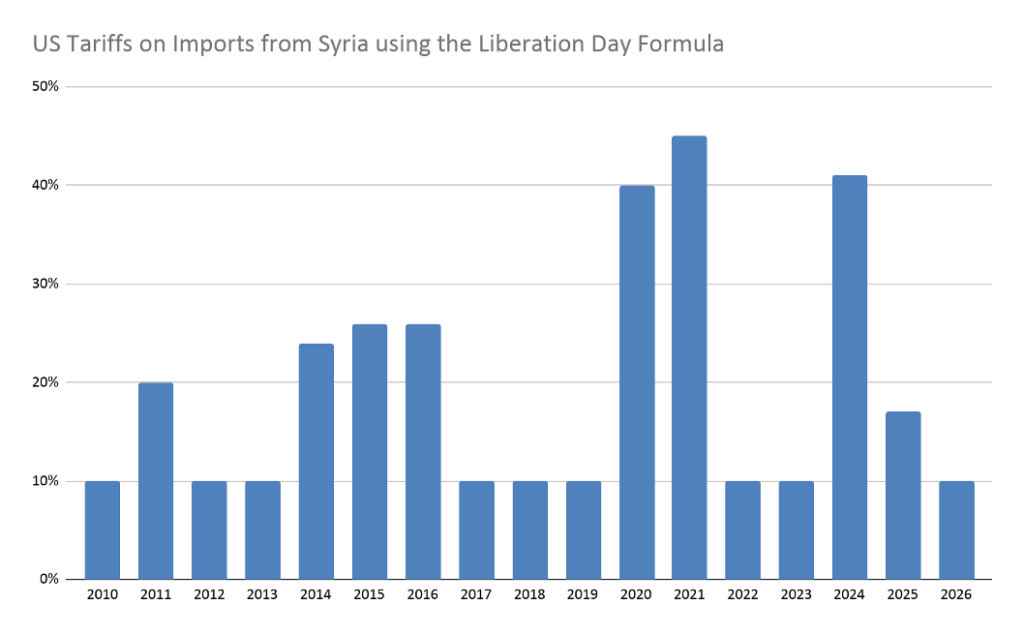
For the US to benefit, Syria too must be helped along its path of recovery. In April 2025, the Trump administration imposed its reciprocal tariff regime under Executive Order 14257 — an initiative aimed at forcing bilateral trade deficits toward zero by applying a tariff equal to half of a country’s trade deficit ratio relative to its exports to America. Countries where the formula’s result was less than 10% faced a base tariff rate of 10%.
While this calculation may have made some sense — even if it was controversial — with many countries around the world, it was illogical in Syria’s case. Due to the effects of severe economic sanctions and international isolation under the Assad regime, Syria engaged in negligible and imbalanced trade with the US — resulting in the Trump administration imposing a 41% tariff rate on Syria.
While the US Supreme Court has since struck down the administration’s aggressive tariff regime and returned Syria to the base 10% rate, the heavily skewed and unstable imbalance in bilateral trade dynamics places Syria in a precarious and highly disadvantageous position.
Source: COMTRADE
Beyond this skewed and uncertain tariff policy, Syria’s trade suffers in other ways. Syria’s regional neighbors like Egypt and Jordan enjoy duty-free privileges under the US government’s Qualifying Industrial Zones (QIZ) protocol. A dedicated bilateral agreement with Syria would not only eliminate persistent tariff disparities and establish critical protections for American capital, but it would also create space for additional benefits akin to those enjoyed by some of its neighbors.
A New Regional Role
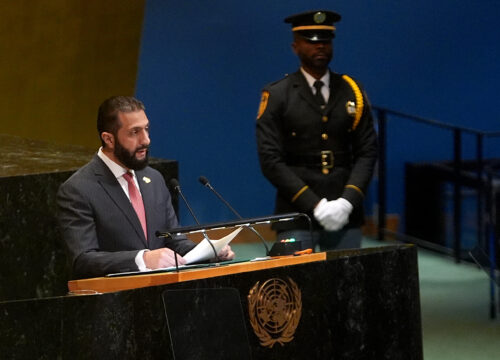
When Assad’s regime collapsed, Syria’s government instinctively sought to position itself as a neutral actor uninterested in foreign entanglements. With time, it has also sought to leverage the country’s unique geographic position as a key to unlock transnational connectivity — as a transit hub tying together everything from energy and commerce to telecommunications and transportation between Asia, the Gulf, and the Levant into the Mediterranean and Europe. This was always set to be an attractive proposition for the region and beyond, but the 2026 Iran war and the shuttering of the Strait of Hormuz put Syria’s geopolitical vision on steroids. Notwithstanding early engagement and investment from regional players, Syria’s interconnectivity hub proposal was presented to the European Union (EU) and the Group of 7 (G7) in April and May 2026, respectively, and then to the UN General Assembly by President Sharaa in September.
The idea of helping to shape a Middle East that is structurally interconnected and interdependent aligns precisely with the Trump administration’s agenda — and with the broader US foreign policy instinct to find ways to divest from a region that has long overdrawn American resources at the expense of engagement elsewhere. A dynamic shift in which the region is driven primarily by economics and trade will dramatically undermine the drivers of rivalry and conflict. Achieving this long-term vision means getting Syria right — ensuring not only that its transition continues apace and in the right direction, but that the recovery and rebuilding of the Syrian economy is based on solid foundations. America should be a core pillar of that vital mission.
Regional Competition
Strategically, the US should not wait. While the Trump administration’s bold stance on Syria has created a historic opening for bilateral relations, the US risks falling behind in an investment race with its great-power competitors. Russia offers one case in point, having pivoted rapidly following Assad’s fall to rebuild its geopolitical and commercial ties with Damascus through economic cooperation. The August 2026 agreement to restructure Russia’s presence at Tartus Port by returning civilian infrastructure to Syrian control is designed in large part to support Syrian maritime commerce interests.
Though it has been slower to engage, China is also positioned to move quickly to embed itself in Syria’s recovering economy. Chinese businesses are already investing in industry and dry ports in several regions of Syria, including a strategic contract with the official agent for Chinese health care device firm AOJ-Technology to invest in Syria’s Hasiya and Adra industrial free zones. Another cooperation agreement with the Chinese Suzhou Land Group was announced through the Syria-China Business Council and aims to lead industrial projects across Syria.
Even US allies and partners are stepping forward to lay the groundwork for deeper, more integrated trade ties with Syria, potentially crowding out an American entry into key markets in which it would otherwise hold an advantage. For example, Saudi Arabia signed a bilateral trade agreement with Syria in August 2025 that will help structure investment relations and give the kingdom an inherent advantage in sectors such as information technology and gas — areas in which the US seeks to engage but will soon fall behind.
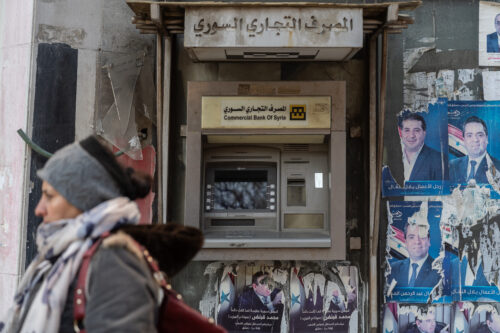
Finally, a formal bilateral agreement would send one of the strongest signals the US could provide to global markets that legitimate investment in Syria is not only permitted but institutionally supported. Despite the removal of most sanctions, global insurers and financial institutions remain constrained by compliance practices, residual regulatory risks, and broader concerns associated with operating in Syria. A US-Syria bilateral trade and investment agreement would not, by itself, eliminate these barriers or restore correspondent banking relationships. It could, however, provide an important additional layer of legal and political confidence by demonstrating a durable US commitment to bilateral investment and providing American investors with enforceable agreement protections. Combined with continued regulatory clarification and financial-sector normalization, such an agreement could help reduce perceived risk, facilitate legitimate trade and investment, and provide greater legal certainty for US investors seeking to participate in Syria’s economic recovery. By acting decisively now, the US can enhance legal certainty for its investors, outmaneuver strategic competitors in the region, and solidify a historic diplomatic victory.
Karam Shaar is the director of Karam Shaar Advisory Limited, where he focuses on political economy research and business consulting related to Syria.
Charles Lister is a senior fellow and the director of the Syria Initiative at MEI, where he focuses on Syria, terrorism, and insurgency across the Levant. He is also a Senior Consultant to Karam Shaar Advisory Limited.
Photo by Selcuk Acar/Anadolu via Getty Image
معهد الشرق الأوسط (MEI) هو منظمة تعليمية مستقلة وغير حزبية وغير ربحية. لا يشارك المعهد في أي أنشطة دعوية، وآراء الباحثين فيه تعبر عن آرائهم الشخصية. يرحب المعهد بالتبرعات المالية، لكنه يحتفظ بالسيطرة التحريرية الكاملة على أعماله، ولا تعكس منشوراته سوى آراء المؤلفين. للاطلاع على قائمة المتبرعين للمعهد، يرجى النقر هنا.