This article is part of a collection of short essays written by the Fellows of the Middle East Institute to explore aspects of the ongoing war with Iran. The intent of the collection is to help readers see new and unexpected elements of the dynamics and impact of the ongoing hostilities and to think harder, deeper, and broader about the implications of the conflict. To read the other essays from this collection, as well as download the full report, please click here.
The conventional framing of China’s role in the Middle East in policy discourse centers on a familiar question: what challenge does Beijing pose to US primacy? The answer is often framed as a largely linear story in which expanding economic influence gradually translates into geopolitical leverage.
Yet this view captures only part of the reality. It assumes that deeper economic integration insulates China from geopolitical shocks, overlooking the extent to which Beijing’s growing regional footprint has also increased its exposure to them.
The Iran war brings this tension into sharp focus. Rather than a discrete geopolitical episode, it functions as a stress test of China’s regional position, revealing how deeply Beijing has become embedded in a regional order it does not shape and is reluctant to underwrite.
China has a direct stake in Iran itself. It purchases the overwhelming majority of Iran’s sanctioned crude oil exports, has deepened economic ties through a long-term strategic cooperation agreement, and has expanded diplomatic engagement in recent years. Beijing has interests on both sides of the Gulf: preserving stable relations with Saudi Arabia and the United Arab Emirates while maintaining its partnership with Tehran. This balancing act becomes increasingly difficult when confrontation between Iran and the United States or Israel intensifies.
China’s Rise Through Access
For more than two decades, China’s Middle East strategy has been organized around the principle of access, not in a narrow diplomatic sense, but as a multi-layered structure encompassing energy flows, infrastructure and logistics connectivity, market access, and, increasingly, digital and technological integration. China’s rise as the world’s largest energy importer cemented deep interdependence with Gulf producers, transforming oil and gas from transactional commodities into strategic inputs within a broader economic relationship.
China’s energy security remains closely tied to the Middle East. In 2025, the region supplied roughly half of China’s crude oil imports and nearly one-third of its liquefied natural gas (LNG), with Gulf producers alone accounting for 42% of crude imports. China also received more than 5 million barrels per day (bpd) of oil transiting the Strait of Hormuz, underscoring the strategic importance of Gulf energy flows and the vulnerability created by reliance on a single chokepoint.
Over time, Beijing has constructed a wider physical and institutional presence in the Middle East comprising ports, industrial zones, telecommunications networks, and large-scale projects under the Belt and Road Initiative (BRI). Chinese state-owned enterprises and policy banks embedded capital within these systems, producing a sustained and increasingly durable material footprint across the region.
This was something both sides chose, as Gulf states moving their economies beyond oil found in China a partner well aligned with their infrastructure financing and industrial development needs — a logic that also extended to Egypt, Algeria, and Morocco.
In recent years, this convergence has broadened into renewable energy, digital infrastructure, and artificial intelligence, further deepening interdependence across sectors. Crucially, this integration unfolded within a regional order still underwritten by the United States as the primary security guarantor, an arrangement China benefited from without directly challenging it.
Yet that success has come with greater exposure. As China’s economic and strategic footprint has expanded across the region, so too have the channels through which instability can affect its interests. The Iran war has made this reality unmistakable, revealing vulnerabilities that had previously remained largely latent.
The Iran War as a Strategic Stress Test
The Iran war marked a sharp deterioration in regional security conditions, particularly through maritime disruption, heightened insurance costs, and increased risk to energy infrastructure and shipping corridors such as the Strait of Hormuz and, more recently, the Red Sea and Bab el-Mandeb Strait. While the conflict does not appear to have fundamentally reordered Gulf alignments, it introduced sustained operational uncertainty into the arteries of regional trade.
For China, the significance of the war lay not in direct military or diplomatic confrontation, but in systemic stress. Its model of access depends on relatively stable commercial flows, even in periods of political tension. The Iran war challenged that assumption.
Although China imports oil from a diverse range of suppliers, roughly 12% of its crude imports come from discounted Iranian shipments, leaving Beijing exposed to disruptions in Iran’s exports or tighter enforcement of US sanctions. Chinese energy imports were not fully interrupted, and strategic stockpiles as well as diversification across suppliers helped prevent acute shortages. But the broader system through which China’s Gulf engagement operates — shipping, insurance, port throughput, and logistics predictability — was exposed to heightened friction.
Costs rose, routing became less efficient, and operational planning became more contingent. The benchmark very large crude carrier (VLCC) freight rate for the Middle East-China route hit an all-time high of $14 per barrel in March 2026. In relative terms, China’s exposure to Hormuz-linked flows (37.7%) far exceeded India’s, Japan’s, and South Korea’s (each at less than 15%). The effects were indirect but widespread, as rerouting and greater volatility strained Chinese-linked ports, industrial zones, and logistics hubs. The result was not breakdown but reduced efficiency across a network built on predictability.
Diplomatically, Beijing maintained its standard repertoire of calls for restraint, support for cease-fires, and appeals to international law. It also positioned itself as a potential facilitator of dialogue. But these instruments proved decoupled from crisis influence. China lacked leverage over Iranian escalation decisions and possessed no coercive or military tools to alter the trajectory of events once conflict dynamics intensified. Beyond immediate economic costs, repeated disruptions also risk exposing the limits of China’s long-standing preference for economic engagement without corresponding security commitments. Partners may increasingly question whether Beijing can protect the overseas interests that accompany its expanding global footprint.
The earlier Saudi-Iran rapprochement, brokered with Chinese support in 2023, illustrated both the reach and the limits of this diplomatic role. It was effective under conditions of mutual political interest in de-escalation, but it was not underwritten by enforcement capacity. Once regional tensions shifted from diplomacy to military exchange, its durability proved conditional.
Gulf responses reinforced the same pattern. Faced with direct threats, regional states relied on established security partners for missile defense, intelligence, logistics, and maritime protection. Despite diversification, crisis management remained anchored in the security architecture led by the US, which retains the only full-spectrum operational capacity in the region.
The Iran war therefore did not change China’s trajectory. It clarified its boundaries. China remained economically central but structurally absent from crisis management.
China’s Security Ceiling
Despite its expanding economic and infrastructural footprint in the Gulf, China faces a durable ceiling on its ability — and willingness — to translate presence into security provision. This ceiling is not the result of a single constraint but the interaction of three reinforcing limits: doctrinal restraint, capability shortfall, and regional political design.
At the doctrinal level, China continues to prioritize non-intervention and to resist the development of formal alliance structures or sustained overseas security commitments. While its overseas military activities have expanded at the margins, these remain episodic and narrowly defined, shaped by the protection of nationals, anti-piracy operations, and limited escort functions rather than any broader security role.
At the capability level, China’s naval reach and ability to supply forces far from home continue to improve, but they remain insufficient to underwrite credible security guarantees in a contested maritime environment such as the Gulf. At the same time, expanding expeditionary capabilities may gradually create pressure for a more active security role. As Chinese citizens, investments, and commercial interests become more exposed overseas, Beijing may find it increasingly difficult to maintain its traditional preference for limited military involvement beyond its immediate neighborhood. The ability to project presence is not the same as the ability to sustain control under conditions of escalation or protracted conflict.
At the regional level, China’s economic attractiveness is partly contingent on its political restraint. Gulf states have sought to diversify partnerships precisely to avoid overdependence on a single security provider. A more assertive Chinese security posture would risk introducing new political constraints that could erode rather than enhance Beijing’s access.
This division of labor is structural, not episodic. China can finance, build, and connect, but it cannot enforce stability or manage escalation.
The deeper implication is that China’s security ceiling is a defining feature of its regional strategy. The very model that enables deep access — avoidance of alignment, conditionality, and military entanglement — also limits its ability to convert that access into control when instability rises.
The Limited Expansion of China’s Security Role
Beijing is gradually assuming security-adjacent roles that protect its interests without crossing into alliance commitments or sustained military responsibility. This reflects pragmatic risk management under conditions of rising exposure. It is designed to manage vulnerabilities at the margins of China’s economic footprint, not to transform China into a security guarantor.
Three broad forms of this are visible in practice.
1. Protection of Strategic Nodes, Not the Region
China’s most consistent security-related activity in the Gulf is the protection of discrete assets rather than the stabilization of the wider environment. This includes limited naval deployments in anti-piracy operations, periodic evacuation capacity, and contingency planning for the protection of nationals and commercial assets. The conflict also highlighted the limits of China’s growing military presence in the region. Although Beijing maintains its only overseas military base in Djibouti overlooking the Bab el-Mandeb Strait, there is little public evidence that it relied on military power to secure its shipping. Instead, it appears to have depended primarily on diplomacy and its relationships with Iran and the Houthis to preserve access to critical maritime routes.
More structurally, it involves treating specific infrastructure nodes where Chinese commercial stakes are concentrated as security concerns — ports, logistics hubs, and energy-linked facilities with Chinese ownership or long-term operational involvement.
However, these activities remain fundamentally asset-centered rather than system-centered, meaning that China is not attempting to secure maritime commons, guarantee shipping lanes, or enforce regional order. It is instead insulating points of high Chinese exposure within an otherwise externally secured system.
This distinction is crucial in that China is selectively protecting its footprint, not extending protection to the environment in which that footprint operates.
2. Commercial Actors on the Front Lines of China’s Overseas Security
A second element of China’s approach is the commercialization of security functions. Chinese firms involved in infrastructure development increasingly incorporate surveillance systems, access control technologies, and digital monitoring platforms into their projects.
In some cases, this creates a blurred boundary between commercial infrastructure and security architecture. Smart port systems, logistics tracking platforms, and integrated digital management tools can enhance situational awareness and operational control without requiring overt military presence.
This extends China’s security reach through technology rather than force. It allows Beijing to increase visibility over its exposures while maintaining formal adherence to non-intervention principles.
At the same time, this approach has limits. It enhances informational and operational control but does not translate into coercive or deterrent capability in a crisis environment. It is a tool of monitoring and efficiency, not enforcement.
3. Diplomatic Stabilization as Substitute for Operational Security
The third component is diplomatic rather than operational. China continues to position itself as a stabilizing interlocutor in regional crises, emphasizing dialogue, de-escalation, and political settlement frameworks.
This role has expanded modestly in recent years, particularly in contexts where China can leverage its economic relationships with multiple Gulf actors and Iran simultaneously. However, it remains fundamentally reactive and declaratory.
Diplomatic engagement functions as a substitute for operational security only in limited circumstances — primarily when the objective is to prevent escalation rather than manage active conflict.
The Logic and Limits of China’s Approach to Securing Its Interests
Taken together, these practices define the boundaries of China’s emerging security role in the Gulf. They reflect a limited expansion of security responsibilities around China’s economic interests, not an ambition to become the Gulf’s security leader.
Their logic rests on four principles:
China seeks to protect its highest-value exposures;
It avoids responsibility for system-wide stability;
It prefers technical, commercial, and diplomatic tools over military ones; and
It calibrates involvement to ensure it does not trigger counterbalancing or alliance expectations.
Treating selected economic activities as national security priorities can reduce specific vulnerabilities, but it cannot change China’s underlying dependence on a stable Gulf or on security conditions that remain largely outside Beijing’s control. It helps manage risk rather than eliminate it.
The Iran war has revealed this limitation. Even where China had strengthened protection for its overseas interests, the safety of those interests still depended on broader regional stability — something Beijing could not provide on its own. In the end, China remains reliant on external security providers, above all the United States, to preserve the environment in which its economic interests operate.
Implications for the United States and Regional Partners
The evolution of China’s position in the Middle East carries implications that extend beyond Beijing, reshaping how the United States and regional governments interpret the region’s changing strategic structure.
The first implication is that China’s expanding economic presence does not automatically translate into commensurate strategic advantage over the United States. Great-power competition in the Middle East is often framed as a zero-sum contest in which Chinese gains imply American decline. The Iran war points to a more complex configuration.
China’s commercial footprint continues to expand within a regional order whose security remains largely underwritten by the United States. Rather than a transfer of influence from Washington to Beijing, the region reflects a widening gap between economic integration and security provision. Chinese influence has increased alongside sustained demand for American deterrence, maritime security, and crisis management, even as questions have grown about the adequacy and durability of US protection.
The second implication is that regional states function as strategic actors rather than passive arenas of competition. Saudi Arabia, the United Arab Emirates, Qatar, Egypt, and others increasingly pursue parallel external alignments that combine Chinese economic engagement with continued reliance on US security guarantees.
China supplies capital, infrastructure, technology, and industrial capacity, while the United States remains the central security partner. These relationships operate in parallel rather than in substitution, enabling regional governments to diversify partnerships while preserving core security ties. The result is a fluid regional order in which influence is continuously renegotiated rather than permanently allocated.
The third implication concerns the nature of the “China challenge” itself. Conventional accounts assume a linear trajectory in which expanding Chinese economic influence steadily displaces US strategic positioning. The Iran war suggests a more recursive dynamic. China’s integration into the region’s economic architecture has generated its own constraints, while persistent instability reinforces continued reliance on US security provision.
The emerging order therefore defies simple labels such as unipolar or transitional. Rather than replacing one dominant power with another, it combines enduring American leadership in security with China’s expanding economic influence. These two forms of power remain institutionally separate — alliances still revolve around the United States, while trade, investment, and infrastructure increasingly center on China — but they have become increasingly intertwined in shaping regional choices.
From this perspective, the main question is no longer whether China is replacing the United States in the Middle East. It is how both powers are being reshaped by a shared structural condition in which economic integration advances more rapidly than the security institutions required to stabilize it.
Conclusion: A Reversed Strategic Question
For much of the past two decades, the “China challenge” in the Middle East has been framed around a question of American strategic adaptation: how should the United States respond to China’s expanding presence in a region long central to US influence?
The Iran war suggests that this framing now captures only part of the reality. It assumes a one-directional dynamic in which Chinese expansion is the primary force shaping regional order. Increasingly, the relationship operates in both directions.
China’s most significant achievement in the Middle East lies in its deep integration into the region’s economic transformation. That achievement has also generated new dependencies. The more embedded China becomes, the greater its exposure to disruptions in a regional security environment it does not control and is reluctant to shape directly.
The Iran war is likely to reinforce a broader strategy of risk reduction. In energy, this means continued diversification of supply, strategic reserves, and accelerated deployment of clean energy technologies. Across its regional presence more generally, it points toward greater investment selectivity, more resilient commercial networks, and limited security enhancements around strategically important assets rather than a fundamental shift toward alliance commitments or large-scale military projection.
Seen in this light, the central strategic question is no longer only how China is reshaping the Middle East or how the United States should respond to China’s rise. It is how the Middle East itself, through episodes of instability such as the Iran war, is redefining the limits of China’s regional strategy.
This does not diminish China’s role. Its economic presence now constitutes a structural feature of the Middle East and is set to remain durable. It does, however, clarify how that presence should be understood. Influence in the region is defined less by the capacity to secure access than by the ability to sustain it under conditions of persistent geopolitical uncertainty.
For China, this marks the opening of a more complex phase in its regional engagement, in which economic success generates both opportunity and obligation. For the United States and regional partners, it reinforces a different lesson: influence in the Middle East is distributed across distinct domains of power that do not move in parallel.
The Iran war underscores a broader challenge for Beijing. China’s economic reach increasingly depends on stability in regions where it has limited ability — and limited willingness — to shape security outcomes. As its overseas interests continue to expand, sustaining a strategy of deep economic engagement paired with restrained security commitments will become progressively more difficult.
John Calabrese is a senior fellow at the Middle East Institute (MEI) and book review editor for The Middle East Journal. His work focuses on the international relations of the Middle East, with a particular emphasis on cross-regional ties between the Middle East and Asia. He also teaches US foreign policy at American University.
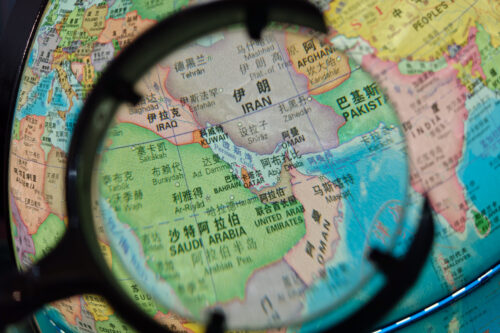
Top image: A Chinese map of the Strait of Hormuz in the Middle East on a globe under a magnifying glass, March 26, 2026. Photo by CFOTO/Future Publishing via Getty Images.
The Middle East Institute (MEI) is an independent, non-partisan, not-for-profit, educational organization. It does not engage in advocacy and its scholars’ opinions are their own. MEI welcomes financial donations, but retains sole editorial control over its work and its publications reflect only the authors’ views. For a listing of MEI donors, please click here.