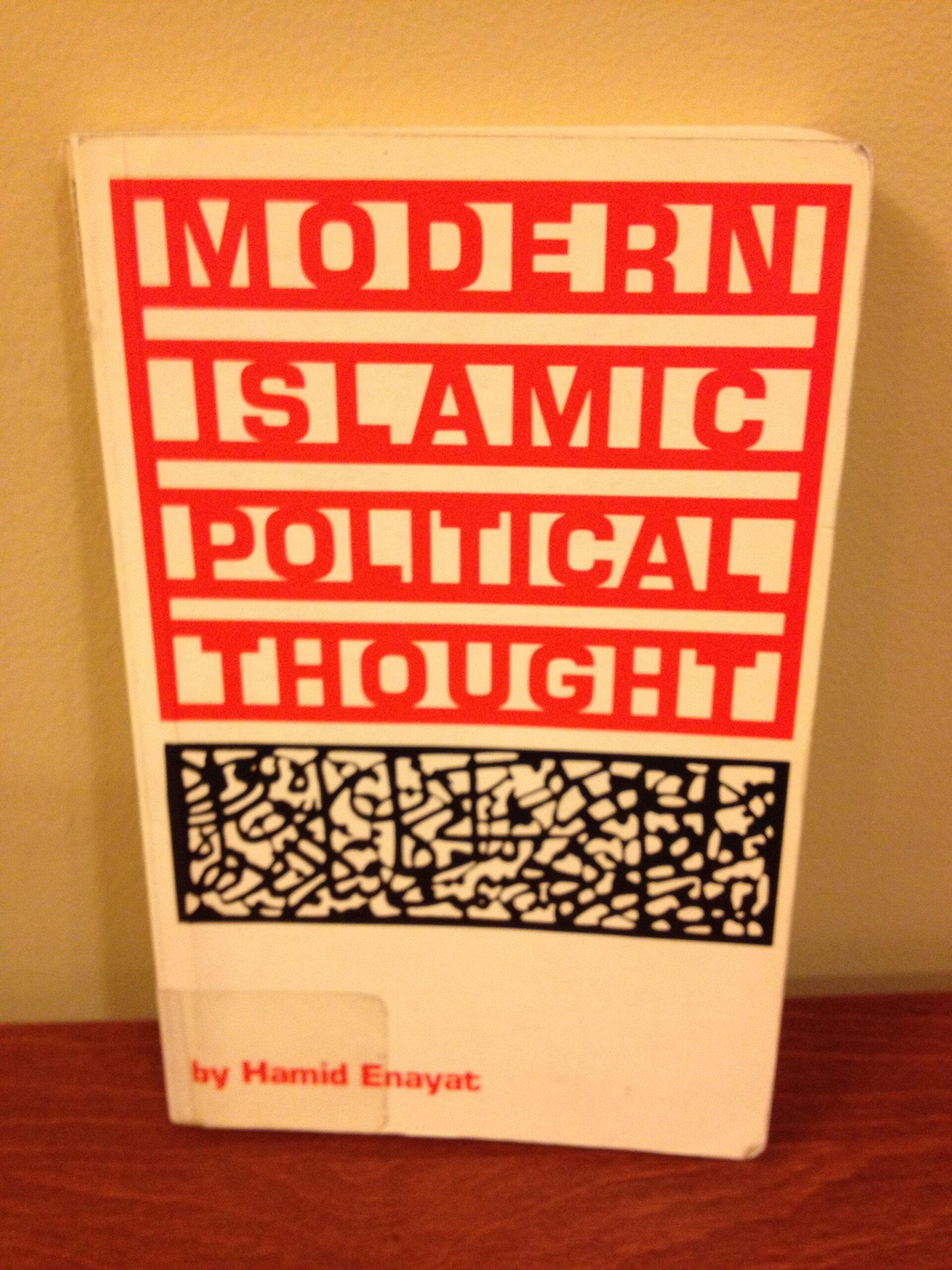
Collection Spotlight: Modern Islamic Political Thought, by Hamid Enayat, 1982
May 13, 2014
Share
In Modern Islamic Political Thought, Hamid Enayat discusses the major currents in twentieth-century Islamic political thought. Although the work is broad in scope, at its core is the assertion that the abolition of the Caliphate was “perhaps [the] most important controversy in twentieth-century Sunni political thought.” To prove this assertion, Enayat traces Islamic political thought from the abolition of the Caliphate to the rise of Islamic fundamentalism. He does this primarily by showing how key twentieth-century intellectual figures in the Muslim world, such as Rashid Rida, Jamal al-Din al-Afghani, Muhammad Abduh, and Abul Ala Maududi, perceived the abolition of the Caliphate. Through a close analysis of primary sources and an understanding of pertinent secondary literature, Enayat demonstrates that this event had a huge impact on these thinkers.
For Scholars:
Modern Islamic Political Thought is on the whole well-researched and well-argued. It is effective in demonstrating the role that the abolition of the Caliphate played in Islamic political consciousness. Martin Kramer, writing for Middle Eastern Studies in 1984, praised the book, saying that Enayat “succinctly described the modern mutation of Islamic political thought, ably summarizing representative texts for the student and the general reader.” Mangol Bayat, writing for Iranian Studies that same year, presents a less favorable view. She questions the validity of the work as piece of scholarship, stating that it is “replete with historical misconceptions,” such as Enayat’s argument that Islam and nationalism are irreconcilable. She further claims that the work “lacks constancy in scholarly detachment and historical objectivity.” Despite the criticisms and fluctuations of quality seen in specific sections, Enayat’s scholarship makes a significant contribution to work on the Caliphate and Islamic fundamentalism.
Primary Research Applications:
The Caliphate
Political Islam
Islamic fundamentalism
Twentieth-century Middle Eastern history
Further Reading in the Oman Library (among other texts):
The Political Thought of Sayyid Qutb: The Theory of Jahiliyyah, by Sayed Khatab, 2006
Islam, Muslims, and the Modern State: Case-studies of Muslims in Thirteen Countries, by Taj ul Hashmi, 1994
The Concept of an Islamic State, by Mahmood Sohail, 1989
Origins of Modern Arab Political Thought, by Khaldun Sati Husry, 1980
The Middle East Institute (MEI) is an independent, non-partisan, not-for-profit, educational organization. It does not engage in advocacy and its scholars’ opinions are their own. MEI welcomes financial donations, but retains sole editorial control over its work and its publications reflect only the authors’ views. For a listing of MEI donors, please click here.