Syria’s SDF Integration: Progress, Obstacles, and Security Risks
November 12, 2026
شارك
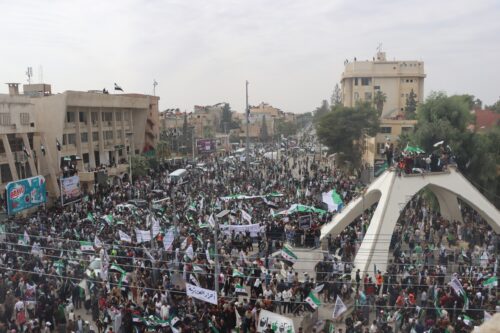
On October 9, protesters in the northeastern city of Hasakah raised the Syrian flag and called for the extension of state authority, roughly six weeks after the Syrian Democratic Forces (SDF) announced their dissolution as an independent force. The protesters, who came from Ghwayran, al-Nashwa, al-Aziziyah, and the surrounding countryside, carried photographs of detainees. Alongside a stronger state presence, they demanded a say in how power would be exercised, who is appointed to run local government, and who is recruited into the security services.
The SDF, a Kurdish-led, multiethnic force that was Washington’s principal partner on the ground in the fight against the Islamic State (ISIS), controlled most of northeastern Syria until this year. On January 30, 2026, it reached an agreement with the Syrian government to integrate its forces into the state, and in late August, after meeting President Ahmad al-Sharaa in Damascus, SDF commander Mazloum Abdi announced the force’s dissolution.
The Hasakah protests expose a problem at the core of the integration process. The January agreement was designed to bring the SDF into the new Syrian state, and its terms — preserving SDF units as brigades, keeping on the civilian staff of the self-governing administration the SDF and its allies had built across the northeast, and bringing Abdi into the presidency as an advisor — were the price of securing it. But a bargain struck between Damascus and the SDF’s leadership does not by itself give Hasakah’s Arab tribes, independent Kurds, Syriacs, and Armenians a stake in the new order, and some of them now see it as shutting them out. Because Hasakah is where that administration was most entrenched and its population the most diverse, it may well be the acid test where integration succeeds or fails. How Damascus addresses these grievances, and whether Washington uses its influence to help, will determine if the agreement becomes the foundation for a stable, unified Syria or a new source of conflict in a region where ISIS is still looking for openings.
Institutional Transition and the Limits of Progress
The Democratic Autonomous Administration of North and East Syria, a de facto self-governing authority whose origins lie in the Kurdish-led cantons declared in 2014, expanded as the SDF drove ISIS out of majority-Arab areas such as Raqqa and Deir ez-Zor in the following years, eventually covering roughly a third of the country. This year’s Damascus-SDF deal was struck after an earlier, March 10, 2025, agreement to integrate the SDF into Syrian state structures faltered and a government offensive against the SDF decisively shifted the balance of territorial control. In January, government forces and allied tribal fighters advanced as SDF control collapsed across Raqqa and Deir ez-Zor and into southern Hasakah. In Raqqa and Deir ez-Zor, state institutions moved in as the SDF withdrew. In Hasakah, however, the SDF retained its institutional core, so its military, security, and civilian structures had to be incorporated through negotiation rather than simply replaced.
Damascus and the SDF reached a series of new understandings over the subsequent weeks, following additional cease-fire arrangements and negotiations. The provisions of the final January 30 agreement include the deployment of security forces from the Ministry of Interior in central Hasakah and Qamishli; the gradual integration of SDF forces and Autonomous Administration institutions into the state; and the formation of three SDF brigades within a division, alongside a brigade of Kobani forces within a division under Aleppo’s command. It also provides for retaining civilian employees, guaranteeing Kurds’ civil and educational rights, and the return of displaced people.
As of early November, the integration of SDF fighters and personnel into state institutions has advanced, but the distribution of power and local participation remain contested. In December 2025, Abdi said the SDF had 70,000 troops, but other estimates put its strength closer to 20,000. According to military sources who spoke to the author on the condition of anonymity, perhaps 10,000 personnel remained after fighters laid down their weapons following the January offensive. From these, four brigades have been formed thus far, three in Hasakah and one in Kobani, with roughly 1,300 personnel each, suggesting a combined strength of around 5,200. For the SDF’s internal security forces known as the Asayish, preliminary lists contained approximately 9,000 names, but it is not clear how many have now been integrated.
Beginning in June, personnel and officers from the new brigades rotated through training courses in al-Nabk, in the Damascus countryside. In a conversation with the author in late October, Ahmed al-Hilali, Hasakah’s deputy governor and a member of the presidential delegation appointed to oversee implementation of the agreement, said the Ministry of Interior had strengthened its presence in central Hasakah through the internal security forces, road security units, and police departments, with similar steps accelerating in Qamishli. He added that he had visited the center integrating members of the Asayish to review its interview and intake procedures. Military integration into the Ministry of Defense was ongoing, he concluded.
These steps reorganize SDF forces within state institutions. In the new unified command, military and security roles are divided between former SDF personnel and government appointees, all under Damascus’s authority. Whether the new arrangement lasts depends on that command’s ability to issue orders and hold violators accountable in deployments, arrests, and the enforcement of court rulings.
On October 15, Hasakah’s chief public prosecutor announced that the city’s main courthouse had resumed work after nearly two years. Hilali told the author that complaint intake, case proceedings, and investigations had restarted; several courts are once again operating, though the criminal court handling serious offenses would require more time. Alongside the integration of judges from the Autonomous Administration, this represents progress in restoring the judiciary. Public confidence, however, continues to depend on the reestablishment of regular court proceedings and the enforcement of judgments.
Hasakah’s more mixed population of Arabs, Kurds, Syriacs, and Armenians further complicates the handover there. So does the need to merge Assad-era state institutions with new government appointees. Throughout the civil war, the Assad regime held on to small enclaves of government and security buildings, known as “security squares,” in central Hasakah and Qamishli while the SDF controlled the rest of both cities, so some state offices continued to function alongside those of the Autonomous Administration.
Demands for Participation and Redress
Protesters staged demonstrations on consecutive Fridays — October 2, 9, 16, and 23 — which spread to al-Shaddadi, Ras al-Ain, and Qamishli. Salem al-Jaryan, a participant in the demonstrations and a notable from Hasakah’s al-Aziziyah neighborhood, told the author that demands centered on extending state control, clarifying the fate of detainees, opening security recruitment to city residents, ending harassment and abductions protesters blamed on the Revolutionary Youth, restarting municipal bodies and courts, and resuming education. The Revolutionary Youth is a Kurdish organization linked to the Democratic Union Party (PYD) and the Kurdistan Workers’ Party (PKK). It remains unclear how many people are still in detention, a central grievance for protesters demanding the release of family members whose whereabouts are unknown. Jaryan emphasized respect for the rights of all communities, pointing to the display of photographs of Kurdish victims and slogans affirming citizenship as evidence of solidarity. Amid some media reports of offensive slogans and attacks on Kurdish symbols during the protests, which organizers dispute, Jaryan responded by claiming that any such acts by individuals did not reflect the views of the protesters as a whole.
Deputy Governor Hilali acknowledged that unifying institutions alone was insufficient to build trust, telling the author, “The success of integration is measured not only by the extent of state authority but also by how that authority is exercised.” He stressed that any allegation of abuse required investigation and accountability, regardless of the identity of the victim or the party accused, as protesters have demanded.
Members of tribal communities have participated in this mobilization alongside activists, young people, neighborhood residents, and detainees’ families. Their demands are not uniform: some want the state’s presence expanded more rapidly, while others challenge the form it is taking and who has been appointed to represent it; at times, the same protesters voice both demands. On October 13, local leaders met with Hasakah’s governor and called for calm, urging that the state be given an opportunity to reopen government offices and restore security. They also rejected the carrying of arms and called for accountability under the law. Their mediation buys the government time, but the weekly protests ensure the state authorities will be judged on how they use this breathing space.
Local governance arrangements help explain the sensitivity surrounding participation. The interim executive bureau formed in July exercises the powers of both the provincial council and its executive bureau pending elections. Appointing officials rather than electing them gets the administration working again, but it lets whoever makes the appointments decide who has a say. For Damascus, incorporating SDF personnel helps avoid a vacuum and confrontation, while allowing those personnel to retain roles within the state. Those left outside this arrangement, including independent Arab and Kurdish activists, professionals, tribal community members, and members of parties outside the Autonomous Administration, are still waiting for published rules that would give them comparable opportunities.
The dispute over participation also extends to Kurdish circles. In comments to the author, Kurdish political activist Aziz Biro described Decree No. 13, which recognizes Kurdish identity and language, as a major step addressing a significant part of the community’s demands. He argued, however, that full redress requires reversing the effects of earlier discriminatory policies, while noting the government’s willingness to pursue a solution. In his view, redress must also encompass language, education, and citizenship, which roughly 120,000 Syrian Kurds lost as a result of the 1962 census, as well as grievances concerning property rights and the right of return. These, he said, are fundamental rights that cannot be reduced to the level of representation held by the SDF in state institutions.
Biro supports integration but criticizes how it is proceeding, describing it as an arrangement between “two armed political formations” that divide positions on the basis of loyalty rather than competence and integrity. He criticizes the limited opportunities available to qualified Arabs, Syriacs, Armenians, and others. While acknowledging the delicate balancing act required during the transition period, he rejects the idea of making these temporary arrangements permanent. For his part, Hilali told the author that he opposes exclusion and ethnic quotas, emphasizing participation based on citizenship, competence, merit, and fair representation.
Security Risks and Implementation Scenarios
At the local level, security risks begin with the gap between demands to bring weapons under state control and the ability to enforce that directive. In Ghwayran, protesters are asking the state to protect them from what they describe as harassment and threats by the Revolutionary Youth movement. On October 11, a 27-year-old man from Ghwayran was reportedly abducted from his workplace by individuals linked to the group and released only after internal security forces intervened. When asked about the allegations, an SDF official declined to comment, referring the author instead to remarks by Abdi in Tal Tamr on October 9, in which the commander rejected efforts to incite unrest among communities in the region but did not address the allegations of abuse against the Revolutionary Youth. With weapons outside institutional control, resorting to self-protection or tribal mobilization could turn a dispute between armed individuals into a confrontation between communities.
Although SDF leadership has publicly expressed confidence in the process and a commitment to peaceful coexistence, concerns about integration have surfaced in foreign media. On October 18, Israel Hayom quoted unnamed Kurdish political figures warning that the integration agreement could collapse and guarantees of rights might not hold. The same figures also alleged that there is an alliance between Arab nationalists and Islamist elements “similar to ISIS,” without providing detailed evidence.
The agreement between Damascus and the SDF was secured with US mediation and help from the Iraqi Kurdistan Regional Government in Erbil, whose leadership has long-standing ties to Syrian Kurdish parties and served as a channel to the SDF. Ankara, which regards the SDF’s core as an extension of the PKK, has made border security and the departure of non-Syrian fighters, many of them PKK cadres from Turkey and Iran, its priorities. If these interests remain aligned, outside engagement can help keep implementation on track. Continued friction, including potential incidents involving the Revolutionary Youth or tribal groups, risks turning security enforcement measures into a wider political crisis.
The tensions and occasional violence between the government, the SDF, and various tribes also create space for other violent spoilers to make trouble, particularly ISIS. Recorded attacks by ISIS in Syria declined from a peak in February and March, although its cells remain a threat, particularly in Deir ez-Zor. Gaps in coordination and persistent grievances could create opportunities for the organization or Iran-linked networks to exploit. This is a potential risk, not evidence of a connection between these actors and tribal mobilization.
Three scenarios are possible in the next phase. The first is gradual progress indicated by the completion of heavy weapons handovers, unification of command, establishment of functioning courts, expansion of participation through transparent recruitment criteria, and tangible improvements in services and access to redress. Holding provincial elections and implementing Kurdish-language schooling would be further signs of this trajectory.
The second is protracted stagnation, with appointments and payrolls remaining within the state framework while jurisdictions overlap, personnel cases remain unresolved, and improvements in services and participation lag. Calm may persist, but each security incident or personnel decision could reignite tensions. Resolving specific disputes and addressing urgent rights concerns would become essential to preventing temporary arrangements from hardening into a permanent model of governance.
The third is a security or political reversal resulting from recurring incidents in which the Revolutionary Youth, tribal groups, or other armed groups outside state control turn to revenge attacks or mobilize along ethnic lines, leading to delayed implementation and an erosion of trust. Protecting civilians, preventing escalation, and holding perpetrators accountable would then take priority, while keeping services running and channels for dialogue open.
Of the three scenarios, stagnation appears most likely in the near term because military integration has advanced faster than the resolution of disputes over local participation, detainees, and accountability. Security incidents could further delay implementation and require new understandings without necessarily collapsing the agreement. The likeliest result is slow progress punctuated by tension; the outcome will depend on how authority is exercised after integration.
Washington’s core interests are preventing an ISIS resurgence and ensuring the secure custody of ISIS detainees. It could support intelligence sharing and operational coordination, help clarify responsibility for detainees and facilitate repatriations, and establish clear security cooperation arrangements with Damascus following the withdrawal of US forces. American support and diplomacy could also encourage transparent recruitment, broader local participation, credible investigations into abuses, and handovers of heavy weapons. Engagement with Israel and other regional actors could help prevent escalation. Developing secure Iraqi oil export routes through Syria to the Mediterranean to reduce reliance on the Strait of Hormuz and exposure to Iranian pressure could be a longer-term objective.
Washington has an interest in bringing the first scenario into existence, reinforced by the involvement of American companies such as HKN Energy in developing the Rmelan oil fields in the area. Sustaining these investments requires stability underpinned by institutions that represent residents, provide opportunities for employment and participation, and reduce the risk of renewed conflict and extremism. Progress in this direction will require transparent recruitment and appointment procedures, effective investigations into abuses, and improvements residents can observe in their daily lives.
Samer Al-Ahmed is a Syrian journalist and researcher focusing on developments in northeast Syria. He holds a master’s degree in international relations and has authored numerous reports and studies for Arab and international centers.
Photo by Ula Muhammed/Anadolu via Getty Images
معهد الشرق الأوسط (MEI) هو منظمة تعليمية مستقلة وغير حزبية وغير ربحية. لا يشارك المعهد في أي أنشطة دعوية، وآراء الباحثين فيه تعبر عن آرائهم الشخصية. يرحب المعهد بالتبرعات المالية، لكنه يحتفظ بالسيطرة التحريرية الكاملة على أعماله، ولا تعكس منشوراته سوى آراء المؤلفين. للاطلاع على قائمة المتبرعين للمعهد، يرجى النقر هنا.