This article is part of a collection of short essays written by the Fellows of the Middle East Institute to explore aspects of the ongoing war with Iran. The intent of the collection is to help readers see new and unexpected elements of the dynamics and impact of the ongoing hostilities and to think harder, deeper, and broader about the implications of the conflict. To read the other essays from this collection, as well as download the full report, please click here.
Rumors that President Masoud Pezeshkian had repeatedly offered to resign grew persistent enough in late July that both his office and that of the new supreme leader, Mojtaba Khamenei, felt compelled to deny them. Whether Pezeshkian ever seriously intended to step down matters less than what the episode revealed: his political survival has become a proxy fight over the direction of the Islamic Republic after its war with Israel and the United States. A president elected to lower the temperature at home and revive diplomacy abroad is now being blamed by the hardline right for the negotiations, the economic pain, and Iran’s failure to turn six months of military endurance into anything resembling a political win.
Around the same time, First Vice President Mohammad Reza Aref ordered universities, research centers, and state agencies to produce, within a month, a two-year strategic plan built around preserving social capital, protecting living standards, and imposing fiscal discipline. Israel and the US, he said, were trying to trap Iran in a state of “no war, no peace,” and the country needed to prepare for every scenario. But the underlying assumption was clear: Tehran no longer expects a stable peace, negotiated or otherwise, and is organizing its government around the likelihood of continuing pressure instead.
Six months after the war began, Iran is neither collapsing nor returning to the order that existed before Israel and the US struck on February 28. Supreme Leader Ali Khamenei was killed, senior commanders and scientists were assassinated, and military, energy, and nuclear infrastructure were hit hard. The state kept functioning anyway. The security forces held together, and the fact that no senior Iranian officials have been assassinated since March suggests the regime adapted to the intelligence and security vulnerabilities exposed early in the war. Mojtaba Khamenei was installed as his father’s successor with unusual speed, and the Islamic Republic demonstrated something it had never had to prove before: that it could survive the death of the man who had run it for nearly 37 years.
What that survival has obscured is how much shifted underneath it. The war did not end factional politics in Iran — it moved the fight. The decisive argument is no longer reformists against hardliners. It is a dispute among regime insiders, all of whom agree the Islamic Republic must survive but disagree sharply about what that requires: a security establishment that wants to convert military endurance into economic recovery, an ideological far-right camp that treats every compromise as betrayal, and a reformist current arguing that peace abroad means nothing without some reconciliation at home.
A Succession That Settled the Office, Not the Authority
Ali Khamenei’s state funeral, held in early July after a long delay, was staged to close the succession question. The regime filled the streets of Tehran, brought in allied dignitaries, and turned the funeral into proof that killing a supreme leader had not killed the state. It also, inadvertently, showed the limits of that proof. Mojtaba was absent from the central public rituals — officially over assassination concerns, though his continued invisibility has since fed rumors that he is dead or incapacitated.
All three living former presidents — Mohammad Khatami, Hassan Rouhani, and Mahmoud Ahmadinejad — were also absent from the official farewell and funeral prayers; by most accounts they were never invited, though Ahmadinejad later appeared in the street procession. A ceremony that could have united rival generations of the Islamic Republic instead drew a visible line between insiders and outsiders.
Mojtaba inherited the title of supreme leader. He did not inherit his father’s revolutionary standing, decades of relationships, or personal authority. The issue surfaced almost immediately inside the hardline camp itself: parliamentarian Hamid Rasai published a Quranic passage about Noah’s son under the headline “Who Is Qualified for Leadership?” — a none-too-subtle reminder that lineage alone confers no legitimacy in Islamic political thought. Rasai denied he was taking aim at Mojtaba, but the fact that the question could be raised publicly at all says something about how unsettled the succession still feels.
Mojtaba’s early governing style has been cautious to the point of indirection. When he endorsed the June 18 memorandum of understanding (MoU) with Washington, he made a point of noting he had held “a different view in principle” before authorizing it, once Pezeshkian and the Supreme National Security Council guaranteed Iran’s interests would be protected. His father used the same maneuver for decades, authorizing diplomacy while letting elected governments absorb the political fallout. The difference is that Ali Khamenei delegated from a position of dominance.
Foreign Minister Abbas Araghchi’s account of wartime decision-making is the most revealing window into how the current system actually works. A committee originally set up inside the Supreme National Security Council’s secretariat to manage the nuclear file, he said, evolved into the six-person body that ran the negotiations — chaired first by Ali Shamkhani, then by Ali Larijani — whose decisions carried the same weight as the full council’s. During the war, Pezeshkian met regularly with Araghchi, Larijani, Mohammad Bagher Zolghadr, and parliament speaker Mohammad Bagher Ghalibaf, then formed a small committee from that group empowered to make real-time calls as talks unfolded — a compact body spanning the presidency, parliament, the foreign ministry, and the security establishment, operating largely outside public view.
Just as telling, Araghchi said he had not met Mojtaba during this period and had no prior relationship with him. That does not mean the new leader was absent from decision-making — other accounts suggest he sent the draft memorandum back with questions and required an unusually large majority inside the council before signing off. It suggests instead that Mojtaba operates one step removed, receiving policy through institutions rather than relying on the informal access his father built up over decades. He sets the boundaries and has the final word, but more experienced political and security figures shape the choices placed before him.
That distance also explains why questions about his condition keep resurfacing. Mojtaba has not appeared in public since the February 28 strike that killed his father and wounded him, and Iranian officials have repeatedly found themselves responding to uncertainty about his whereabouts and the extent of his injuries. In June, Assembly of Experts member Ahmad Khatami acknowledged that Mojtaba’s leg injuries had initially been serious enough that amputation was considered, while insisting that he had since recovered. Yet his continued absence has meant his physical condition is difficult to independently assess.
Mojtaba has, however, been explicit about what sits outside the bargaining space. Days after the funeral, he pledged that Iran would avenge his father’s death and the war’s other dead, around 3,500 Iranians — a national obligation, he said, that would outlast any change in personnel. Two weeks later, responding formally to Hizballah in Lebanon, he called Iran’s defense of the group a continuing strategic policy and said protecting Lebanon’s territorial integrity was the first condition of the MoU with Washington.
Negotiations, in his framing, can pause the fighting; revenge and the defense of the “Resistance Front” are standing commitments no negotiator is authorized to trade away. Hizballah’s fighters pledged allegiance to him directly, and Mojtaba answered by invoking his father and Ruhollah Khomeini together — a reminder that his authority abroad still needs affirming by networks his father spent over 30 years building, even as he layers a harder-edged Iranian nationalism on top of the old transnational ideology.
The Real Fight Is Now Inside the Political Right
The war suppressed factional combat while the Islamic Republic’s survival was genuinely in doubt. Once the immediate danger passed, the fighting resumed — almost entirely within the ruling right. On one side is a pragmatic security establishment: senior Islamic Revolutionary Guard Corps (IRGC) figures, institutional conservatives, career diplomats, and political managers like Ghalibaf, none of whom want to reform the Islamic Republic but all of whom accept that military endurance has to eventually produce something tangible — restored oil exports, unfrozen assets, reconstruction.
On the other side is the ideological current around Saeed Jalili and the Paydari Front, the self-styled “super-revolutionaries,” who cannot govern the country but do not need to: their power runs through parliament, state television, the mosques, and semi-official pressure networks, and consists mainly of the ability to accuse, obstruct, and intimidate.
That power was on open display at Ali Khamenei’s funeral, where demonstrators reportedly shouted abuse and threw stones at Araghchi’s car — not a reformist or an opposition figure, but a diplomat executing policy the state’s own security apparatus had authorized. Underlying that attack was the assertion that revolutionary purity, as radicals define it, outranks the formal chain of command.
This is not a new tactic. For years the top of the Islamist system let the radical street pressure presidents and diplomats without issuing direct orders. The trouble is that once the state itself decides diplomacy is necessary, the same networks become a liability rather than an asset.
That tension is exactly what the Pezeshkian resignation story was about: Mohammad Bagher Kharrazi, a hardline cleric who runs the fringe Hizballah Party of Iran, claimed the president had submitted multiple resignations and attributed to Mojtaba a warning that the next one would be accepted. The Presidential Office called it an outright lie; more tellingly, Nour News — a platform close to the security establishment — insisted only official channels could speak for the supreme leader, and Mojtaba’s office followed up by branding Kharrazi’s account false. The real dispute was not whether Pezeshkian wanted to quit. It was over who gets to speak in Mojtaba’s name.
Pushback has started to surface from inside the system itself. Ebrahim Rezaei and Mahmoud Nabavian, two of parliament’s loudest opponents of negotiation, were removed from the leadership of its National Security Commission. It is not clear whether that was a routine reshuffle or a deliberate intervention, but either way it does not read as an embrace of normalization so much as a demand for more disciplined behavior from inside the tent.
Ghalibaf has become both the clearest target and the clearest beneficiary of this fight. A former IRGC commander, police chief, and Tehran mayor, he belongs to the security establishment but presents as an administrator, which lets him defend diplomacy without looking like he is abandoning the revolution. He frames the talks as converting military leverage into economic and political gains, which makes him useful to both the IRGC and the civilian government — and a natural target for the ideological far right.
MP Mohammad Bagheri Bonab compared the campaign against him to earlier ones waged against Akbar Hashemi Rafsanjani, Khatami, and Larijani — a pattern suggesting that acceptable loyalty in the Islamic Republic keeps narrowing, and yesterday’s insider keeps becoming today’s suspect compromiser.
The hostility toward Ghalibaf predates the war — Jalili’s camp has accused him since the 2024 election of splitting the conservative vote to deny Jalili the presidency — and the war simply gave that old grudge a new script: that Ghalibaf is trading Iran’s military sacrifices for an inadequate diplomatic deal. Ghalibaf is no reformer, but that is precisely why he matters: he is the military-technocratic type best suited to the emerging order, revolutionary enough for the IRGC’s trust, pragmatic enough to negotiate, experienced enough to run the state.
The Guard Did Not Lose to Diplomacy — It Absorbed It
The IRGC is the war’s clearest institutional winner, but not because it defeated or sidelined civilian government. It has folded diplomacy into its own strategic logic instead. Iranian officials now routinely describe negotiations as war continued by other means: the armed forces generate leverage, diplomats convert it into sanctions relief and the release of frozen assets, and diplomacy becomes acceptable only because it is presented as the outcome of resistance rather than its alternative.
That logic explains why the veteran diplomats behind the 2015 nuclear deal remain indispensable despite years of attacks from the far right. In May, Nabavian demanded the removal of Araghchi and his deputy foreign minister, Majid Takht-Ravanchi, another veteran of the 2015 nuclear talks. Yet whenever Tehran faces a genuine external crisis it returns to the same diplomatic bench, because these officials have technical experience and institutional memory that the self-declared ideological loyalists do not. The security establishment depends on people it does not fully trust, and its answer has been to supervise them more closely rather than replace them.
That creates its own risk. The IRGC has gained further sway since Ali Khamenei’s death, some regional commanders appear to have more operational latitude than before, and a prolonged, low-grade conflict protects military budgets and institutional relevance in a way a durable peace would not.
A Truce Is Negotiable, Peace Is Not
Hardline commentator Mohsen Kouhkan put the ceiling on postwar diplomacy about as plainly as anyone has: Iran and the US might reach a cessation of hostilities, he said, but not peace. That distinction is the whole story. Peace implies trust and predictability. A cessation of hostilities just means the shooting stops, buying Tehran time to rebuild without either side reconsidering the underlying conflict. That appears to be exactly the outcome institutional conservatives want: negotiate, avoid another full war, but treat permanent reconciliation with Washington as both ideologically off-limits and politically dangerous.
Reformists are pushing past that boundary. Azar Mansouri, who heads the Reform Front, has called for “two great peaces” — an honorable peace abroad and an internal one built on listening to critics and rebuilding public trust. The conservative outlet Fars fired back, framing this as a false choice between those who want peace and those who want war. For the security establishment, peace is something secured externally through strength, which can leave the domestic distribution of power untouched. For reformists, it has to change the relationship between state and society — which is exactly why reformists remain institutionally weak but increasingly hard to ignore.
That argument has spread well past the reformist camp itself. Mohammad Reza Bahonar, a veteran conservative on the Expediency Council, has said Iran cannot simply return to its old governing model and has called for genuine political parties, legal channels for protest, and eventually constitutional reform. His sharpest observation is that Iranians can remain deeply critical of the government while still feeling obligated to defend the country’s territorial integrity and independence — in other words, the war produced a rally around Iran, not around the Islamic Republic.
A survey reportedly conducted by Ali Rabi’i, whose full methodology has not been published, is said to have found severe food insecurity, weak institutional trust, and declining public support for financing the regional “resistance” network, alongside majority support for diplomacy and the cease-fire. If that holds, it sits uneasily against Mojtaba’s own public reaffirmation of the Hizballah relationship as a strategic priority; the war may have hardened Iranians’ will to defend their country while eroding their appetite for bankrolling an open-ended regional project.
Underneath all of this sits an economy that is not keeping pace with the regime’s endurance, with inflation, particularly for food, rising sharply and unevenly across provinces and income groups.
Even military figures are picking up the language of economic grievance and public trust: former IRGC commander Yahya Rahim Safavi has argued that national power depends on public satisfaction and economic performance as much as defensive capability — not a reformist program, but a sign that parts of the security establishment now count public trust as a security asset in its own right.
Accountability Flows Downward
What has not happened in postwar Iran is as telling as what has. There has been no public accounting of how foreign intelligence penetrated the state deeply enough to reach a supreme leader and senior commanders, and no institution has accepted responsibility for the air-defense failures or the decisions that exposed the country to war in the first place.
Instead, accountability has moved in the other direction. The judiciary says it has opened cases against more than 3,100 people accused of assisting the enemy, with hundreds of properties, vehicles, and bank accounts frozen or seized — though how many of those cases have produced formal charges or convictions, as opposed to investigations, is still unclear — and officials have promised the confiscated assets will help rebuild damaged hospitals, schools, and bridges. No comparable scrutiny has touched the top of the regime; alleged spies and dissidents are being asked to shoulder both the blame for the war and part of the bill for rebuilding.
Pezeshkian sits at the bottom of that same logic. He cannot reasonably be blamed for sanctions, military escalation, or economic weaknesses that predate his presidency, yet he remains the face most visibly answerable for inflation and living standards, defending negotiations he does not fully control while Araghchi absorbs blame for concessions decided elsewhere. That may be exactly why Mojtaba’s office intervened to knock down the resignation rumors — not out of confidence in Pezeshkian’s performance, but because removing him would solve nothing and cost the system stability it cannot spare. Pezeshkian is too weak to set the country’s direction and too useful to discard.
Six months on, Iran is not simply a more militarized version of itself — it is a less personalized, more security-mediated, and more openly contested one. Mojtaba is constitutionally decisive but politically dependent on men with far more experience than he has. The IRGC controls the strategic framework but now has to manage reconstruction and public expectation, not just confrontation. The radicals are loud but increasingly disciplined from above. And the reformists, powerless institutionally, are winning the argument that matters most: that a regime cannot buy social peace with patriotism alone, and that external calm means little if the relationship between Iran’s rulers and its people does not change with it.
The real contest in Tehran now is not between those who want the Islamic Republic to survive and those who want it to fall. It is between those who agree it must survive and disagree, sometimes bitterly, over whether that requires permanent confrontation or a controlled retreat from it.
Managing “no war, no peace” until the end of President Donald Trump’s term may be the rational response to current conditions. It may also be how a state without an obvious center of gravity turns emergency into a permanent way of governing — one that favors the security establishment, narrows political competition, and risks handing Iran’s adversaries exactly the outcome they were after: a country that can absorb repeated shocks while growing poorer, warier, and harder to govern with each one. The Islamic Republic’s achievement these past six months was making sure Ali Khamenei’s death did not become the system’s death. Its unresolved problem is whether that system can generate real authority without him — and whether it has anything to offer its people beyond the promise of surviving whatever comes next.
What This Means for Washington
For Washington, the Iranian regime’s combination of resilience and political weakness argues against both maximalist expectations and diplomatic complacency. The US should not assume that economic pain, elite infighting, or Mojtaba Khamenei’s uncertain authority will cause the regime to collapse on a timetable useful to US policy, even if Washington is eager for a quick end to the US-Iran war.
So far, pressure has also strengthened the very institutions most capable of keeping the system together: the IRGC, the Basij militia, and the wider security establishment. Yet the same internal fragmentation creates a different problem for diplomacy. Pezeshkian, Ghalibaf, and Araghchi can negotiate, but they cannot by themselves guarantee that an agreement will survive attacks from hardliners or competing claims about what the supreme leader has authorized.
Any new accord with Tehran therefore ideally needs to be narrower, verifiable, and sequenced, with unmistakable evidence that the leadership has endorsed it and with reciprocal steps that give neither side reason to believe the other is simply buying time for the next round of confrontation.
Washington should preserve military deterrence and economic leverage, but recognize that pressure aimed at forcing wholesale political capitulation may instead deepen securitization, weaken advocates of compromise, and validate the hardline argument that negotiations are merely preparation for another US-Israeli attack. The most realistic objective is not to engineer Iran’s internal political outcome, but to exploit the regime’s need for economic relief and strategic breathing room while limiting its capacity for nuclear escalation and regional coercion. For now, Iran’s domestic politics make a grand bargain with Washington less likely but they also make a carefully bounded deal more necessary.
Alex Vatanka is a Senior Fellow at the Middle East Institute. He specializes in Middle Eastern regional security affairs with a particular focus on Iran.
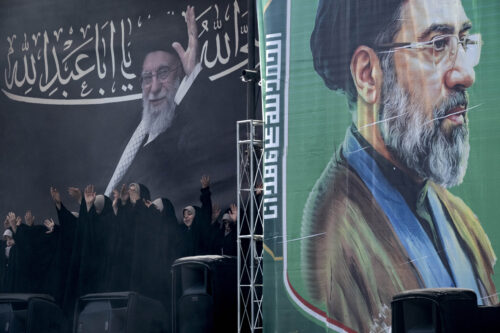
Top image: A group of veiled Iranian schoolgirls perform beneath portraits of Iran’s Late Supreme Leader, Ayatollah Ali Khamenei, and Supreme Leader Ayatollah Mojtaba Khamenei, during a religious rally in southern Tehran, Iran, on August 4, 2026. Photo by Morteza Nikoubazl/NurPhoto via Getty Images.
The Middle East Institute (MEI) is an independent, non-partisan, not-for-profit, educational organization. It does not engage in advocacy and its scholars’ opinions are their own. MEI welcomes financial donations, but retains sole editorial control over its work and its publications reflect only the authors’ views. For a listing of MEI donors, please click here.
The Mecca Alliance Meets the Red Sea – Saudi Arabia’s New Defense Pact Faces Its First Major Test