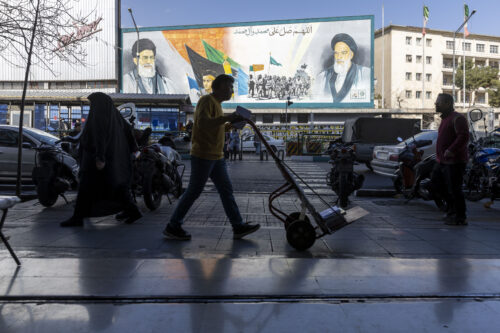
Whenever Iran is shaken by nationwide protests, as it was just last month, analysts and activists are consumed by the same two questions: will the country’s regime finally fall, and what will come next if it does? Answers abound. Some analysts think that the country’s leadership is surprisingly secure and that the regime can withstand more demonstrations. Some believe it will collapse, only to be followed by another dictatorship under the Islamic Revolutionary Guard Corps, the most politically powerful branch of the country’s armed forces. Others are more optimistic, arguing that the entire system will go down and that an external opposition figure, perhaps the former Iranian crown prince Reza Pahlavi, will help the country transition to a democratic government or that Pahlavi will set up a constitutional monarchy. Those more optimistic still think that Iran might have a negotiated transition toward democracy, with regime figures offloading power to opposition ones.
Iran does seem poised on the brink of great change. The regime is exhausted, and Iranians are infuriated by decades of economic mismanagement. Its supreme leader, Ali Khamenei, is an 86-year-old cancer survivor. If upcoming talks in Oman between Tehran and Washington fail to break the nuclear impasse and address Iran’s other destabilizing activities, the Trump administration might also resort to attacking the country. But current speculation about Iran’s day after (including among U.S. officials debating what course of action to take) glosses over the factor that will determine whether Iranians will have a better future: the state of the country’s opposition movement. That movement, unfortunately, is deeply fractured. Its members are divided into many factions—college students, ethnic minorities, diasporic monarchists, to name just a few—that are frequently at odds with one another. For example, opposition activists routinely accuse one another of secretly collaborating with the Iranian regime or with foreign governments. As a result of this fractiousness, they have struggled to capitalize on the Islamic Republic’s weakness.
Photo by Majid Saeedi/Getty Images
The Middle East Institute (MEI) is an independent, non-partisan, not-for-profit, educational organization. It does not engage in advocacy and its scholars’ opinions are their own. MEI welcomes financial donations, but retains sole editorial control over its work and its publications reflect only the authors’ views. For a listing of MEI donors, please click here.