This article is part of a collection of short essays written by the Fellows of the Middle East Institute to explore aspects of the ongoing war with Iran. The intent of the collection is to help readers see new and unexpected elements of the dynamics and impact of the ongoing hostilities and to think harder, deeper, and broader about the implications of the conflict. To read the other essays from this collection, as well as download the full report, please click here.
The following essay was originally published in The Dispatch on August 7, 2026. It is reprinted here with their permission.
It has become a commonplace for Americans to describe our current war with Iran as stuck in a kind of limbo, neither full war nor real peace. We’re not the only ones. Iraq finds itself caught in a limbo of its own, between America and Iran, between the tolerable and the intolerable, between progress and relapse.
And like our own muddled state of affairs, theirs too is one largely — but not solely — of our devising.
To understand Iraq’s current predicament, there are three things one must recognize. That the fiercest political divides are no longer among Sunni, Shiite, and Kurd, but among the Shiites themselves. That the prime ministry has increasingly become a facade hiding a battle among powerbrokers behind the scenes. And that Iraq may prove to be the worst casualty of the Iran war, despite playing barely a bit part in it.
All politics is Shiite.
Iraq’s second civil war — what Americans call the ISIS war — began in 2014 and ended three years later with the triumph of Iraq’s Shiites over both its Sunni and Kurdish communities. That eventuality largely derived from the unwillingness of the United States to treat the conflict as a revival of the first civil war — the one the U.S. unleashed by creating a security vacuum after its invasion in 2003, and which we ended only with the surge of 2007-2008, which secured the country and forged a power-sharing agreement among the communities. By focusing myopically on wiping out the Islamic State, we allowed the Iranian-backed Popular Mobilization Forces to crush first the Sunnis and then the Kurds.
As a result, Iraqi politics today is all about the Shiites. The two great Kurdish parties, the Kurdistan Democratic Party (KDP) and the Patriotic Union of Kurdistan (PUK), still exist, but both must look to Baghdad for money and permission in ways they didn’t need to before 2017. A handful of Sunni parties led by petty crooks scrabble to be rewarded with crumbs by the various Shiite parties that hold all real power and wealth in the country.
Worse, with each election, more power shifts to the Shiite parties most closely aligned with Iran. The tripartite division of Iraq — into Shiites, Sunnis, and Kurds — that Americans exaggerated and then exacerbated still exists, but it is almost beside the point. All power in Iraq is wielded by the Shiites and the only battles that matter to the future course of the country are those among various Shiite parties and personalities. Moreover, because of the way that the U.S. rushed to constitute a government after the 2003 invasion and then ignored Iraq’s internal politics after the 2011 withdrawal of U.S. troops, the best among the Shiites have slowly but inexorably given way to the worst.
The war of the would-be kings.
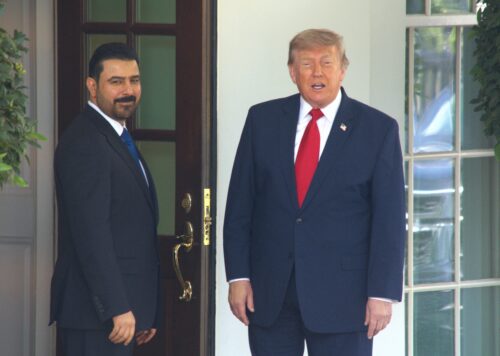
In mid-July, Iraq’s new prime minister, Ali al-Zaidi, came to Washington. Iraqis and Americans alike were thrilled. Dozens of new business deals were signed and President Donald Trump took an instant liking to al-Zaidi, inviting him to stay at the White House for an unscheduled lunch and calling him “a very brilliant guy.” “This man is going to be a great leader in the Middle East, beyond Iraq. His influence is going to spread all throughout the Middle East,” Trump predicted.
That was important because al-Zaidi was chosen prime minister of Iraq almost solely to win over the American president. Contrary to Trump’s claims, al-Zaidi did not win the Iraqi election that brought him to power. He did not even run in it. He was chosen seven months after the race by the real power behind the throne, Iraq’s chief jurist, Faiq Zaidan. Zaidan chose al-Zaidi because he believed him to be, in the words of many Iraqis, “the Iraqi Donald Trump.” And Zaidan wanted an Iraqi Donald Trump because Trump, as he admitted, threatened to cut off all aid to Iraq if the Iraqis didn’t choose someone he liked.
For Americans, the selection of al-Zaidi should illustrate two key points. First, as influential as Iran has become in Iraq, America still matters to Baghdad, and Washington can still exert its influence over the country. Too often over the past decade, Americans have assumed that Iraq was so lost to Iran that it wasn’t worth trying to shape the country’s future, creating a self-fulfilling prophecy. Second, the man calling the shots in Iraq is not the prime minister, but Zaidan from his unusual post as president of Iraq’s Supreme Judicial Council. Especially since the end of the second Iraqi civil war, it is Zaidan who has emerged as the most powerful man in Iraq.
Zaidan is not a democrat. And despite his job title, he is not a terribly just man either, wielding power as ruthlessly as many prior Iraqi dictators — albeit nowhere near the horrors of Saddam Hussein — and he is not necessarily a friend of the United States. But he is an Iraqi nationalist; he does not seem to want to be a creature of Tehran, and he is mindful of American power. Moreover, he is the most formidable ruler of post-invasion Iraq since former Prime Minister Nouri al-Maliki.
Yet Zaidan’s power is not unchecked. In addition to contending with the Iranians and, occasionally, Americans, Zaidan is reportedly being challenged by another Shiite leader, Qais al-Khazali — the leader of the Iranian-backed Asaib Ahl al-Haq militia, a U.S.-designated terrorist group. Al-Khazali is personally guilty of the murder of American soldiers during the Iraq War, but nonetheless hopes to be prime minister of Iraq and to wrest power from Zaidan. For that reason, al-Khazali has begun making overtures to the United States — just as Zaidan has.
The struggle for supreme power in Iraq between Zaidan and al-Khazali may well become the defining feature of Iraqi politics in the months, even years, to come. It may prove a more potent driver than what either the U.S. or Iran wants. Yet their fight is unlikely to displace Washington and Tehran altogether.
Despite the beating that Iran has taken during the ongoing conflict, Iraqis remain very wary of their great eastern neighbor, especially because many fear that Iran is likely to triumph in the end, emerging from the war with control over the Strait of Hormuz and tens or hundreds of billions of dollars to spend. But the war has also revived Iraqi respect for America’s role, both in the show of unrivaled U.S. military power and because of Baghdad’s urgent need for American assistance with its own oil exports amid the fighting.
Iraq and the Iran war.
To read the American newspapers, you might be excused for thinking that Iraq was largely left out of the war with Iran. There are stories about periodic attacks on American forces and allies by the Iranian-backed Iraqi militias — followed by U.S., Israeli, and now Saudi retaliations — but these have been relatively few. The Kurds of the KDP have been hammered regularly by Iranian drones and ballistic missiles, but these bombardments barely register in the Western press. This is despite the fact that, unlike America’s other regional allies, the Kurds don’t have any air defenses of their own and neither the U.S. nor the Israelis have spared any to shield them.
Even worse for Iraq has been the war’s impact on Iraqi oil exports. Before the war began, Iraq had climbed into fourth place among global oil exporters, behind only Saudi Arabia, Russia, and the United States. Iraq was exporting 3.5 to 4 million barrels of oil per day, nearly all of it through the Strait of Hormuz. The closure of the strait has choked off Iraqi oil exports to barely 250,000 barrels per day, a little more than 6 percent of their prewar sales.
Oil drives the Iraqi economy. Oil sales account for 85 to 90 percent of Iraq’s government revenues. Almost 40 percent of the labor force works directly for the government (and more than 60 percent of Iraqis who earn regular, full-time wages). Moreover, roughly 40 percent have sources of income that rely heavily or entirely on those who work directly for the government.
So Iraq, like the other Arab states of the Gulf region, has had to rely on its savings to cover this massive shortfall in revenue, but unlike the Saudis, Emiratis, Kuwaitis, and Qataris, it does not have massive sovereign wealth funds to draw upon. Iraq’s population is too large (48 million Iraqis compared to just 22 million Saudi citizens) and its economy too corrupt to amass significant public savings. Before the war began at the end of February, Iraq had about $110 billion in currency reserves. Four months later, in early July, and even after a few weeks with the strait mostly open, Iraq was still down to less than $80 billion in reserves. If the strait remains closed, at its current burn rate, Iraq can only cover its costs for another nine to 10 months at most.
The end of an era, again.
In the midst of all this, the United States is withdrawing from Iraq, again. On September 30, U.S. forces are scheduled to leave Iraqi Kurdistan, having withdrawn from the rest of Iraq last year. Both American officials and many Iraqi elites expect some U.S. functions — like training and arms sales — to continue from a large Office of Security Cooperation within the U.S. embassy. Of course, that is what the United States tried in 2011, only to find it was premature, and the absence of U.S. military forces led quickly to the revival of civil war and invasion by ISIS.
This time, the American departure is supposed to be accompanied by the disarmament of Iraq’s Iranian-backed militias, but no one really expects that to happen as advertised. Most of the militias, including al-Khazali’s, have agreed to disarm. Even these are expected to turn over only part of their arsenal, or integrate their troops into the Iraqi security forces so as to better control the latter. At least two groups, Kata’ib Hezbollah and Harakat Hezbollah al-Nujaba, have simply refused to lay down their weapons, and given that they’re the main perpetrators of attacks on Americans and American allies in recent years, that is no trifling matter. No one knows what the Iraqi government will be willing or able to do with them, but it will be an acid test for both Washington — which wants them disarmed — and Tehran — which does not.
Where does all of this leave Iraq? Up for grabs. Each of these elements creates points of leverage for the U.S. if the Trump administration is willing to employ them. Washington can back the Sunnis and Kurds — or merely threaten to do so — to incentivize better behavior from the Shiite groups. Likewise, Washington can lay out both redlines and demands for both Zaidan and al-Khazali and help one or the other, or back a third candidate against both of them. The U.S. doesn’t have to do enough to win the power struggle; it simply has to complicate the internal fight enough to secure Iraq’s compliance with our requirements. The U.S. can also help Iraq manage its finances with loans from international organizations like the International Monetary Fund and World Bank, or even its own Treasury, in return for tangible changes in policy.
Yet Iraq’s predicament also serves as the millionth reason why the United States cannot afford to be seen as having lost the Iran war, let alone having surrendered control of the Strait of Hormuz and acquiesced to Iranian coercion of our Gulf allies. The Iraqis are watching carefully too. If they believe that Iran won the war, America’s significant residual influence will evaporate. Iraq truly will become an Iranian satrapy and serve as a gateway for Iranian power and influence into the Arab world.
Kenneth M. Pollack is the Vice President for Policy at the Middle East Institute. He has served as a Persian Gulf military analyst for the CIA, director for Persian Gulf Affairs at the National Security Council, and director of the Center for Middle East Policy at the Brookings Institution. He is the author of 10 books on the political and military affairs of the Middle East, and his 11th, The Iraq Wars, will be published in February.
Top image: President Donald Trump welcomes Iraqi Prime Minister Ali al-Zaidi at the White House in Washington, DC, July 14, 2026. Photo by Li Yuanqing/Xinhua via Getty Images.
The Middle East Institute (MEI) is an independent, non-partisan, not-for-profit, educational organization. It does not engage in advocacy and its scholars’ opinions are their own. MEI welcomes financial donations, but retains sole editorial control over its work and its publications reflect only the authors’ views. For a listing of MEI donors, please click here.
The Mecca Alliance Meets the Red Sea – Saudi Arabia’s New Defense Pact Faces Its First Major Test