Top Khamenei Aide Hails Iran-Backed “Resistance” Groups across Region
January 31, 2017
Share
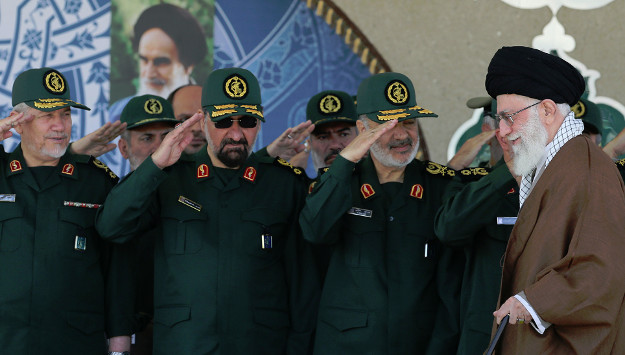
A senior Iranian official creditedthe country’s Supreme Leader Ali Khamenei and the Islamic Revolution Guards Corps (I.R.G.C.) for exporting Iranian revolution abroad. He also claimed that Damascus and Baghdad would have fallen if the I.R.G.C. forces had not intervened. “The [Iranian] school of resistance went to Lebanon and established Hezbollah; the school of resistance with its presence in Syria taught them [Syrian government forces and foreign Shiite militia groups] how to resist against infidel terrorists for 68 months,” said Major General Yaha Rahim Safavi, a senior military advisor to the Supreme Leader.
He also revealed Iran’s leading role in establishing Shiite militia groups inside Iraq. “The school of resistance in Iraq created 20 Hashd al-Shaabi [Popular Mobilization Force] brigades that are liberating Mosul now. Iranian martyrs taught resistance lessons to other countries,” the former I.R.G.C. chief commander said at a ceremony commemorating Iranian military personnel killed during the Iran-Iraq war in the 1980s.
While the Rouhani government tries to assure the world that Iran does not pose a threat to regional stability, Safavi’s remark provides clear evidence of the Iranian regime’s agenda to export its revolution abroad at the expense of regional stability.
The Middle East Institute (MEI) is an independent, non-partisan, not-for-profit, educational organization. It does not engage in advocacy and its scholars’ opinions are their own. MEI welcomes financial donations, but retains sole editorial control over its work and its publications reflect only the authors’ views. For a listing of MEI donors, please click here.