This Burning Land: Lessons from the Front Lines of the Transformed Israeli-Palestinian Conflict
The Middle East Institute is proud to host Greg Myre and Jennifer Griffin for a discussion about the ongoing challenges in the Israeli-Palestinian conflict based on their knowledge and experiences recounted in their new book, This Burning Land: Lessons from the Front Lines of the Transformed Israeli-Palestinian Conflict. Myre and Griffin, journalists who are husband and wife, traveled to Jerusalem in 1999 in hopes of finally seeing Middle East peace. Instead, the pair watched as violence in the area escalated and the peace process disintegrated.
This Burning Land: Lessons from the Front Lines of the Transformed Israeli-Palestinian Conflict
The Middle East Institute is proud to host Greg Myre and Jennifer Griffin for a discussion about the ongoing challenges in the Israeli-Palestinian conflict based on their knowledge and experiences recounted in their new book, This Burning Land: Lessons from the Front Lines of the Transformed Israeli-Palestinian Conflict. Myre and Griffin, journalists who are husband and wife, traveled to Jerusalem in 1999 in hopes of finally seeing Middle East peace. Instead, the pair watched as violence in the area escalated and the peace process disintegrated.
Inside the United Nations Assistance Mission in Afghanistan
The Middle East Institute is proud to host Staffan De Mistura, the Special Representative of the UN Secretary-General for Afghanistan, for a lecture and discussion on the UN's mission in Afghanistan. De Mistura will speak at MEI following the UN Security Council debate on the mandate renewal of the United Nations Assistance Mission in Afghanistan (UNAMA). The Security Council resolution with the new mandate is scheduled to be adopted on March 22, 2011, the day of this event.
The Obama administration's efforts to win a settlement freeze as a confidence-building measure have failed, and the U.S.has not presented a new vision for resuming the moribund peace process. Nevertheless, many analysts now recommend shifting the diplomatic focus to negotiations to define the border between Israel and the future state of Palestine. Resolving the border would address the issues of settlements and Jerusalem as well as potential land swaps between the two states.
Protracted Mass Displacement in Afghanistan and Iraq
The Middle East Institute, in partnership with the Fondation Pour le Recherche Strategique, is proud to host Dr. Susanne Schmeidl and Dr. Geraldine Chatelard for a discussion of situations of protracted mass displacement in Afghanistan and Iraq. Funded by the European Commission, the project aims to generate policy recommendations that will strengthen transatlantic cooperation to respond to the refugee crises in the above-mentioned countries. The event will feature the findings of the two project team leaders, based on more than two dozen field-research papers.
Israel After Egypt: Opportunities and Challenges for Peace
The Middle East Institute is proud to host the Honorable Robert Wexler and Dr. Yoram Peri for a discussion about the challenges facing Israel and the Middle East peace process in the wake of the resignation of Egyptian president Hosni Mubarak. Some in Israel, including former Israeli Prime Minister Ehud Olmert, argue that current events in the region make it imperative that Israel move quickly to secure a peace treaty with the Palestinians. Others insist Israel proceed with caution, given the increased instability in the region.
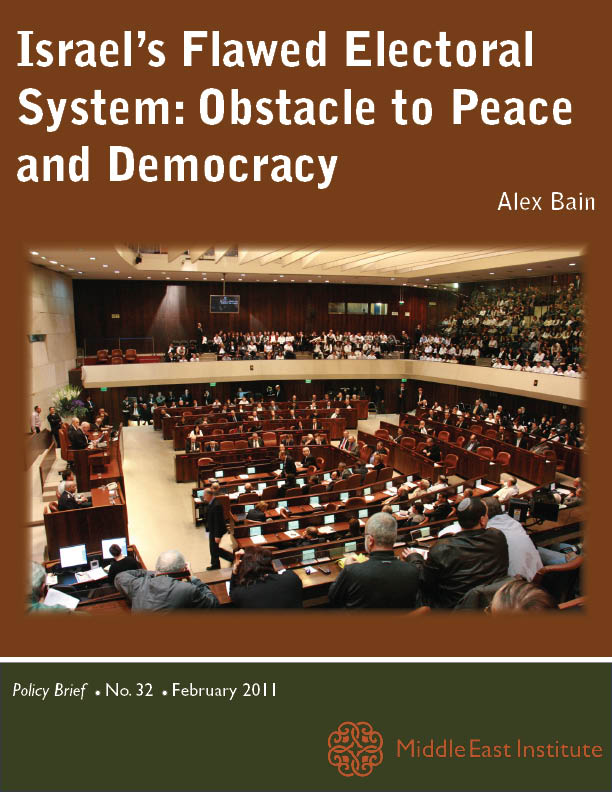
Israel's Flawed Electoral System: Obstacle to Peace and Democracy
Israeli politics is notable for its wide array of parties and unstable coalition governments. The main institutional cause of this chronic instability is the system of nationwide proportional representation, which gives disproportionate influence to minor parties. This instability limits the ability of Israeli governments to pursue coherent long-term strategies and leads to policies that address the concerns of minority groups at the expense of the national interest.
Afghanistan: Looking Ahead to the Next Fighting Season
The Middle East Institute presents a lecture and discussion with Andrew Exum, Fellow at the Center for A New American Security, assessing the possibility of a new Taliban insurgency in Afghanistan and its ramifications for U.S. strategy there. The past six months have seen some remarkable successes in southern Afghanistan. But if hard-won security gains collapse in the face of a renewed Taliban offensive in 2011, the NATO strategy to secure Afghanistan will be in grave danger.
America's War on Terror After Iraq and Afghanistan
The Middle East Institute hosts a lecture and discussion with Mark N. Katz, examining the impact of the current and future US withdrawals from Iraq and Afghanistan on Islamic radicals. Katz argues that the US withdrawals from both countries will lead radicals to conclude they have defeated the US in the "War on Terror" and that US regional strength is on the decline. This, he argues, will spur Islamic radicals to seek further gains elsewhere.
Few question the desirability of finding a political resolution to the Afghan conflict or doubt Pakistan’s pivotal role. The growing divide of opinion in this country is over how best to achieve that outcome. One camp led by our military strategists insists that various political agreements are likely to result from accumulated military successes, sustained by Afghan governance reforms and economic improvements. Visible counterinsurgency gains are expected to gradually wean fighters away from the ranks of the insurgency.
External and Internal Partnerships in Israeli Education
Educational reform in Israel has repeatedly shifted from expecting individual excellence to expecting access for all. Excellence and access reflects the early history of the country when Jewish funders from France, England, and Germany established educational systems for Jewish children. The Zionist organizations that structured much of the curriculum and the external funding streams insured the Jewish schools were far better funded than the British-supported schools during the Mandate.
The Struggle for a Democratic Future in Afghanistan: The 2010 Parliamentary Elections
The Middle East Institute is proud to host Marvin Weinbaum, scholar at the Middle East Institute, and Caroline Wadhams, Director for South Asia Security Studies at the Center for American Progress, for a discussion on the outcomes and impact of the recent parliamentary elections in Afghanistan. Recently returned from Afghanistan, where
The Middle East Institute is proud to host Mr. Habibullah Khan, current head of the Federally Administered Tribal Areas (FATA) Secretariat, to discuss the security, policy, and cultural challenges surrounding the integration of FATA into Pakistan's mainstream political system. In his talk, Mr. Khan will highlight the primary characteristics of life in the tribal areas and outline the present governance system.
This Commentary first appeared as an op-ed in McClatchy News, July 6, 2010.
The misuse and abuse of language is yet another obstacle to obtaining peace in the Middle East. In recent weeks the media, government officials and commentators have so garbled the use of the words “blockade” and “embargo” to describe events in Gaza that understanding what is occurring, the legal implications, and developing a reasonable policy are almost impossible.
The last five years of the Israeli-Palestinian conflict could be summed up in one word: Gaza.
Israel’s lethal raid on the flotilla attempting to deliver aid to Gaza is part of a recurring theme that goes like this: Gaza wallows in dysfunction. Tensions steadily build. A confrontation erupts. Every major crisis between the Israelis and the Palestinians in recent years has revolved around Gaza—the overcrowded, impoverished strip of sand squeezed between Israel and the Mediterranean.