Bashar al-Assad and his top regime cronies appear to be operating under a deeply flawed assumption: the relatively broad-based opposition it now faces is similar to the narrower Muslim Brotherhood challenge it defeated back in 1982 by killing more than 10,000 Syrians in Hama. Much the same way it did 30 years ago, the regime keeps pounding away at the resistance. But unlike the Hama massacre, a few severe blows will not put an end to this latest uprising. Instead, Assad’s brutish tactics will only escalate the bloodshed and resistance.
This Opinion was first published on CNN.com on February 6, 2012
The double veto cast by Russia and China at the United Nations Security Council on Saturday represents a clarifying moment in the Syrian uprisings.
At the 2012 Munich Security Conference, U.S. Secretary of State Hillary Clinton noted, "We don't know what the endgame will be until we start the game." Well, fasten your seatbelt — the game over Syria has started.
Mark N. Katz, examines the impact of the current and future US withdrawals from Iraq and Afghanistan on Islamic radicals. Katz argues that the US withdrawals from both countries will lead radicals to conclude they have defeated the US in the "War on Terror" and that US regional strength is on the decline. This, he argues, will spur Islamic radicals to seek further gains elsewhere. But regardless of the boost to their cause that the withdrawals from Iraq and Afghanistan may provide, they will likely meet three key obstacles in their pursuit of increased power and influence.
Afghanistan: Looking Ahead to the Next Fighting Season
Andrew Exum, Fellow at the Center for A New American Security, assesses the possibility of a new Taliban insurgency in Afghanistan and its ramifications for U.S. strategy there. The past six months have seen some remarkable successes in southern Afghanistan. But if hard-won security gains collapse in the face of a renewed Taliban offensive in 2011, the NATO strategy to secure Afghanistan will be in grave danger. Andrew Exum will discuss the situation in southern Afghanistan as well as how the American public can know whether the strategy is succeeding or failing this summer.
Syria on the Verge: Implications for a Nation in Revolt
International response has been growing to the violent crackdowns in Syria, yet the government remains mostly unresponsive. Radwan Ziadeh, Ausama Monajed, Amb. Theodore Kattouf, and Andrew Tabler discuss the domestic and regional implications of the ongoing political unrest and violence in Syria.
One of the most enduring epithets for Hamas, right up there with “terrorist,” is “proxy.” If you Google “Hamas Iran proxy,” you get 1,750,000 hits. The idea that the relationship between Sunni Hamas, the Gaza affiliate of the Muslim Brotherhood, and Shia Iran was merely a marriage of convenience and not a true love match is rejected by those who forget that most enduring maxim of Middle East politics: “The enemy of my enemy is my friend.” And implicit in that maxim are two more words: “for now.”
The Arab League observer mission to Syria—sent under an agreement with the Syrian government to withdraw forces from the cities, release all political prisoners and allow monitors and journalists free movement throughout the country—has utterly failed and should not be extended.
MEI scholar Randa Slim led a discussion about Hezbollah and its reaction to shifting regional dynamics in the wake of the Arab Spring. Although Lebanon has not experienced the same levels of unrest as its neighbors, Hezbollah is not immune from the regional instability resulting from the revolutions roiling the Middle East. Hezbollah is currently the principal orchestrator of a new governing coalition that is rife with internal divisions.
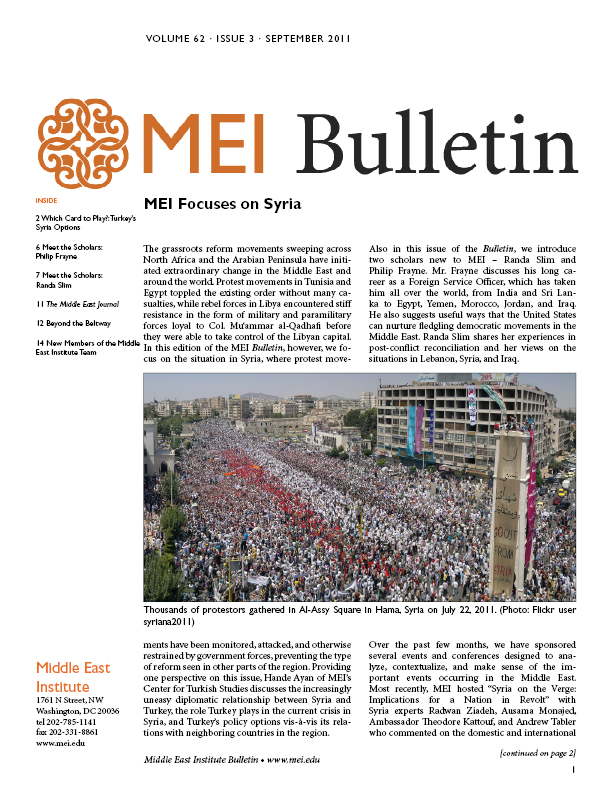
Amidst ongoing violence against protestors in Syria, Hande Ayan of the Center for Turkish Studies discusses the uneasy diplomatic relationship between Turkey and Syria and Turkey’s role in the political situation there. The September 2011 Bulletin also introduces MEI scholars Philip Frayne, who speaks on his Foreign Service career and offers his insights on how the US can support democratic transitions in the Middle East, and Randa Slim, who is interviewed on her experience in post-conflict reconciliation.
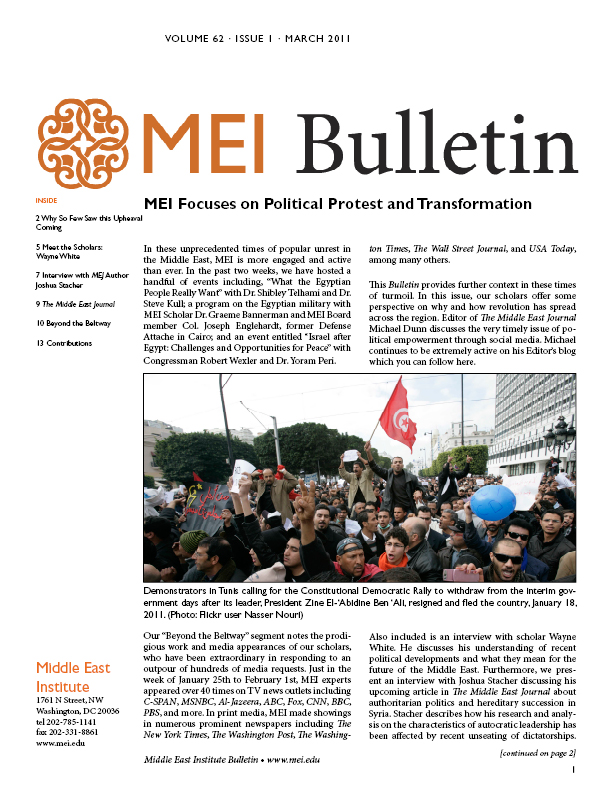
Amidst the historic turmoil sweeping across the Arab world, in the March 2011 Bulletin, MEJ editor Michael Dunn addresses political empowerment through social media, scholar Wayne White is interviewed on recent political developments, and Joshua Stacher previews his forthcoming article on authoritarian politics and hereditary succession in Syria.
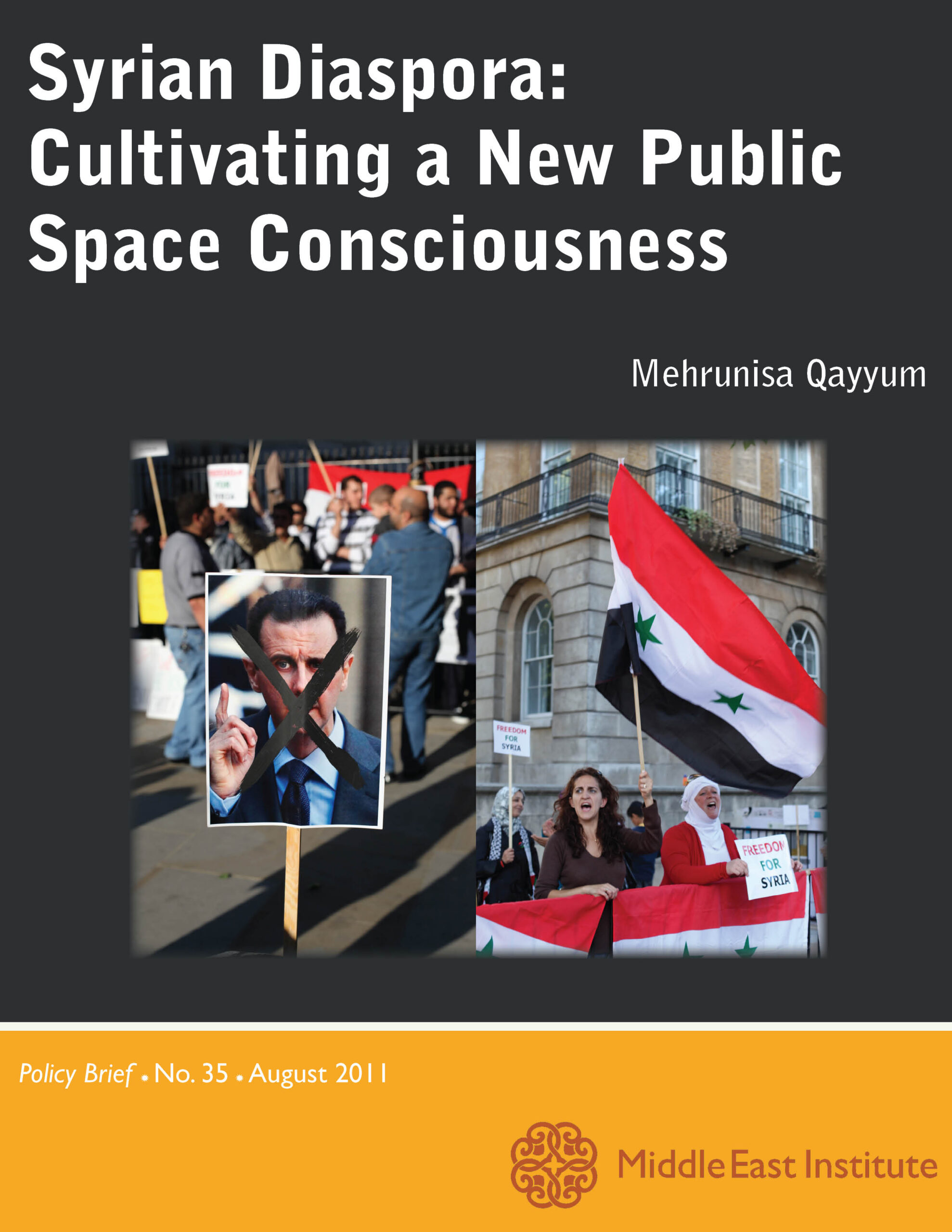
Syrian Diaspora: Cultivating a New Public Space Consciousness
The Syrian government under both Hafiz and Bashar al-Asad has long pursued a strategy of intimidation and violence against political dissidents, while imposing legal and security structures that inhibit the growth of civil society. The resulting profound vacuum of civil society has made organizing for political change, both inside and outside of Syria, extremely difficult. Furthermore, this overall strategy of intimidation has led to “brain drain” as large numbers of highly educated Syrians flee to other countries.