Palestinian Peace Strategy in a Changing Middle East: Prospects for Fatah-Hamas Reconciliation, and US-Palestinian Relations
The Middle East Institute and the Foundation for Middle East Peace are proud to host Ziad Abu Zayyad a veteran journalist and the co-founder and editor of the Palestine/Israel Journal. In his talk, Mr.Abu Zayyad will address whether a rapprochement between Fatah and Hamas is possible, and will also discuss the main challenges facing the US-Palestinian bilateral relationship.
This Burning Land: Lessons from the Front Lines of the Transformed Israeli-Palestinian Conflict
The Middle East Institute is proud to host Greg Myre and Jennifer Griffin for a discussion about the ongoing challenges in the Israeli-Palestinian conflict based on their knowledge and experiences recounted in their new book, This Burning Land: Lessons from the Front Lines of the Transformed Israeli-Palestinian Conflict. Myre and Griffin, journalists who are husband and wife, traveled to Jerusalem in 1999 in hopes of finally seeing Middle East peace. Instead, the pair watched as violence in the area escalated and the peace process disintegrated.
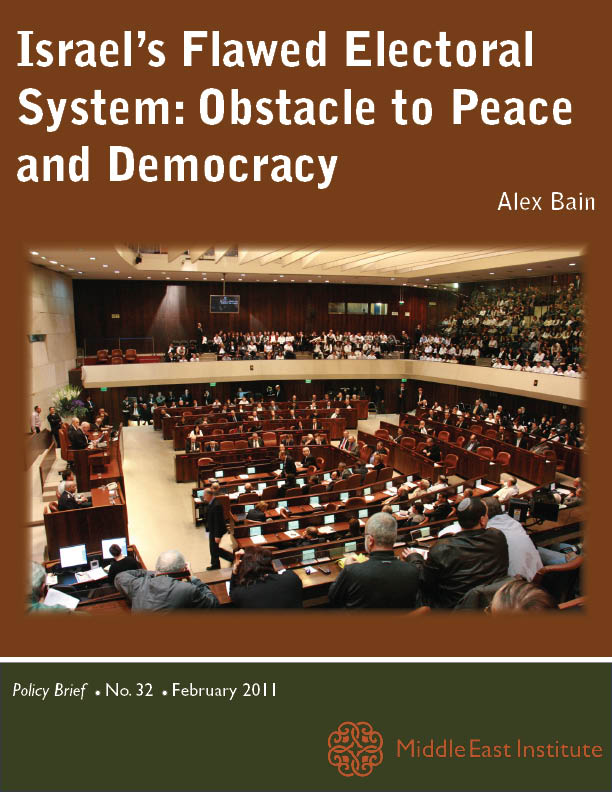
Israel's Flawed Electoral System: Obstacle to Peace and Democracy
Israeli politics is notable for its wide array of parties and unstable coalition governments. The main institutional cause of this chronic instability is the system of nationwide proportional representation, which gives disproportionate influence to minor parties. This instability limits the ability of Israeli governments to pursue coherent long-term strategies and leads to policies that address the concerns of minority groups at the expense of the national interest.
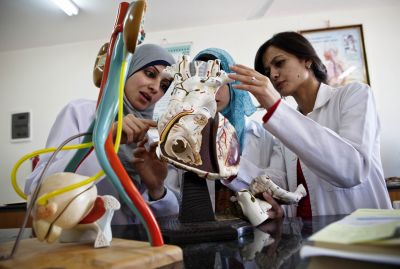
Struggling for the Center: Teacher-Centered vs. Learner-Centered Practices in Palestinian Higher Education
Alongside the struggle for an independent Palestine, not to mention the internal power struggles between the rival Fatah and Hamas movements, another struggle — largely absent from local news headlines and talk on the streets — is unfolding in classrooms in Palestinian higher education. Faculty are pushing back against the hegemony of teacher-centered instruction and embracing, in principle if not in practice, the global movement toward learner-centered pedagogy.
This Commentary first appeared as an op-ed in McClatchy News, July 6, 2010.
The misuse and abuse of language is yet another obstacle to obtaining peace in the Middle East. In recent weeks the media, government officials and commentators have so garbled the use of the words “blockade” and “embargo” to describe events in Gaza that understanding what is occurring, the legal implications, and developing a reasonable policy are almost impossible.
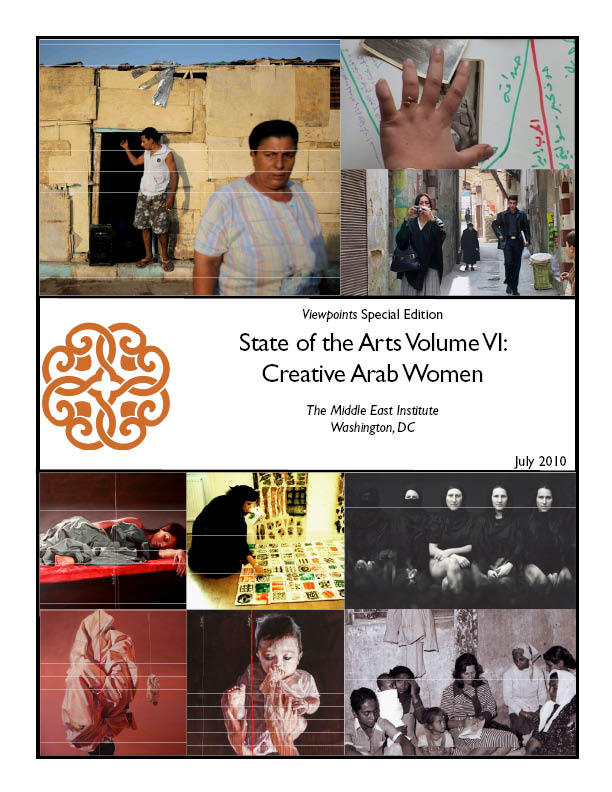
Introduction to The State of the Arts in the Middle East: Volume VI: Creative Arab Women
Creative Arab Women is the sixth edition of the MEI Viewpoints series on the State of the Arts in the Middle East. The 14 essays in this collection offer a glimpse into the rich and varied cultural output of Arab women in the region and the diaspora. Partly reminiscences and partly calls to action, they are essays of survival and empowerment that add a deeply personal dimension to the subject of the role of Arab women as cultural producers. MEI is grateful to Dr.
The last five years of the Israeli-Palestinian conflict could be summed up in one word: Gaza.
Israel’s lethal raid on the flotilla attempting to deliver aid to Gaza is part of a recurring theme that goes like this: Gaza wallows in dysfunction. Tensions steadily build. A confrontation erupts. Every major crisis between the Israelis and the Palestinians in recent years has revolved around Gaza—the overcrowded, impoverished strip of sand squeezed between Israel and the Mediterranean.
The Middle East Institute, the Foundation for Middle East Peace, Churches for Middle East Peace, and Americans for Peace Now invite you to a presentation and discussion featuring Rabbi Arik Ascherman, Executive Director, Rabbis for Human Rights-Israel. RHR-Israel works to prevent human rights violations in Israel and the Occupied Territories, and to bring human rights grievances to the attention of the Israeli public through education and advocacy.
United States Will Pay a Heavy Price for the Gaza Flotilla Incident
Asserting its need to be secure from future terrorism launched from Gaza, Israel used force last week to maintain a blockade that has been creating a humanitarian cataclysm for the people of Gaza. In the early days following the attack on the aid flotilla, the Israeli military interpretation of events dominated much of the popular media coverage in the United States. Gradually, though, attention shifted to the incident’s negative impact on Israel’s international standing and the security implications of continued international and regional uproar.
The Middle East Institute is proud to host Dr. Hanan Mikhail Ashrawi, Member of the PLO Executive Committee and the Palestinian Legislative Council, or a discussion about Palestinian-Israeli proximity talks and other issues related to the peace process and the situation in the West Bank and Gaza.
In Search of a Voice: Arab Soccer Players in the Israeli Media
Soccer is the most popular sport in Israel. As such, it is also a strategic research site in which to study Israeli society and its complex social and ethnic relations.
Walls and Goals: The Israeli-Palestinian Encounter in Football
Dedicated to the memory of Israel Tzvi Raab Z”L, a true lover of the game
The long, complex encounter between the Israeli and Palestinian people has been examined in many cinematic and literary creations. In this essay, I will explore several that use football as a lens to read opposing political agendas and as a means to resolve conflict.
A Step on the Path to Peace: How Basketball is Uniting Arab and Jewish Youth in Jerusalem
Basketball is a game where all five players need to share the ball. If it is played with great teamwork, the sum of the parts is greater than the individual. It’s a great forum for building trust. A lot of the game happens with things you can’t see. Communication and trust with teammates is the key. It seems to me that the same can be said of peacemaking.
–R.C. Buford, General Manager of the NBA’s San Antonio Spurs[1]
The Israel-Palestine Conflict: Views of a Palestinian-Israeli member of the Israeli Knesset
Dr. Ahmad Tibi is a member of the Arab Movement for Change and was first elected to the Israeli Knesset in 1999. He currently serves as Deputy Speaker of the Knesset and head of the parliamentary committee of inquiry, which seeks to accommodate Palestinians through integration into jobs in the public sector. He has played a key role in the politics of the Palestinian-Israeli community, which constitutes approximately one fifth of Israel's population. He has also played a key role in relations between Palestinian-Israelis and Palestinians in the occupied territories and Dr.