This text has been translated by AI and may contain errors.
Skip to Content

Research & Commentary Results

Filter by
1389 Results
Can Palestinian citizens of Israel teach other Arabs a lesson in democracy?
  • Analysis
  • Can Palestinian citizens of Israel teach other Arabs a lesson in democracy?

    While attention in the third Israeli general elections in a year has focused on the performance of the caretaker prime minister Binyamin Netanyahu, a powerful light must be shed as well on the successful performance of Israel’s Palestinian citizens, who again increased their representation in Israel’s parliament.

    March 6, 2020

    Lebanon crisis: How the US can bypass Hezbollah and help the people
    Supporters shout slogans during a rally for Qassem Soleimani in southern suburbs of Beirut, Lebanon, on Jan. 5, 2020. Hezbollah leader Sayyed Hassan Nasrallah urged on Sunday its fighters to attack U.S. soldiers in the region in retaliation for the assassination of Iranian top commander Qassem Soleimani by the United States. (Photo by Bilal Jawich/Xinhua via Getty) (Xinhua/ via Getty Images)
  • Analysis
  • Lebanon crisis: How the US can bypass Hezbollah and help the people

    As Lebanon nears a breaking point due to its acute financial crisis, the Trump administration faces a policy dilemma: should it financially support a corrupt ruling faction that is allied with Hezbollah – Iran’s friend and Washington’s nemesis – or should it hold off on aid and watch the country fall apart?

    March 3, 2020

    And now what? A realistic approach to the Israeli-Palestinian impasse
    Thousands of protesters gather at Al-Manara Square to protest against U.S. President Donald Trump's Middle East plan, in Ramallah, West Bank on February 11, 2020.
  • Analysis
  • And now what? A realistic approach to the Israeli-Palestinian impasse

    The announcement of Donald Trump’s “deal of the century” was a rude shock, roundly condemned by almost everyone concerned with peace and justice between Israelis and Palestinians. But it also presents an urgent challenge for all those who reject it because they realize the dire implications of what it portends for the future of any peaceful negotiated solution. If a genuine two-state solution is truly dead, and an equitable one-state solution is even harder to achieve, then where does that leave us? What is, or should be, the agenda for the foreseeable future for those concerned with the Israeli-Palestinian issue.

    March 2, 2020

    Battered Survivor: Hezbollah at Home and Abroad
    Supporters shout slogans during a rally for Qassem Soleimani in southern suburbs of Beirut, Lebanon, on Jan. 5, 2020. Hezbollah leader Sayyed Hassan Nasrallah urged on Sunday its fighters to attack U.S. soldiers in the region in retaliation for the assassination of Iranian top commander Qassem Soleimani by the United States. (Photo by Bilal Jawich/Xinhua via Getty) (Xinhua/ via Getty Images)
  • Analysis
  • Battered Survivor: Hezbollah at Home and Abroad

    The past decade and a half have been a real whirlwind for Hezbollah, but the group seems to have weathered all of these storms, at least for now. However, it’s one thing for Hezbollah to survive and another altogether for it to thrive. In a special roundtable report from MEI, renowned Hezbollah analysts offer their perspectives on a series of key questions about the major upcoming challenges facing the group. This report includes contributions from Bilal Y. Saab, Nicholas Blanford, Nizar Hamzeh, Matthew Levitt, Magnus Ranstorp, Bruce Riedel, Randa Slim, and Michael Young.

    February 28, 2020

    Why there’s little media coverage of the Lebanon and Iraq protests
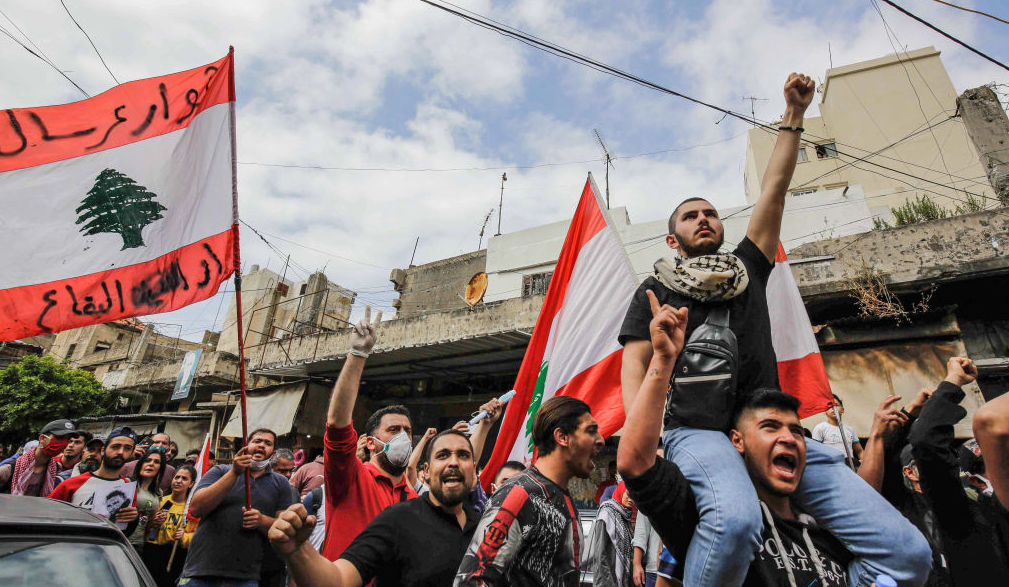
    Lebanese protesters wave national flags during demonstrations to demand better living conditions and the ouster of a cast of politicians who have monopolised power and influence for decades, on October 21, 2019 in downtown Beirut. -
  • Analysis
  • Why there’s little media coverage of the Lebanon and Iraq protests

    Lebanese and Iraqi protesters have faced an uphill battle drawing global media attention since Arab Spring-like uprisings erupted in both countries last October. Coverage of the protests has been dwarfed by other major international news stories running concurrently with the uprisings, such as Brexit and the Hong Kong protests. The main implication of low coverage has been a lack of sustained international pressure on Lebanese or Iraqi political leaders to accommodate protester demands for wholesale systematic changes.

    February 24, 2020

    Understanding EU-MENA relations: Current and changing dynamics
    Jordanian King Abdullah II gestures as he delivers a speech at the European Parliament, on January 15, 2020, in Strasbourg, eastern France.
  • Analysis
  • Understanding EU-MENA relations: Current and changing dynamics

    This year could mark a turning point in the European Union’s relations with the countries of the MENA region. If the EU is to realize the objectives laid out in its 2016 global foreign and security policy strategy and become a major world power, it has to be more proactive and creative, especially in the Middle East.

    February 19, 2020

    Turkey’s eastern Mediterranean quagmire
    A picture taken at the port of Dilovasi, outside Istanbul, on June 20, 2019 shows the drilling ship 'Yavuz' scheduled to search for oil and gas off Cyprus, next to a warship.
  • Analysis
  • Turkey’s eastern Mediterranean quagmire

    The eastern Mediterranean has become an increasingly important focus for Turkey’s foreign and security policy, but the interlocking of new issues like energy politics and sovereignty rights with old problems like Cyprus has created significant challenges for Ankara.

    February 18, 2020

    Iran targeted Israel’s April 2019 elections. Was it preparing for the US 2020 elections?
     Benny Gantz a former head of the IDF and head of Israel resilience party speaks to supporters in a campaign event on January 29, 2019 in Tel Aviv, Israel.
  • Analysis
  • Iran targeted Israel’s April 2019 elections. Was it preparing for the US 2020 elections?

    The April 2019 Israeli elections between incumbent Prime Minister Benjamin Netanyahu and his competitor Benny Gantz were fraught with tension even before external entities got involved. But when Israel’s internal security service, Shin Bet, revealed that suspected Iranian cyber actors had accessed Gantz’s mobile phone, there was yet another issue to contend with, albeit one not specific only to Israeli elections: interference.

    February 13, 2020

    How did China Win Over the Israeli People?
    Middle East Institute
  • Analysis
  • How did China Win Over the Israeli People?

    According to the latest poll published by the Pew Research Center, the Israeli public sees China in a favorable way. Only in Russia and Nigeria does China get a more sympathetic audience. This result seems surprising, when compared to China’s low level of favorability in other Western countries. However, the strong favorability rating registered in the Pew survey is less surprising than it seems, and in fact is a clear indication that the wide-ranging Chinese soft power efforts to appeal to the Israeli public opinion have paid off.

    February 11, 2020

    Lebanon’s inconvenient truths: A brief rejoinder
    Anti-government protesters demonstrate ahead of the expected naming of a new cabinet tomorrow by Prime Minister Designate Hassan Diab, on January 16, 2020 in Beirut, Lebanon.
  • Commentary
  • Lebanon’s inconvenient truths: A brief rejoinder

    In response to numerous comments from readers about his article “Lebanon’s inconvenient truths,” author Bilal Saab has published a brief rejoinder.

    February 3, 2020

    Why Jordan was so quick to reject Trump’s peace plan
    Thousands of Jordanians protested on Friday against President Trump's Middle East Peace Plan on January 31, 2020 in Amman, Jordan.
  • Analysis
  • Why Jordan was so quick to reject Trump’s peace plan

    Jordan’s response to President Donald Trump’s so-called “deal of the century” has been quick and unequivocal. Less than an hour after the release of the peace plan at a White House ceremony on Jan. 28, Jordanian Foreign Minister Ayman Safadi issued a statement in which he reiterated Amman’s support for the two-state solution and the Arab Peace Initiative (API) as the only path to a just and lasting settlement to the Israeli-Palestinian conflict, without referring directly to the Trump proposal.

    February 3, 2020

    Arab states unanimously reject Trump plan
    Palestinian president Mahmud Abbas (3rd-L) and Palestine Liberation Organisation (PLO) Secretary-General Saeb Erekat (2nd-L) look on as Arab League Secretary-General Ahmed Aboul Gheit (L) reads a statement during an Arab League emergency meeting discussing the US-brokered proposal for a settlement of the Middle East conflict, at the league headquarters in the Egyptian capital Cairo on February 1, 2020.
  • Commentary
  • Arab states unanimously reject Trump plan

    The communiqué, while largely symbolic, was nonetheless a major victory for Abbas’ beleaguered leadership.

    February 3, 2020

    FBI probes NSO Group
    An Israeli woman uses her iPhone in front of the building housing the Israeli NSO group, on August 28, 2016, in Herzliya, near Tel Aviv.
  • Commentary
  • FBI probes NSO Group

    Reuters reported on Jan. 30 that the FBI has been investigating Israeli spyware firm NSO Group since 2017. The revelation comes after Sen. Chris Murphy and UN Special Rapporteur Agnes Callamard called on the U.S. to investigate the apparent hacking of Amazon CEO Jeff Bezos’s phone by Saudi Crown Prince Mohammed bin Salman. In its statement, the UN identified NSO Group as a likely source of the malware.

    January 31, 2020

    Trump's "Peace Plan"
    Middle East Institute
  • Podcast
  • Trump's "Peace Plan"

    Khaled Elgindy and Michael Koplow join host Alistair Taylor to discuss the long-awaited “deal of the century” Middle East peace plan. President Trump rolled the plan out at the White House on Tuesday with Israeli Prime Minister Benjamin Netanyahu in attendance, while the Palestinians, who have refused to deal with the administration since it recognized Jerusalem as Israel’s capital at the end of 2017, were not there – and not invited. How has it been received so far, and where might things go from here?

    January 31, 2020