This text has been translated by AI and may contain errors.
Skip to Content

Research & Commentary Results

Filter by
1389 Results
Lebanon’s inconvenient truths
BEIRUT, LEBANON - JANUARY 16: An anti-government protester bangs a pan as they demonstrate ahead of the expected naming of a new cabinet tomorrow by Prime Minister Designate Hassan Diab, on January 16, 2020 in Beirut, Lebanon.
  • Analysis
  • Lebanon’s inconvenient truths

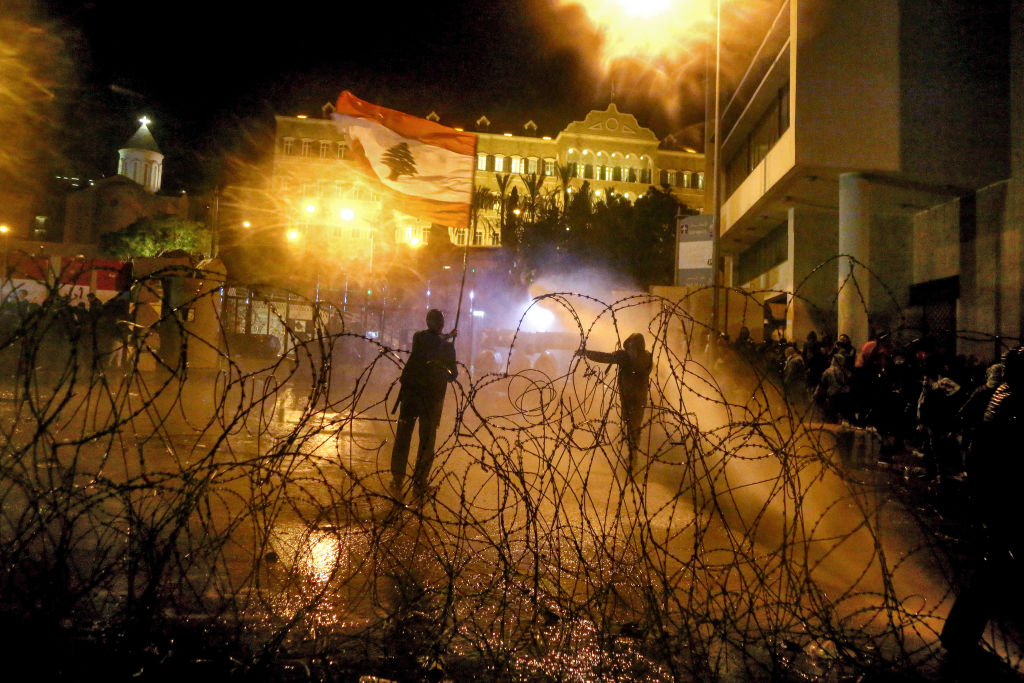
    By any objective standard, the Lebanese protest movement has failed. This is not necessarily an indictment against it. Rather, it’s a reality one cannot and should not ignore. The responsible thing to do now is to try to understand why it has fallen flat, despite more than 100 days of demonstrations in various regions of the country including the capital, Beirut. 

    First, a word of solace. In the annals of history, the Lebanese are in good company as most uprisings and revolutions failed to attain their goals. And even when they did, success either didn’t last long or was completely reversed due to counterrevolutions and other spoilers, both foreign and domestic.

    January 29, 2020

    The day after Soleimani: Israel contemplates “success leveraging”
     A file photo dated September 18, 2016 shows Iranian Revolutionary Guards' Quds Force commander Qasem Soleimani during Iranian Supreme Leader Ayatollah Ali Khamenei's meeting with Revolutionary Guards, in Tehran, Iran.
  • Analysis
  • The day after Soleimani: Israel contemplates “success leveraging”

    Iranian Gen. Qassem Soleimani was on Israel’s “most wanted” list for more than a decade. Israeli intelligence identified him as a looming threat early in his career, and with time he outperformed even the graver threat predictions, as he systematically built the Islamic Revolutionary Guard Corps’ (IRGC) Quds Force into a formidable regional stealth operation. Soleimani was a highly sophisticated executioner of Iran’s long-term strategy, which can be described as an effort to build a “double crescent.”

    Trump’s “peace plan” aims to bury the two-state solution
    A picture taken on January 27, 2020 shows Israel's controversial concrete barrier (C) separating the Jewish settlement of Neve Yaakov (foreground) in the northern part of east Jerusalem and the Palestinian area of al-Ram (background) in the occupied West Bank.
  • Commentary
  • Trump’s “peace plan” aims to bury the two-state solution

    The notion that an American president, in consultation with two Israeli leaders, could decide on the future of Palestinians without any Palestinian involvement seems to epitomize Trump’s overall approach to the conflict.

    January 27, 2020

    It’s shameful to use Palestinians as props in Israel’s election
    U.S. President Donald Trump and Prime Minister of Israel Benjamin Netanyahu shake hands while walking through the colonnade prior to an Oval Office meeting at the White House March 25, 2019 in Washington, DC.
  • Analysis
  • It’s shameful to use Palestinians as props in Israel’s election

    The upcoming visit to the White House by Israel’s caretaker prime minister has nothing to do with the Middle East conflict and everything to do with giving yet another political favor to Benyamin Netanyahu. While the Jan. 28 visit may be all about the Israeli elections, it is shameful and dangerous for American officials to be giving time and space for discussions that affect the Palestinian people without their involvement.

    January 27, 2020

    The ties that bind: The South Caucasus and the Middle East
    Turkish Foreign Affairs Minister Mevlut Cavusoglu (C), Minister of Foreign Affairs of Iran, Javad Zarif (R) and Azerbaijani Minister of Foreign Affairs, Elmar Mammadyarov (L) pose for a photo prior the tripartite meeting of foreign ministers of Turkey, Azerbaijan and Iran in Istanbul, Turkey on October 30, 2018.
  • Analysis
  • The ties that bind: The South Caucasus and the Middle East

    As neighboring regions, the South Caucasus and the Middle East are inextricably intertwined — so much so that the former is sometimes even considered part of the Greater Middle East. While geographical proximity is the strongest driver of interconnectivity between the two regions, geopolitics, business ties, and energy interests also link countries from the South Caucasus and the Middle East and form the basis for important bilateral and regional relationships.

    January 24, 2020

    Lebanon's New "Shadow Government"
    Middle East Institute
  • Podcast
  • Lebanon's New "Shadow Government"

    Against the backdrop of a massive economic and financial crisis and a now three-month-old nationwide protest movement, Lebanon swore in a new government on Tuesday — a technocratic cabinet that is widely seen as a “shadow government” for Hezbollah and other entrenched political leaders. MEI’s Paul Salem, Randa Slim, and Bilal Saab join host Alistair Taylor to discuss what lies ahead.

    January 23, 2020

    Can the new Lebanese government survive?
    A handout picture provided by the Lebanese photo agency Dalati and Nohra shows Lebanon's Parliament Speaker Nabih Berri (C-L) and President Michel Aoun (C) and prime minister designate Hassan Diab (C-R) posing for a group photo with the newly formed government at the presidential palace in Baabda, east of the capital Beirut, on January 22, 2020.
  • Analysis
  • Can the new Lebanese government survive?

    No amount of analytical nuance or ingenuity can challenge the conclusion that the newly formed government in Lebanon is Hezbollah’s creation. The only question left to answer is: why did Hezbollah do it?

    January 22, 2020

    The next Israeli election: The triumph of the fringes?
    Ballots seen with the party names during the elections. Israel holds elections for the next Prime Minister.
  • Analysis
  • The next Israeli election: The triumph of the fringes?

    Jan.15, 2020 was the last date to submit electoral “lists” for the Israeli election scheduled for March 2. A flurry of parties on both ends were registered in the days before the Jan. 15 deadline, and some of their leaders may well be part of and influence the Israeli government that will (eventually) be formed.

    January 22, 2020

    Lebanese oligarchs approve technocratic shadow government
    Lebanon's President Michel Aoun (L) meets with prime minister designate Hassan Diab at the presidential palace in Baabda, east of the capital Beirut, on January 21, 2020.
  • Commentary
  • Lebanese oligarchs approve technocratic shadow government

    The new government is politically aligned with the pro-Hezbollah and pro-Syrian axis in Lebanon, and is very unlikely to drum up international and regional support.

    January 21, 2020

    The sky is sliding: Why and how the Lebanese avoided catastrophe and aggravated challenges over time
    A Lebanese protester gestures at riot police guarding a road leading to parliament in central Beirut on January 19, 2020 amid ongoing anti-government demonstrations. (Photo by PATRICK BAZ / AFP) (Photo by PATRICK BAZ/AFP via Getty Images)
  • Analysis
  • The sky is sliding: Why and how the Lebanese avoided catastrophe and aggravated challenges over time

    Lebanon’s in trouble and the Lebanese may soon face the real reckoning that they’ve thus far avoided. Having bought time they’ve increasingly needed with money they’ve increasingly lacked, but somehow conjured, they’re running out of both. Its leaders must act, soon, to avoid a complete catastrophe. And, whether avoiding or coping with collapse, the Lebanese must well and truly consider how to shape a better future.

    January 21, 2020

    The Military-Security Dimension of Israel-Southeast Asia Relations
  • Analysis
  • The Military-Security Dimension of Israel-Southeast Asia Relations

    Over the past two decades, Israel has developed robust bilateral relationships with China, India, and Singapore. Israel has also succeeded in forging ties with Japan and South Korea. More recently, Israel has devoted considerable attention to strengthening its relations with Southeast Asian countries, particularly Vietnam, the Philippines, Thailand and Myanmar. Military-security cooperation in the form of arms trade as well as technology transfer and licensed production has emerged as an important dimension of Israel’s relations with Southeast Asian countries.

    January 7, 2020

    Israel in 2020: Heading for yet another election
    Israel's Prime Minister Benjamin Netanyahu attends the weekly cabinet meeting in Jerusalem on January 5, 2020.
  • Commentary
  • Israel in 2020: Heading for yet another election

    Politically Netanyahu seems to be about as popular as before his long-awaited indictment, which portends another inconclusive election and a political system unable to break the deadlock.

    January 6, 2020

    Stalemate and violence in Israel-Palestine
    Palestinians wave national flags as they march in the streets of the occupied West Bank city of Ramallah, calling for the cessation of divisions between Fatah and Hamas and the unification of the West Bank and Gaza Strip, on January 12, 2019.
  • Commentary
  • Stalemate and violence in Israel-Palestine

    Holding long overdue elections for the Palestinian presidency and the legislative arm of the Palestinian Authority could be a step toward redressing the Fatah-Hamas conflict.

    January 6, 2020