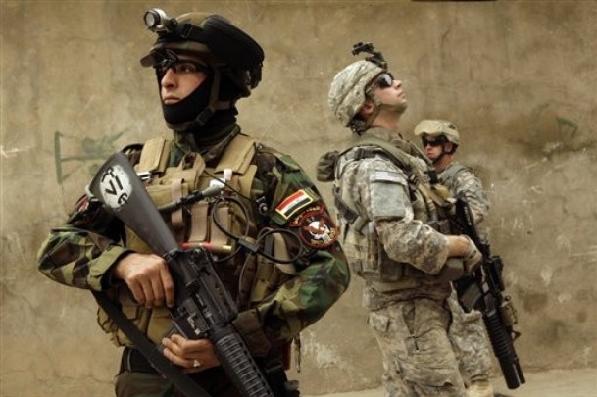
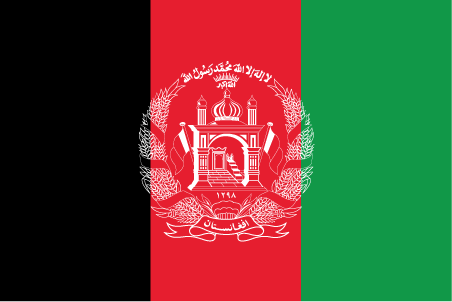
Mark N. Katz, examines the impact of the current and future US withdrawals from Iraq and Afghanistan on Islamic radicals. Katz argues that the US withdrawals from both countries will lead radicals to conclude they have defeated the US in the "War on Terror" and that US regional strength is on the decline. This, he argues, will spur Islamic radicals to seek further gains elsewhere. But regardless of the boost to their cause that the withdrawals from Iraq and Afghanistan may provide, they will likely meet three key obstacles in their pursuit of increased power and influence.
Afghanistan: Looking Ahead to the Next Fighting Season
Andrew Exum, Fellow at the Center for A New American Security, assesses the possibility of a new Taliban insurgency in Afghanistan and its ramifications for U.S. strategy there. The past six months have seen some remarkable successes in southern Afghanistan. But if hard-won security gains collapse in the face of a renewed Taliban offensive in 2011, the NATO strategy to secure Afghanistan will be in grave danger. Andrew Exum will discuss the situation in southern Afghanistan as well as how the American public can know whether the strategy is succeeding or failing this summer.
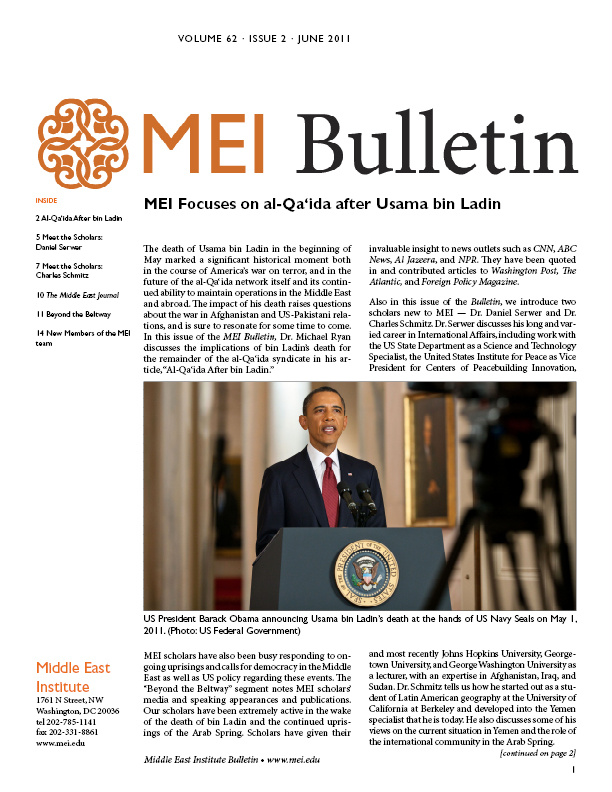
In the June 2011 Bulletin, Dr. Michael Ryan discusses the implications of bin Ladin’s death for the remainder of the al-Qa’ida network. It also introduces new MEI scholars Dr. Daniel Serwer, who is interviewed on his career in technology and peacebuilding, and Dr. Charles Schmitz, who speaks about his work on Yemen.
Inside the United Nations Assistance Mission in Afghanistan
The Middle East Institute is proud to host Staffan De Mistura, the Special Representative of the UN Secretary-General for Afghanistan, for a lecture and discussion on the UN's mission in Afghanistan. De Mistura will speak at MEI following the UN Security Council debate on the mandate renewal of the United Nations Assistance Mission in Afghanistan (UNAMA). The Security Council resolution with the new mandate is scheduled to be adopted on March 22, 2011, the day of this event.
Protracted Mass Displacement in Afghanistan and Iraq
The Middle East Institute, in partnership with the Fondation Pour le Recherche Strategique, is proud to host Dr. Susanne Schmeidl and Dr. Geraldine Chatelard for a discussion of situations of protracted mass displacement in Afghanistan and Iraq. Funded by the European Commission, the project aims to generate policy recommendations that will strengthen transatlantic cooperation to respond to the refugee crises in the above-mentioned countries. The event will feature the findings of the two project team leaders, based on more than two dozen field-research papers.
Afghanistan: Looking Ahead to the Next Fighting Season
The Middle East Institute presents a lecture and discussion with Andrew Exum, Fellow at the Center for A New American Security, assessing the possibility of a new Taliban insurgency in Afghanistan and its ramifications for U.S. strategy there. The past six months have seen some remarkable successes in southern Afghanistan. But if hard-won security gains collapse in the face of a renewed Taliban offensive in 2011, the NATO strategy to secure Afghanistan will be in grave danger.
America's War on Terror After Iraq and Afghanistan
The Middle East Institute hosts a lecture and discussion with Mark N. Katz, examining the impact of the current and future US withdrawals from Iraq and Afghanistan on Islamic radicals. Katz argues that the US withdrawals from both countries will lead radicals to conclude they have defeated the US in the "War on Terror" and that US regional strength is on the decline. This, he argues, will spur Islamic radicals to seek further gains elsewhere.
Few question the desirability of finding a political resolution to the Afghan conflict or doubt Pakistan’s pivotal role. The growing divide of opinion in this country is over how best to achieve that outcome. One camp led by our military strategists insists that various political agreements are likely to result from accumulated military successes, sustained by Afghan governance reforms and economic improvements. Visible counterinsurgency gains are expected to gradually wean fighters away from the ranks of the insurgency.