Turkey's Dual Track Approach Toward the Kurdistan Regional Government
Turkey’s policy toward the Kurdistan Regional Government (KRG) in northern Iraq has undergone an important shift since 2009. Only a few years ago, Turkey did not recognize Iraq’s Kurdish Regional Government and refused to meet with its representatives in any official capacity due to its fear that recognition would embolden Turkey's own Kurdish minority to demand similar home-rule status.
The Struggle for a Democratic Future in Afghanistan: The 2010 Parliamentary Elections
The Middle East Institute is proud to host Marvin Weinbaum, scholar at the Middle East Institute, and Caroline Wadhams, Director for South Asia Security Studies at the Center for American Progress, for a discussion on the outcomes and impact of the recent parliamentary elections in Afghanistan. Recently returned from Afghanistan, where
The Middle East Institute is proud to host Mr. Habibullah Khan, current head of the Federally Administered Tribal Areas (FATA) Secretariat, to discuss the security, policy, and cultural challenges surrounding the integration of FATA into Pakistan's mainstream political system. In his talk, Mr. Khan will highlight the primary characteristics of life in the tribal areas and outline the present governance system.
Turkey’s professional military has been a force for modernization and progress throughout the nation’s history. As the constitutionally-appointed guardian of the Turkish Republic, however, the military has often intervened in political affairs, resulting in a constant, underlying tension between the government and the military establishment in Turkey.
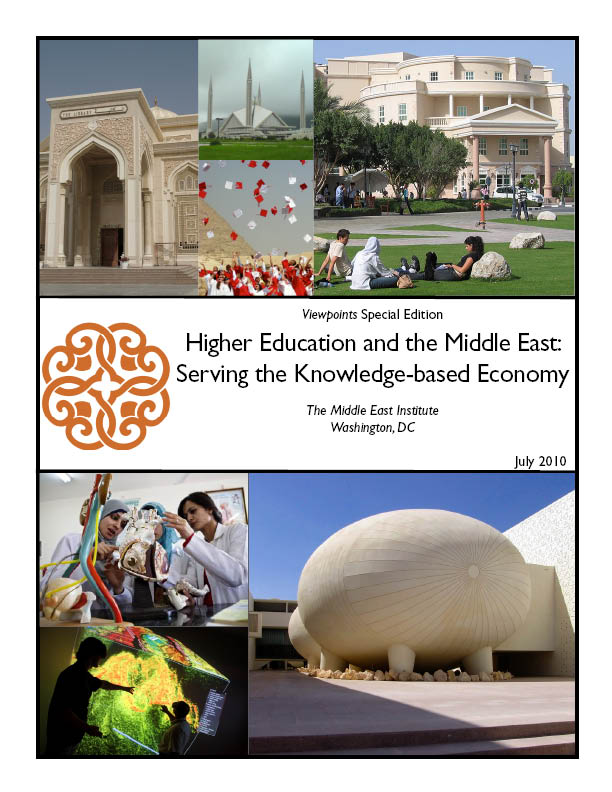
Higher Education and the Middle East: Serving the Knowledge-based Economy
This is the first of three volumes examining the internationalization of higher education and the Middle East. The 12 essays included in this volume explore some of the changes that are taking place and the challenges that lie ahead as Middle Eastern countries seek to build sustainable higher education systems and strengthen their economies. Within the dynamic global higher education landscape, is the Middle East a stagnant backwater or a center of creative initiative? What are, and should be the roles of foreign partners and providers?
United States Will Pay a Heavy Price for the Gaza Flotilla Incident
Asserting its need to be secure from future terrorism launched from Gaza, Israel used force last week to maintain a blockade that has been creating a humanitarian cataclysm for the people of Gaza. In the early days following the attack on the aid flotilla, the Israeli military interpretation of events dominated much of the popular media coverage in the United States. Gradually, though, attention shifted to the incident’s negative impact on Israel’s international standing and the security implications of continued international and regional uproar.
The Middle East Institute is proud to host Salman Taseer, the Governor of Pakistan's Punjab province. He will examine Pakistan's accomplishments over the past year and its looming challenges.
Children can learn many lessons from playing sports: leadership, self-confidence, and the concept of working toward a common goal are a few such lessons. These are all skills that, when applied in life off the field, can augment the potential for success there as well.
Turkey and the Middle East: Ambitions and Constraints
Hugh Pope, Turkey/Cyprus Project Director for the International Crisis Group (ICG), discussed the issue of recent speculation regarding Turkey’s “shift away from the West.”
The Middle East Institute is proud to host Kandahar-based writers and researchers Alex Strick van Linschoten and Felix Kuehn for a discussion about the state of the Taliban in Afghanistan and the current situation in Kandahar. Strick van Linschoten and Kuehn translated and edited My Life with the Taliban, an account of the inner workings of the organization from the perspective of former Taliban minister and ambassador to Pakistan, Mullah Abdul Salam Zaeef, who was arrested following the overthrow of the Taliban and spent four years in Guantanamo Bay.
Turkey and Israel: What Lies Behind the Recent Volte Face
In recent months, the Israeli-Turkish relationship, strong and stable during the 1990s, has been placed under severe pressure. Tensions began in January 2009 when Israel launched military operations in Gaza, later prompting Turkish Prime Minister Recep Tayyip Erdogan to walk out of a televised debate with Israeli President Shimon Peres following a heated exchange over the issue.