After decades of political setbacks, Iran’s former Revolutionary Guards commander has returned to the center of power. Is he an incidental beneficiary of war, or have observers underestimated him all along?
The Human Story Behind Gaza: Jaser AbuMousa on the Costs of Survival for Palestinians
Brian sits down with MEI Senior Fellow Jaser AbuMousa to assess the situation on the ground in Gaza three years after October 7 and a year into the ceasefire. Drawing on his own personal experience, Jaser explores the toll that the war and continued destruction have taken on Gaza’s residents, the implications of the recent Israeli and US elections, and the difficult path forward.
The Unavoidable Neighbor: Managing Iran Beyond the War
Gulf states and their partners are increasingly looking beyond their most immediate interests of containing the war with Iran. While recent talks between Saudi Arabia, Turkey, Pakistan, and Iran have kept de-escalation on the agenda, a broader regional security framework and non-aggression pact has also emerged, envisioning a longer-lasting solution to regional conflicts. The talks have yet to produce a settlement, but they reflect a growing recognition that Gulf security cannot depend entirely on Washington. Iran will still be there, and its neighbors will have to find ways of living with it.
Since 1967, Israeli settlements in the West Bank have been a contested feature of the Israeli-Palestinian conflict. The ultimate disposition of the settlements and ongoing activity related to their growth have repeatedly defied agreement in negotiations over a resolution to the conflict.
The Houthis are a political-military faction and Zaydi religious movement founded in northwestern Yemen in the 1980s. A key member of Iran’s Axis of Resistance with links to other militant organizations in the Arabian Peninsula and the Horn of Africa, the group has continued to pose a threat to Western interests on a global scale.
The India-Middle East-Europe Economic Corridor (IMEC) is a proposed multinational infrastructure initiative aimed at upgrading connectivity between the three regions through integrated trade, energy, and digital networks. Announced at the G20 summit in New Delhi in September 2023, IMEC is envisioned partially as a counterweight to China’s international infrastructure project, the Belt and Road Initiative.
After a decade of post-Arab Spring isolation, Turkey’s leaders have recognized that their ambition to position the country as an agenda-setter on the world stage requires active engagement in all directions. President Recep Tayyip Erdoğan’s consolidation of executive authority has centralized foreign policy decision-making and tied it to his domestic political priorities, transforming the country’s revisionist approach to one shaped primarily by personal and pragmatic interests.
Two big misconceptions have been circulated about the Egyptian revolution in January 2011: first in the international media, research, and policy circles, and second inside Egypt itself through the Egyptian media. In the international sphere, the misconception was that the Egyptian revolution was a “cute” Facebook, social media, social network, or internet revolution (in which scrappy youths banded together over the internet to create change). Inside Egypt, the second misconception is that it was a pre-planned, organized, orchestrated, well-led revolution.
The Middle East Institute is proud to host Ilan Peleg and Dov Waxman, authors of the book Israel's Palestinians:The Conflict Within (Cambridge, 2011), for a discussion about their findings. One in five citizens of Israel are Palestinian. Often overlooked by outside observers, the challenges facing the Palestinian minority in Israel are an inseparable part of the Israeli-Palestinian conflict. Resolving this conflict – a central concern of U.S. foreign policy and current international diplomacy – requires more than the establishment of a Palestinian state.
The Middle East Institute is proud to host Ilan Peleg and Dov Waxman, authors of the book Israel's Palestinians:The Conflict Within (Cambridge, 2011), for a discussion about their findings. One in five citizens of Israel are Palestinian. Often overlooked by outside observers, the challenges facing the Palestinian minority in Israel are an inseparable part of the Israeli-Palestinian conflict. Resolving this conflict – a central concern of U.S. foreign policy and current international diplomacy – requires more than the establishment of a Palestinian state.
*This Commentary first appeared on neimanwatchdog.org on July 8, 2011
While political debate still roils over the legality of the American role in Libya, other questions have grown more pressing. Those questions include whether the European side of the NATO operation can be sustained and whether the Libyan opposition truly has the ability to achieve their goal of taking down the regime of Muammar Qaddhafi & Co.
These issues are critical for those favoring US participation in NATO operations as well as those opposed.
My Father Died for Pakistan, An Examination of Religious Extremism in Pakistan
The Middle East Institute is proud to host Shehrbano Taseer, daughter of Governor Salmaan Taseer, who was murdered this past January for speaking out against the misuse of Pakistan's blasphemy laws. The assassinations of Punjab Province Governor Salmaan Taseer and Federal Minister for Minorities Affairs Shahbaz Bhatti have raised concerns about the rise of religious extremism in Pakistan. Shehrbano Taseer will discuss her father's work and legacy and offer her thoughts on the state of religious minorities and the spread of extremism in Pakistan.
After the Arab Spring: Toward Political & Economic Inclusion in the Arab World
The Middle East Institute and the UNDP are proud to host a discussion with UNDP Administrator Helen Clark, Under Secretary for Economic, Energy and Agricultural Affairs Robert D. Hormats, and Middle East Institute Scholar Amb. Edward Walker about how best to address political, economic and human development needs in the Arab world today.
Palestinian Authority-Hamas Unity Agreement: An overdue step towards peace or another stone in the road?
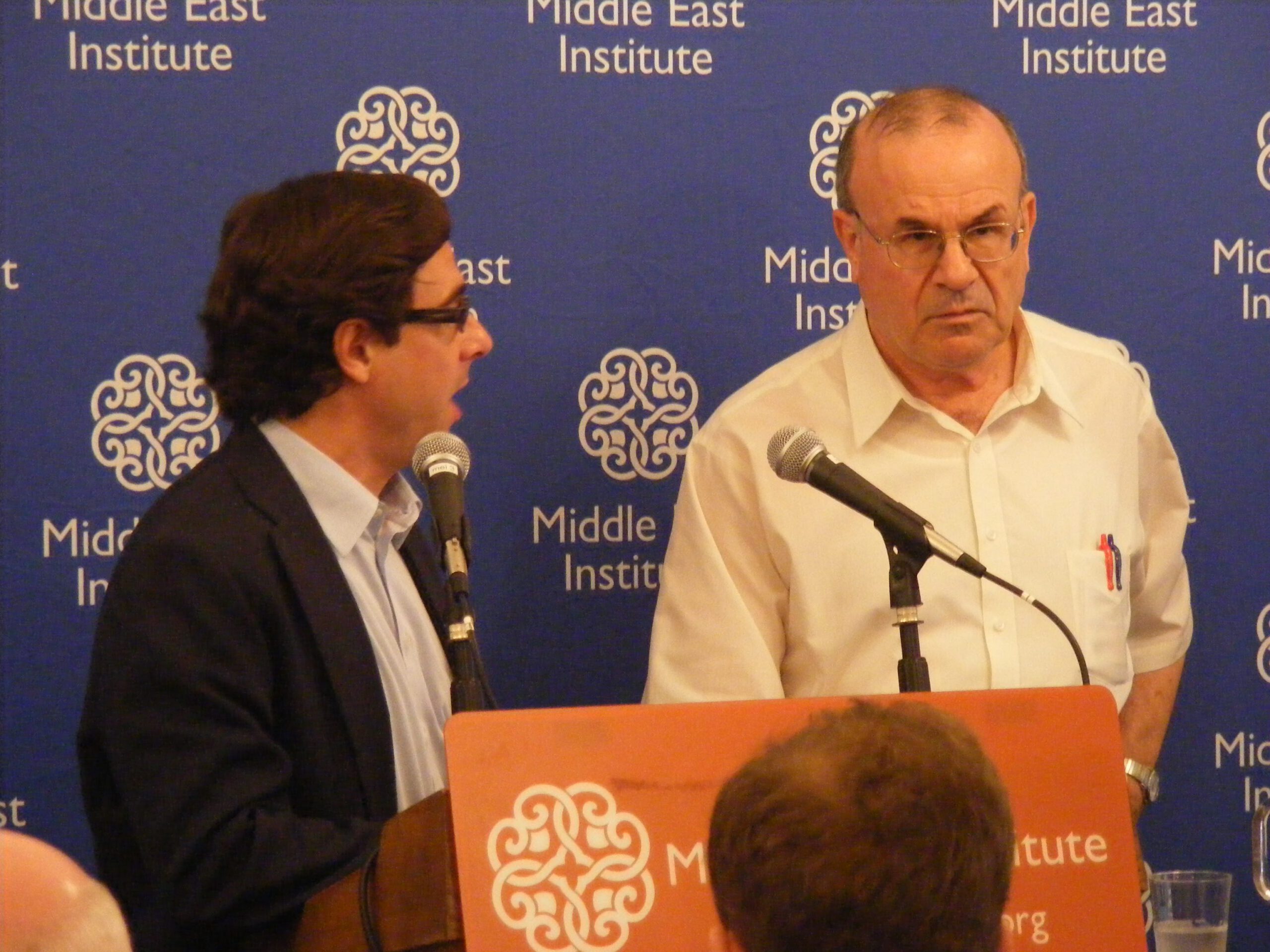
Dr. Matti Steinberg, Israel's premier expert on Islamist politics and Hamas, has spent his career as a public intellectual and analyst of Israel's relations with the modern Arab and Islamic world. He has taught at the Hebrew University and the Herzliya Interdisciplinary Center. Dr. Steinberg has just completed a semester teaching a seminar to graduate students on Islamic Fundamentalism as a Gruss-Lipper lecturer and scholar at the Woodrow Wilson School at Princeton University.
*Co-written by James P. Farwell. This article originally appeared in the National Interest online on June 9, 2011
Informed observers are increasingly raising the fear that new elections will put the Muslim Brotherhood in control of Egypt’s parliament and the presidency. Of course it will try. Senior Brotherhood leader Sobhi Saleh, who helped write Egypt’s interim constitution, said in a recent video that he expects the new government to be Islamist.
Critical attention is increasingly directed toward Pakistan's Inter-Service Intelligence (ISI) for its alleged involvement in a series of recent high profile terrorist attacks inside Pakistan as well as earlier in India and Afghanistan. The panelists will examine the scope of the ISI's activities and its composition. They will discuss its place within the military establishment and whether it ever operates as a rogue organization. Panelists will also consider to what extent the ISI's relationship with US intelligence is cooperative or competitive.
تُعد المجلة الرئيسية لمعهد الشرق الأوسط أقدم مطبوعة محكّمة مكرّسة لدراسة الشرق الأوسط الحديث، وتغطي المجلة الرئيسية في المعهد السياسة والمجتمع والثقافة في المنطقة.