Since 1967, West Bank settlements have been a contested feature of the Israeli-Palestinian conflict. The term refers to Israeli residential communities established in the territory on the west bank of the Jordan River, which was militarily occupied by Israel in the June 1967 Six-Day War. Successive Israeli governments have furthered settlement expansion in the West Bank. The formal position of the Palestinian Liberation Organization — the internationally recognized representative body of the Palestinian people — and much of the international community is that these settlements are illegal under international law, prevent the establishment of a mostly contiguous Palestinian state, and are an obstacle to peace. Accordingly, the ultimate disposition of the settlements and ongoing activity related to their growth have remained contentious core issues repeatedly defying agreement in Israeli-Palestinian negotiations.
What Are Settlements?
In the Israel-Palestine context, the term “settlements” refers to Jewish Israeli communities that Israel has established beyond the 1949 armistice lines, or so-called “Green Line,” in territory that it militarily occupied in the course of the 1967 Six-Day War. Israeli law and international law differ in their characterization of all such communities as settlements. Israel has formally annexed the Golan Heights and East Jerusalem, taken from Syria and Jordan, respectively, in 1967, and treats the civilian communities in those areas as legally distinct from those in the West Bank. However, much of the international community does not recognize Israeli sovereignty there. This backgrounder focuses primarily on West Bank settlements that comprise communities in areas to which Israel has not applied sovereignty under its own law.
Israeli motivations for establishing and maintaining settlements in the occupied territories vary. The Israeli government has asserted national security requirements and historical claims. Some settlers have moved to the West Bank to stake an affirmative ideological claim to the territory as Israeli land, while others have built homesteads and communities there for economic reasons, because financial benefits extended to them by Israeli governments have long made the housing there more affordable than in Israel’s crowded cities.
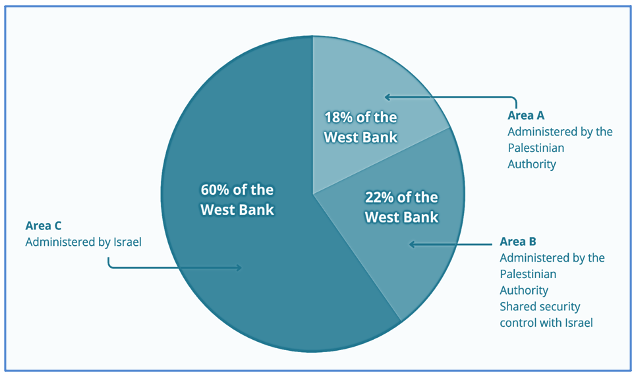
Areas A, B, and C of the West Bank, as defined in the Oslo Accords. Source: ANERA.
Israel formally annexed East Jerusalem in 1980, and considers all of Jerusalem to be its capital. One year after the annexation of East Jerusalem, the Israeli government unilaterally annexed the Golan Heights. Most countries do not recognize Israeli sovereignty in either territory, considering them occupied under international law. However, the United States, under President Donald Trump’s first administration, recognized Israel’s sovereignty over Jerusalem in 2017, and over the Golan Heights in 2019.
While no formal settlements existed in the Gaza Strip after 2005, when Israel unilaterally disengaged from the territory and dismantled the 21 settlements it had established there, many international organizations hold that Israel’s continued control over the area via the use of technology, the withholding and diversion of tax revenues, and its regulation of Gaza’s airspace, fishing zones, and entry of goods and people constitutes occupation. Moreover, some hardline Israeli ministers have recently pushed for the resettlement of Gaza.
Status Under Israeli Law
Israel’s approach to the legality of settlements and their underlying justification is complex. Broadly speaking, successive Israeli governments have argued that most settlements comply with international law, either because they adhere to relevant legal conventions or because those conventions do not apply. Israel has asserted that for a settlement to be recognized under Israeli law, it must be constructed on state land, obtain building permits from the government, and be established through a government resolution. Further, any settlements that do not meet those criteria are called “outposts,” which are considered illegal under Israeli law.
A damning 2005 report (the “Sasson Report”) commissioned by Israeli Prime Minister Ariel Sharon, under pressure from the George W. Bush administration, found that outposts were often built without official approval but with backing from state and public bodies. Nevertheless, a subsequent committee appointed by Prime Minister Benjamin Netanyahu’s second government produced a 2012 report (the “Levy Report”) that argued all of Israel’s building activity in the West Bank is legal.
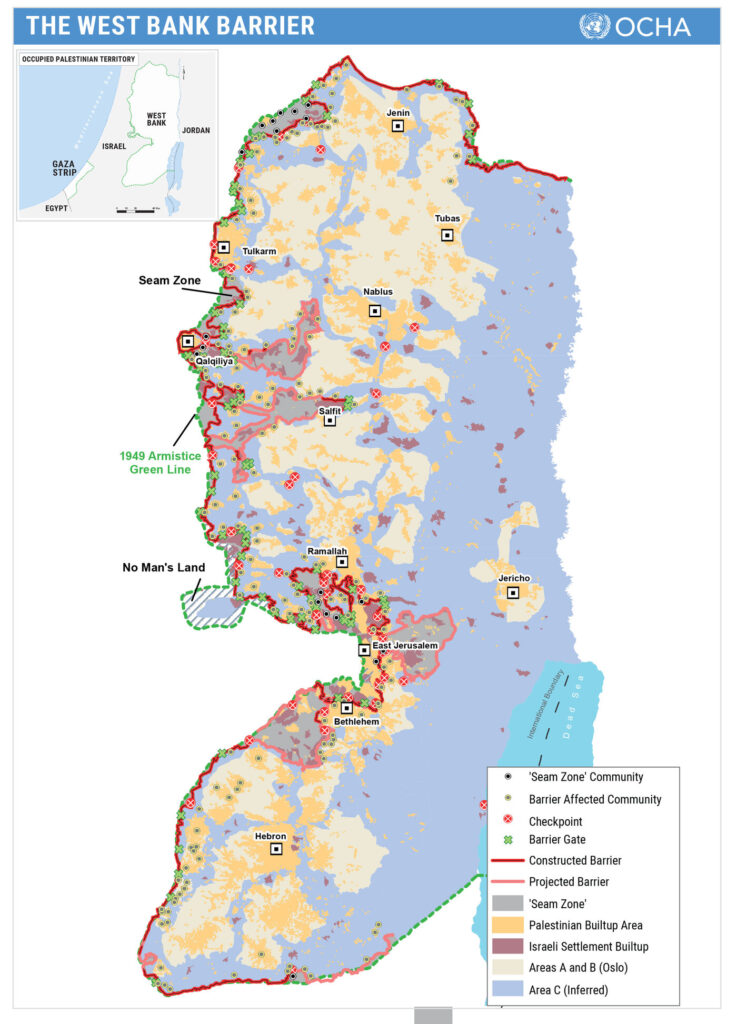
The West Bank barrier. Source: UN OCHA
Realities on the Ground
Increasing Settlement Expansion
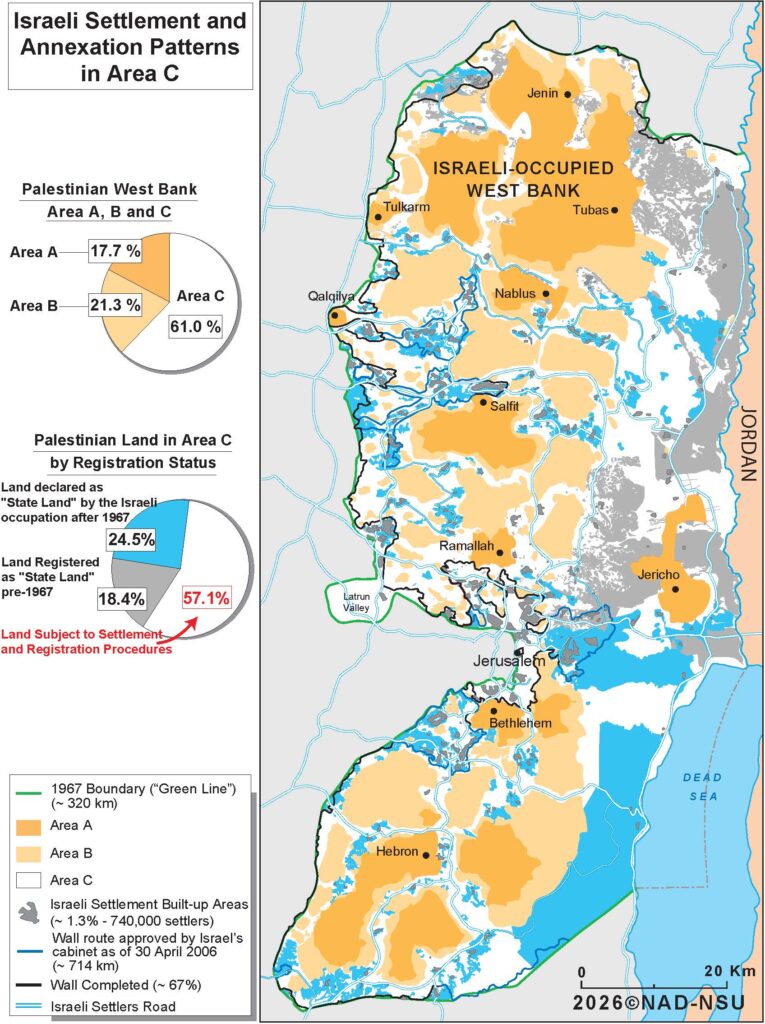
The 1990 Oslo Accords divided the West Bank into Areas A, B, and C, whereby administrative and security control are split to varying degrees between Israel and the Palestinian Authority and the movement of Palestinians within and between those areas is restricted by checkpoints and segregated roads. Since 2022 and 2023, settlements have expanded at a record speed in Area C (those West Bank territories fully administered by Israel), with the number of plans and tenders advanced by the Israeli government increasing from year to year. Beyond settlement planning, which enables future settlement construction, settlement expansion involves constructing additional housing units in existing settlements, establishing new outposts, and building more key bypass roads (that skirt Palestinian population centers) to lay the groundwork for further growth.
The establishment and expansion of settlements has often been accompanied by the demolition of Palestinian homes, confiscation of Palestinian land, and eviction of Palestinian residents, particularly in Israeli-controlled Area C. In early 2026, the Israeli government moved forward with plans to establish a system for registering large areas of West Bank land as state property. The process will require landowners to provide proof of ownership in ways that are almost impossible for most Palestinians. Under this new process, if Palestinians fail to present the requisite documentation, the land will be automatically registered as state owned. By denying existing Palestinian communities in Area C the opportunity to develop and for those in B and C to expand, while simultaneously encouraging the expansion of Israeli settlements in the same areas, Israel’s planning policy is interfering with the eventual establishment of a contiguous and sovereign Palestinian state.
Settler Violence
Alongside the growing expansion of West Bank settlements is the intensifying problem of violence perpetrated by settler extremists. This phenomenon has tracked with the growth of right-wing sentiment in Israel. Far-right Jewish violence in Israel, first documented in the early 1980s, has often come from individuals living in illegal farms and outposts across the West Bank. Attacks by Palestinian extremists on Israeli settlers and settlements have also long been part of the landscape, and they have been invoked by some of the Jewish perpetrators of violence and vandalism, as well as by the Israeli government, to justify their actions. In recent years, Palestinian attacks in the West Bank have been on the decline as Jewish settler attacks are rising. Between February 2020 and May 2026, the United Nations Office for the Coordination of Humanitarian Affairs (OCHA) recorded 1,553 Palestinian fatalities and 50,388 Palestinian injuries in the West Bank. For roughly the same period, between 2020 and 2025, OCHA recorded 42 settler fatalities, and between 2020 and 2026, it recorded 516 settler injuries.
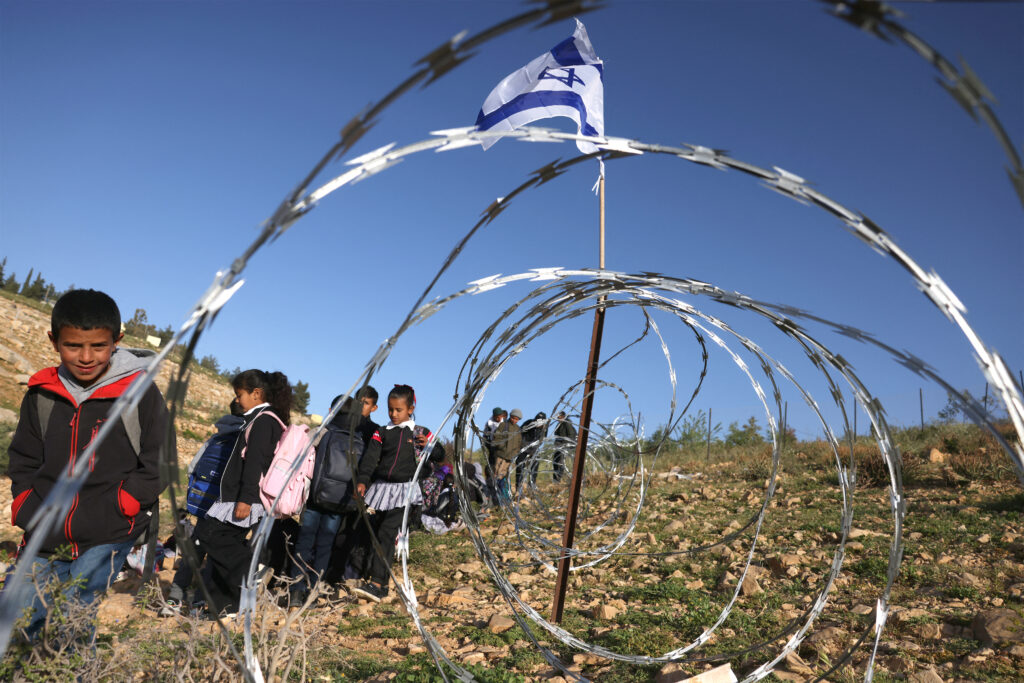
Palestinians and observers have noted incidents where Israel Defense Forces (IDF) soldiers enabled settler violence. According to a January 2024 UN report, in almost half of the recorded incidents after October 7, 2023, Israeli military or security forces either accompanied or supported the attackers. Senior Israel Security Agency (Shin Bet) officials have also recently accused the Israel Police of avoiding the allocation of forces for operations against extremist Jewish violence in the West Bank. The reported incidents include, but are not limited to, physical violence, torching fields and livestock, theft and vandalization of property, destruction of water pipes, and intimidation. The perpetrators’ stated motivations for this violence range from forcing Palestinians from their homes to clear the land for settlements to revenge for Palestinian violence against Jews. The situation has escalated so dramatically that a former Israeli prime minister, Ehud Olmert, has declared settler violence part of an “effort … to ethnically cleanse territories in the West Bank.” According to statistics from the IDF and the Israel Security Agency, these attacks rose by 27% between 2024 and 2025. The number of severe incidents classified as terrorism rose by over 50%. This increase in settler violence has become a key driver of forced displacement, particularly in Bedouin and herding communities.
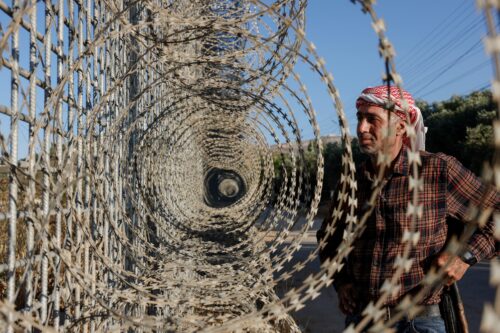
Palestinian children passing razor wire erected by Israeli settlers blocking their path to school in the West Bank, on April 14, 2026. Source: Hazem Bader/AFP via Getty Images.
Movement and Resource Restrictions
Settlement growth has also led to movement restrictions and unequal resource access for Palestinians, who suffer the negative impacts of infrastructure changes built to accommodate and secure settler communities.
One of the most recognizable barriers to the freedom of movement is the “security fence” or “separation barrier,” the construction of which was approved by the Israeli cabinet in 2002 as a security measure for Israel in response to the Second Intifada. The measure has significantly contributed to the safety of Israeli citizens: after Israel constructed the barrier, suicide bombings dropped by over 90%, according to the Israeli Ministry of Defense, and the IDF has also emphasized its effectiveness. However, the barrier is more than twice as long as the internationally recognized borders of the West Bank, with its circuitous route cutting well within the West Bank.
Months after the Six-Day War, the United Nations Security Council (UNSC) adopted Resolution 242, calling for Israeli withdrawal from territories occupied in the war in exchange for peace and recognition from the Arab states. This framework, known as the “land for peace” principle, became the backbone for subsequent peace efforts between the parties. Following the adoption of Resolution 242, several efforts were made, including the 1978 Camp David Accords and the Oslo Accords of 1993-95. While the Camp David Accords are typically remembered for their role in leading to a peace treaty between Egypt and Israel, two framework agreements were reached at this Camp David summit: the first relating to the disposition of Palestinian territories based on Resolution 242 and Palestinian political status. Among other reasons, the vagueness of the terms regarding the West Bank and Gaza contributed to this first framework’s failure. The 1995 Oslo II Accord, however, borrowed from elements of it. A decade later, under the terms of a 2004 Knesset-approved disengagement plan, Israeli Prime Minister Ariel Sharon unilaterally withdrew from and dismantled all Gaza settlements and four settlements in the West Bank — although in 2025, the Israeli government effectively repealed that disengagement, paving the way for the reestablishment of those four West Bank settlements.
The disposition of settlements has remained a core issue in subsequent negotiations. Formal and informal diplomatic efforts throughout the 2000s were often marked by a “land swap” approach that envisioned Israel retaining the so-called “blocs” (the major built-up areas closest to Israel’s pre-1967 borders) in exchange for territory within Israel’s pre-1967 borders going to the Palestinians. If conceptual buy-in seemed to exist, disagreements and objection persisted over the proportion and location of the swaps, and ongoing settlement expansion while negotiations were in process.
In 2016, the UNSC adopted Resolution 2334 with 14 votes in favor and the US abstaining. The resolution, inter alia, condemns and calls for a freeze on settlement construction and expansion; moreover, the text expresses “grave concern” that settlement and outpost construction in the West Bank precludes a two-state solution along 1967 borders. While this resolution was consistent with long-articulated American policy, the abstention that allowed for its passage did upend a precedent of the US defending Israel at the UN.
Four years later, in 2020, the United Arab Emirates seized an opportunity to head off Netanyahu’s pledge to immediately annex 30% of the West Bank, in accordance with the framework laid out in President Donald Trump’s Peace to Prosperity plan. In exchange for Israel not pursuing annexation over these areas of the West Bank for four years, and in a break with long-standing Arab solidarity with the Palestinians, the UAE offered a normalization agreement with Israel that became the first phase in the Abraham Accords.
Map of Israeli settlement and annexation patterns in Area C. Source: Negotiations Affairs Department of the Palestinian Authority, 2026.
Settlement Policy
US Policy
Until recently, US executive branch policy on West Bank settlements had remained relatively consistent. Presidential administrations, from Richard Nixon to Barack Obama, maintained that West Bank settlements are an obstacle to peace and illegal under international law. Shifts began with the first Trump administration, including when then-Secretary of State Mike Pompeo declared that the US did not consider Israeli settlements inconsistent with international law. This announcement overturned the Hansell Memorandum, a 1978 legal opinion that established the prior US legal position on settlements. President Joe Biden later restored the US position that settlement expansion is inconsistent with international law. Responding to growing settler violence, Biden also imposed sanctions on extremist Israeli settlers, though they did not lessen settler violence or settlement expansion. Trump rescinded these sanctions during his second administration.
The US Congress has become more involved in settlement-related issues, along increasingly partisan lines. Some lawmakers have introduced bills such as the West Bank Violence Prevention Act, which would authorize sanctions on violent settlers. By contrast, other members of Congress introduced a bill to bar the use of the term “West Bank” in US government documents and replace it with “Judea and Samaria” — the biblical names for the region often used by Israel — which would suggest American support for the Israeli position, albeit without formal recognition of Israel’s control of the land.
Israeli Policy
As settlements have expanded, successive Israeli governments have maintained similar positions on the topic. In recent years, however, Israeli settlement activity has accelerated. This trend became more pronounced following the installation of an extreme right-wing government on November 1, 2022, and especially after the Hamas attack on Israel on October 7, 2023.
In 2025, Israel set aside more than 2.60 billion shekels (roughly $830 million) to fund new settlements. Meanwhile, the IDF aided the construction of new outposts, signaling a departure from previous Israeli military policy. The Israeli cabinet has recently opened a land registration process that could result in Israel gaining control over vast areas of the West Bank for future development. This followed a controversial decision by the security cabinet that expanded Israeli oversight and enforcement activities into Areas A and B in contravention of the principles laid out by the Oslo Accords, which delegates civilian control of those areas to the Palestinians. This trajectory of settlement policy reflects the current Israeli government’s explicitly articulated moves to consolidate power, encourage settlement expansion, and prevent the viability of a Palestinian state.
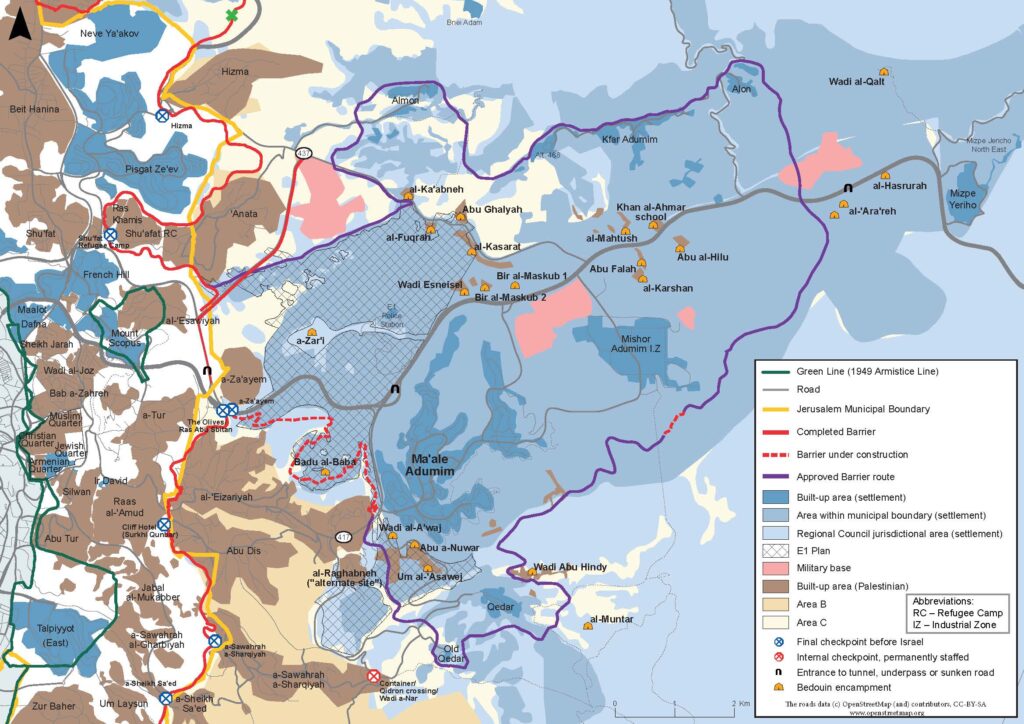
Map of Maale Adumim/E1 expansion plan, October 2013. Source: B’Tselem.
International Policy
International actors have largely agreed that a two-state solution is the preferred outcome to the Israeli-Palestinian conflict, which has translated into opposition to settlement expansion, as recently seen in condemnation of new Israeli policies to extend authority further in the West Bank. External actors most commonly address settlements through independent and joint statements, though approaches vary. For example, as Israel’s largest trading partner, the European Union and its member states have addressed settlements through economic differentiation, which includes measures to exclude settlement-linked entities and activities from bilateral trade relations with Israel. On the other hand, some Arab states have made their participation in Gaza’s reconstruction, or willingness to normalize with Israel, conditional on Israel ceasing future settlement activities. Joint condemnations denouncing Israeli settlement policies have also come from the region.
Looking Forward
West Bank settlement activity continued to develop significantly in 2026. Coupled with sociopolitical dynamics in Israel, developments in the coming months could prove critical for diplomatic possibilities down the road and a deteriorating situation on the ground. Three trends or developments are worth watching in this regard:
Most recently, the Israeli government approved a highly contentious settlement project involving the long-delayed expansion of the existing settlement of Maale Adumim by 3,401 housing units on a hill between Jerusalem and the settlement called E1. Any settlement activity on E1 is opposed by the Palestinians and observers because it would prevent the establishment of a contiguous Palestinian state, isolate East Jerusalem from the West Bank, and jeopardize the viability of a two-state solution.
The 2023 transfer of enforcement powers over land use in the West Bank from the Israeli military to civilian ministerial control is another issue with critical ongoing consequences. Smotrich’s expansive powers over land surveying and registration, land allocation, and legality of construction have already resulted in the strict enforcement of demolition orders for Palestinian construction — for which Palestinians are generally unable to obtain permits. Meanwhile, Israeli outposts, including many that are home to perpetrators of violence against Palestinians, are often spared or retroactively legalized. Further, this shift from military to civilian authority over the West Bank has enabled Israel to step up de facto annexation of the territory, avoiding the stronger international pushback that formal de jure annexation would incur.
The third issue of significance is the approaching Israeli election scheduled for the autumn of 2026. While settlements are not expected to be a main topic of the campaign, they continue to be an ideological issue with post-election implications. If a more centrist coalition were to emerge as the winner after the votes are counted — an outcome that remains uncertain according to recent polling — it could lead to a reversion to some of the pre-existing regulations on settlement policy. Such a reversion would thereby limit the current pace and breadth of settlement acceleration efforts under Smotrich, even if an underlying trend toward settlement growth would likely persist.
The future of West Bank settlements, an issue that has a significant impact on the lives of so many in the Levant, will be shaped both by domestic Israeli politics and international pressure. Ultimately, unchecked settlement expansion will continue to obstruct diplomatic efforts to resolve the conflict and undermine the prospect of a Palestinian state.
This backgrounder was researched and written by MEI spring 2026 intern Taylor Issa with input from MEI Senior Fellow Lucy Kurtzer-Ellenbogen.