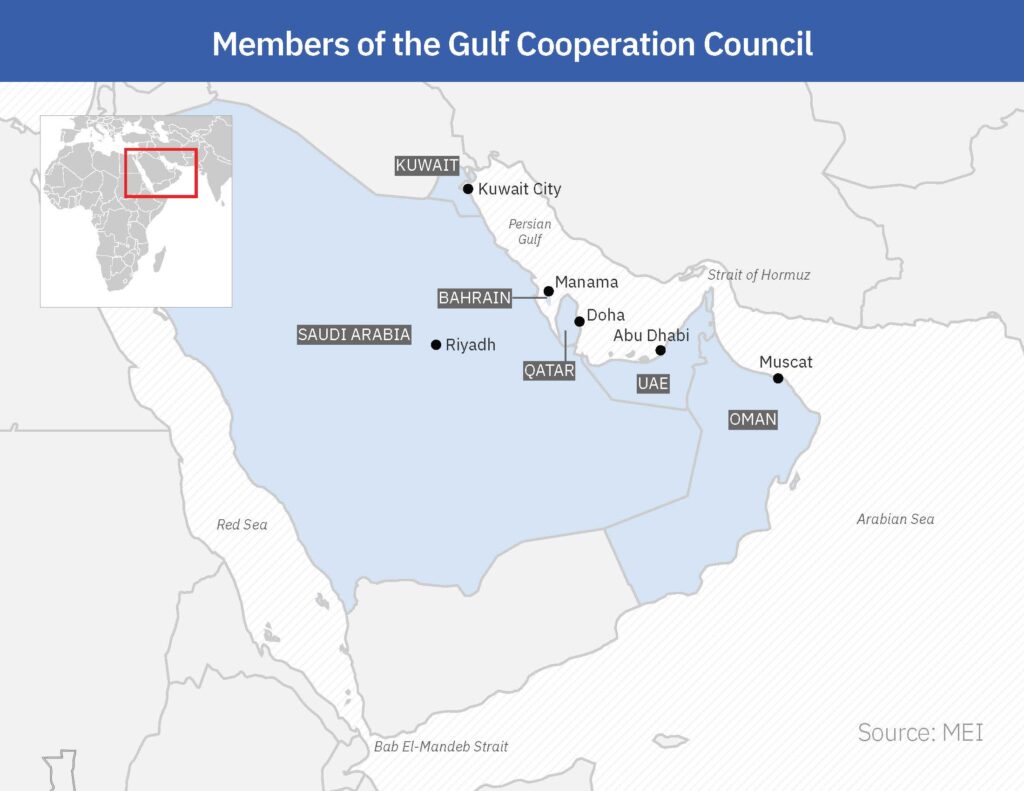
The Gulf Cooperation Council (GCC) is a regional political and economic alliance comprising six states in the Arabian Peninsula: Bahrain, Kuwait, Oman, Qatar, Saudi Arabia, and the United Arab Emirates. Formed at a meeting in Abu Dhabi on May 25, 1981, and based in Riyadh, the bloc’s primary aim is to promote “coordination, integration, and interconnection among the member states in all fields.” It has delivered on parts of that mandate: freedom of movement for GCC citizens, legislative alignment, intelligence sharing, a joint military force (Peninsula Shield Force), and mutual recognition of national IDs and driver’s licenses. But the group’s more ambitious goals remain unmet — a single currency, deeper defense integration, and a common foreign policy have all stalled or fallen short. Whether the regional fallout from the wars sparked by the October 7, 2023, Hamas attack on Israel pushes the GCC toward deeper integration or fragmentation remains to be seen.
Formation
The Gulf Arab monarchies founded the GCC in response to regional and global upheavals in the 1970s and 1980s. Chief among them was the Iranian revolution in 1979 and Iran’s subsequent attempts to export the revolution to the Gulf, instigate sectarian conflict between Sunnis and Shi’as, and overthrow the Gulf monarchies. Worsening tensions between Iraq and Iran, which culminated in a brutal armed conflict in 1980-88, were another contributing factor. Spillover from the Iran-Iraq War put the security of the other states in the Gulf region at risk, compelling them to take a more unified position to mitigate the consequences. Monarchical solidarity in the face of external threat remains a bedrock of the group to this day. This was perhaps most vividly illustrated a decade later, during the Iraqi occupation of Kuwait, when Saudi Arabia hosted the Kuwaiti royal family and government-in-exile.
Internal divisions within the wider Arab world also contributed to the creation of the GCC. These rifts came about after Egypt and Israel signed a peace treaty in 1979, which undermined the position of the Arab League toward normalization with Israel and the way Arab states collectively viewed their national security at the time. The Gulf states, therefore, felt they needed a new, more select consultative forum where they could discuss their interests and consider potential policy options.
Since its founding the GCC has periodically mulled the idea of expanding its membership. It came close to doing so in 2011, when concerns about the destabilizing nature of the Arab Spring for monarchical regimes in the region encouraged the organization to invite Jordan and Morocco to join. The two countries ultimately became strategic partners rather than full members after the consensus on admitting them reportedly fractured months later, while interest from the prospective new members had apparently also waned.
Organizational Structure
The organizational structure of the GCC is a three-tiered hierarchy: the Supreme Council, the Ministerial Council, and the General Secretariat.
Supreme Council
The Supreme Council is the highest authority of the GCC and consists of the heads of each member state, i.e., the reigning monarchs of the Gulf. The presidency of the council rotates between countries on a yearly basis, and regular sessions are held annually, usually in December, with member states able to request extraordinary sessions provided they have the support of another member. The meetings are considered valid if attended by two-thirds of the members. The decisions of the council on what the GCC describes as “substantive matters” require unanimous agreement of participants, with “procedural matters” merely needing a majority of votes; each member state has one vote.
The Supreme Council has two subsidiary bodies that report to it. The Advisory Body, composed of five experts from each member state appointed for three-year terms, studies issues referred to it by the Supreme Council. The Dispute Settlement Commission is formed on a case-by-case basis, rather than being a permanent body, with its composition depending on the nature of the dispute.
Ministerial Council
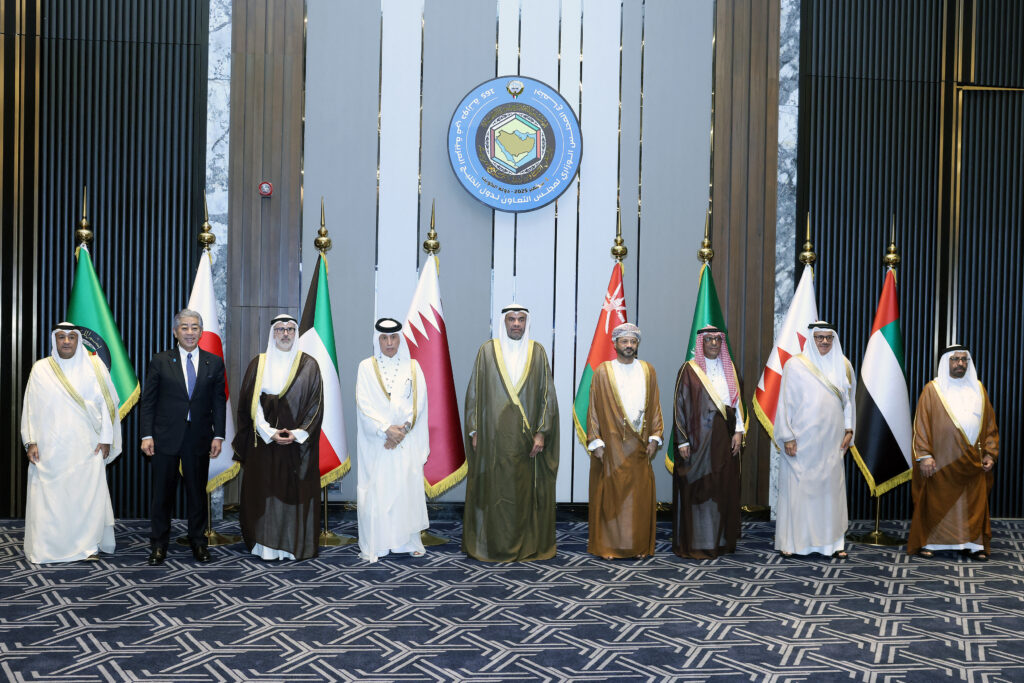
The second subdivision is the Ministerial Council, which consists of the foreign ministers of the member states or their representatives. The state that holds the most recent presidency of the Supreme Council’s regular session serves as its president. This body meets on a quarterly basis, with extraordinary sessions being held at the request of any member state provided it has the support of another member. At least two-thirds of members must be present for a session to be considered valid. Alongside the Ministerial Council, there is a Joint Defense Council comprising the defense ministers of each member state.
The responsibilities of the Ministerial Council include proposing policies, putting forth recommendations to enhance cooperation between member states, and referring decisions that require approval to the Supreme Council. Preparing for Supreme Council meetings, such as by setting the agenda, also falls within the Ministerial Council’s purview. Its voting procedures are the same as those for the Supreme Council.
General Secretariat
The third and final subdivision is the General Secretariat. Its responsibilities include conducting negotiations with external actors on behalf of the GCC; producing studies to improve the cooperation, coordination, and integration of joint Gulf projects and initiatives; issuing periodic reports on the GCC’s activities; monitoring the implementation of decisions; producing studies requested by the Supreme or Ministerial councils; and organizing meetings, which includes preparing agendas and draft resolutions for the Ministerial Council. The Supreme Council appoints a secretary-general for a term of three years, renewable once. Jasem Mohamed al-Budaiwi of Kuwait took on the role in February 2023. His responsibilities include overseeing the General Secretariat and its various departments as well as representing the GCC externally.
Economic Links
Economic coordination has been a central pillar of the GCC since its inception. While the political economies of all six member states are characterized by heavy dependence on rentier extraction of hydrocarbon revenues — about 22% of the world’s oil output and 10.3% of gas output comes from the GCC — they have long recognized the need for deeper integration to enhance collective resilience and further economic diversification. The structural similarities in their economies and intrinsic competition between member states like Saudi Arabia and the UAE to attract foreign direct investment and regional headquarters for multinational corporations can make such cooperation challenging. Nevertheless, as early as 1983, the GCC established a free trade area, eliminating tariffs on most intraregional goods. This evolved with the launch of the customs union in 2003 and the Integrated Customs Tariff, implemented on January 1, 2025.
The proposal for a single GCC currency and central bank progressed during the early 2000s but stalled when Oman withdrew in 2006, citing issues with the timetable and convergence criteria, and the UAE pulled out in 2009 after Riyadh was selected over Abu Dhabi to host the central bank, effectively derailing the project. Saudi Arabia is by far the largest state in the bloc in terms of both size and population, and its weight has long fueled concern — particularly in Qatar and Oman — that Riyadh’s push for deeper integration could come at the expense of smaller members’ autonomy.
Despite these challenges, intra‑GCC trade has expanded significantly since the creation of the common market in 2008, reaching $146 billion in 2024. Member states also agreed on a common 5% value-added tax (VAT) framework in 2016 in response to the 2014 oil‑price crash, though follow-through has been uneven: Only four of the six states have since implemented it, and at rates ranging from 5% to 15%. In a similar vein, Oman will begin implementing an income tax in 2028.
Sustained efforts to harmonize infrastructure have been led by the ambitious GCC Railway initiative, a planned 2,177‑kilometer, $250 billion network, though actual implementation remains slow. In addition, the GCC Interconnection Authority is engaging in multiple projects to further grid integration, while a GCC Unified Water Strategy has been developed to deal with water scarcity.
Overall, economic cooperation within the GCC has produced mixed outcomes — strengthening trade, tax coordination, and policy alignment — while deeper integration goals like a currency union remain unrealized amid political divergence and national sovereignty concerns.
Security Cooperation
In addition to the GCC’s focus on political and economic cooperation, the bloc also has a security component, originally known as the Peninsula Shield Force but subsequently renamed the Unified Military Command at the al-Ula Summit in Saudi Arabia in January 2021. The decision to form the joint military force was taken in 1982 at the GCC’s third session in Manama, Bahrain, at the recommendation of the bloc’s defense ministers. The multinational unit consists of earmarked infantry, armor, artillery, and combat elements that can be called up from member states, with approximately 40,000 personnel available to fill the billets. Member states send formations to Saudi Arabia for rotational deployments and training at the headquarters in King Khalid Military City. Maj. Gen. Abdulaziz bin Ahmed al-Balawi of Saudi Arabia assumed command in July 2025.
As of mid-June 2026, the force had been called up on three occasions. The first was in 1991 during the liberation of Kuwait. The second was in February 2003, when Kuwait received approval from its GCC partners to deploy units from the joint Gulf force on its territory in anticipation of the US invasion of Iraq. The third was in March 2011, when Bahrain requested that the Peninsula Shield Force secure strategic locations in the country following protests by opposition forces during the Arab Spring.
The GCC states have also signed a number of cooperative security agreements. The 1994 GCC Security Agreement prohibits illegal arms trading and promotes use of advanced technologies to disrupt weapons trafficking. The Joint Defense Agreement, signed in 2000, mandates developing a shared arms industry for arms manufacturing. The 2004 GCC Counter-Terrorism Agreement created a permanent committee tasked with researching and monitoring terrorism trends as well as issuing recommendations for how to combat this threat. Finally, in November 2012, Kuwait became the last member state to ratify the bloc’s Internal Security Pact, which calls for the increased coordination of internal security and surveillance policies as well as improved information sharing and joint action plans.
During the 12-day war between Iran and Israel in June 2025, the GCC collectively condemned Israel’s attack on Iran but also held an extraordinary meeting, during which they denounced the Iranian strike launched against Qatar and welcomed the cease-fire announced by President Donald Trump. In the US and Israeli war with Iran that started in February 2026, the GCC issued an official statement condemning Iranian attacks on the Gulf states. The GCC did not take any military action during either of these conflicts above and beyond the efforts by individual member states to defend against Iranian drone and missile strikes.
Successes and Failures
The GCC has had mixed results when it comes to policy coordination and institutional integration. The successes include the bloc’s collective backing of Iraq during the Iran-Iraq War of 1980-88; its strong support for Kuwait during the 1990-91 Iraqi invasion and First Gulf War, when member states took in Kuwaiti refugees and joined the coalition that liberated the country; the establishment of a customs union, launched in 2003 and completed in 2015; and the signing of joint free trade agreements with the European Free Trade Association states (2009) and, most recently, the UK (2026), among others.
The GCC has been less successful in achieving the full potential of an integrated market. A common market became operational on January 1, 2008, which, theoretically, extended equal rights to citizens of GCC states to take up employment and residence, access education and healthcare, establish companies, and buy or sell shares in listed firms in all six member states. However, the impact of the common market has not been as significant as might have been expected due to the segmented nature of individual labor markets and comparatively low cross-border trade flows between the GCC states.
Despite the members’ history of intergovernmental cooperation, a number of important political issues have sharply split the GCC countries over the years — some of which continue to do so to this day.
The most notable was the crisis of 2017, in which Saudi Arabia, the UAE, Bahrain, and Egypt cut diplomatic ties with Qatar. They issued a set of 13 non-negotiable demands requiring that Qatar stop interfering in the internal affairs of other Gulf states and Arab countries; “stop incitement through Qatari media channels” by closing down Al Jazeera and other outlets; halt the naturalization of any more citizens from other Gulf states; stop incitement against Egypt and other countries by supporting opposition groups; stop supporting the Muslim Brotherhood, Hizballah, al-Qaeda, and Fateh al-Sham (formerly the Nusra Front); and deport people hostile to other GCC countries from its territory, particularly members of the Muslim Brotherhood. The four states also paused all land, air, and sea traffic with Qatar, effectively blockading the country. Qatar absorbed the economic shock of the blockade by rerouting trade through Turkey and Iran — including a Turkish and Iranian air and sea lift of food — and by injecting tens of billions in state reserves to steady its banks and currency. The long-term impact proved limited, but the initial disruption was significant. Many Qatar Airways flights were rerouted through Iran due to the closure of much of the region’s airspace. The crisis was resolved on January 5, 2021, when the GCC states, along with Egypt, signed the al-Ula Agreement at the 41st GCC Summit, held in the city of the same name in Saudi Arabia.
Another point of difference within the bloc has been the issue of relations with Israel. While the GCC as an organization does not have any formal ties with Israel, some of the individual states do. This began with the Abraham Accords in 2020, when the UAE and Bahrain, followed by Morocco, established full diplomatic relations with Israel. Other GCC states have had unofficial relations with Israel. Israel opened trade offices in Qatar and Oman in 1996 with the warming of diplomatic relations following the Oslo Accords. However, Oman closed the Muscat office in October 2000 due to the Second Intifada. Qatar closed the Doha office from 2000 until 2005 for the same reasons and then shut it permanently and expelled the staff in response to Operation Cast Lead in 2009. Saudi Arabia was engaged in normalization talks with Israel during the Biden administration, with a key Saudi condition being an irreversible pathway to a Palestinian state, but halted the process after the Hamas attacks of October 7, 2023, and Israel’s subsequent military campaign in Gaza. Kuwait’s position is that it will not have ties with Israel unless a Palestinian state is established.
When it comes to Iran, the GCC states have taken various positions. Saudi Arabia, the UAE, and Bahrain have adopted a more confrontational approach while Oman, Qatar, and Kuwait have preferred engagement and mediation — with Oman and Qatar repeatedly brokering US-Iran talks. Iranian missile and drone strikes across the Gulf during the 2026 US-Israel-Iran war, however, pushed the latter group toward a harder line.
More recently, Saudi-Emirati rivalry burst into the open in December 2025, when the UAE-backed Southern Transitional Council (STC), a secessionist group, moved to seize territory across southern Yemen, including areas that were under the control of the Saudi-backed, internationally recognized government of Yemen. Saudi Arabia responded by launching airstrikes to help that government retake control; the UAE then announced the withdrawal of its remaining forces, and the STC said it would dissolve in January 2026. The episode triggered a wider public feud between the two countries over their divergent policies not only in Yemen but also in Sudan and Libya.
US Government Policies and Congressional Legislation
Rep. Mike Lawler, chairman of the House Foreign Affairs Middle East and North Africa Subcommittee, introduced the Gulf Diplomacy Act on November 18, 2025, which would allow the GCC to open a diplomatic mission in the US. Rep. Lawler said the proposed mission would “provide a centralized diplomatic channel, facilitating multilateral dialogue between the US and the Gulf region.” He argued it would complement existing bilateral ties with individual member states while creating a forum for regional coordination, and would help institutionalize a US-Gulf partnership he characterized as increasingly complex, interdependent, and vital to global stability.
There have also been multiple US-GCC summits over the years, beginning in 2015. Themes commonly discussed include security and defense issues as well as Iran. The most recent summit was in May 2025, attended by President Trump, where the close partnership between the US and the GCC was reaffirmed and the crisis in Gaza was discussed.
Conclusion
The GCC’s record since its founding reflects a pattern of partial integration shaped as much by shared interests as by enduring political differences. Economic coordination has produced tangible gains — expanded intra-regional trade, tax alignment, and infrastructure connectivity — but deeper integration, such as a fully realized common market, monetary union, and cohesive foreign policy, has remained limited. Moments of unity, often in response to external threats, have frequently been offset by intra-Gulf rivalries, from the 2017-21 Qatar crisis to more recent frictions over Yemen. The GCC thus operates as a pragmatic coordinating framework, balancing collective action against members’ individual priorities.
The June 2025 war and the ongoing 2026 conflict involving Iran, the United States, and Israel, may nonetheless represent a potential inflection point. Iranian missile and drone strikes have exposed shared vulnerabilities in air defense and maritime security, likely spurring calls for more robust collective security mechanisms — enhanced intelligence sharing, integrated air defenses, and greater naval cooperation to protect critical waterways. But long-time constraints over differing threat perceptions, internal competition and rivalries, and reliance on external security partners will remain a limiting factor. While these dynamics may not lead to rapid or comprehensive integration, they are likely to encourage more sustained and practical forms of coordination in response to an increasingly volatile regional security environment.
This backgrounder was researched and written by MEI Senior Research Assistant Hamad Alshamlan, with input from Associate Fellow F. Gregory Gause III.
Top image: Gulf Cooperation Council flag. Source: Rico Shen via Wikipedia.
Access Additional MEI Expertise
The Middle East Institute has a number of renowned experts who are well versed on the topic of the Gulf and the Arabian Peninsula, including MEI Associate Fellow F. Gregory Gause III, Senior Fellow Brian Katulis, and Senior Fellow Karen E. Young. Our experts are available for interviews or commentary.
For assistance with reaching Dr. Gause or any of our scholars, please send an email to [email protected] or call 202-785-1141 ext. 241.