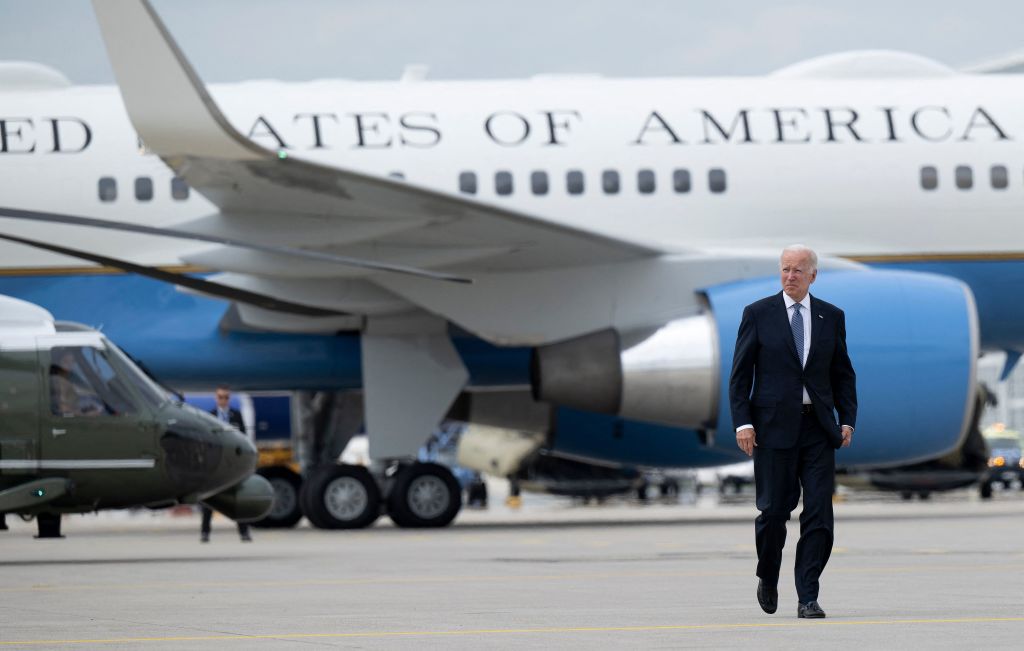
Despite U.S. President Joe Biden’s meandering efforts to explain his about-face on Saudi Arabia—visiting the country this week after having dubbed it a “pariah” on the campaign trail—there remains much apprehension about his trip on both ends of the political spectrum. Progressives and human rights advocates worry the president will sacrifice U.S. values for short-term Faustian bargains in an attempt to secure cheap oil and expand Arab-Israeli normalization. Republicans and realists, who favor an interest-driven approach to foreign policy, aren’t sure there is enough to be gained by Washington on these fronts to justify a presidential visit.
These concerns are warranted. During his two-day stay in Saudi Arabia—which follows a jaunt in Israel and the occupied Palestinian territories—Biden will be meeting the leaders of nine key Arab countries. They include the kingdom’s crown prince, Mohammed bin Salman, who U.S. intelligence concluded ordered the 2018 assassination of Saudi journalist Jamal Khashoggi, as well as the leaders of Egypt, Iraq, Jordan, and Gulf countries.
The United States’ Arab partners are, without exception, authoritarians with varying degrees of popular standing. And although they are dependent on Washington for their security, many have refused to shun Russia in the wake of its invasion of Ukraine. They also continue to expand their economic and military ties with China.
Despite U.S. President Joe Biden’s meandering efforts to explain his about-face on Saudi Arabia—visiting the country this week after having dubbed it a “pariah” on the campaign trail—there remains much apprehension about his trip on both ends of the political spectrum. Progressives and human rights advocates worry the president will sacrifice U.S. values for short-term Faustian bargains in an attempt to secure cheap oil and expand Arab-Israeli normalization. Republicans and realists, who favor an interest-driven approach to foreign policy, aren’t sure there is enough to be gained by Washington on these fronts to justify a presidential visit.
The Middle East Institute (MEI) is an independent, non-partisan, not-for-profit, educational organization. It does not engage in advocacy and its scholars’ opinions are their own. MEI welcomes financial donations, but retains sole editorial control over its work and its publications reflect only the authors’ views. For a listing of MEI donors, please click here.