
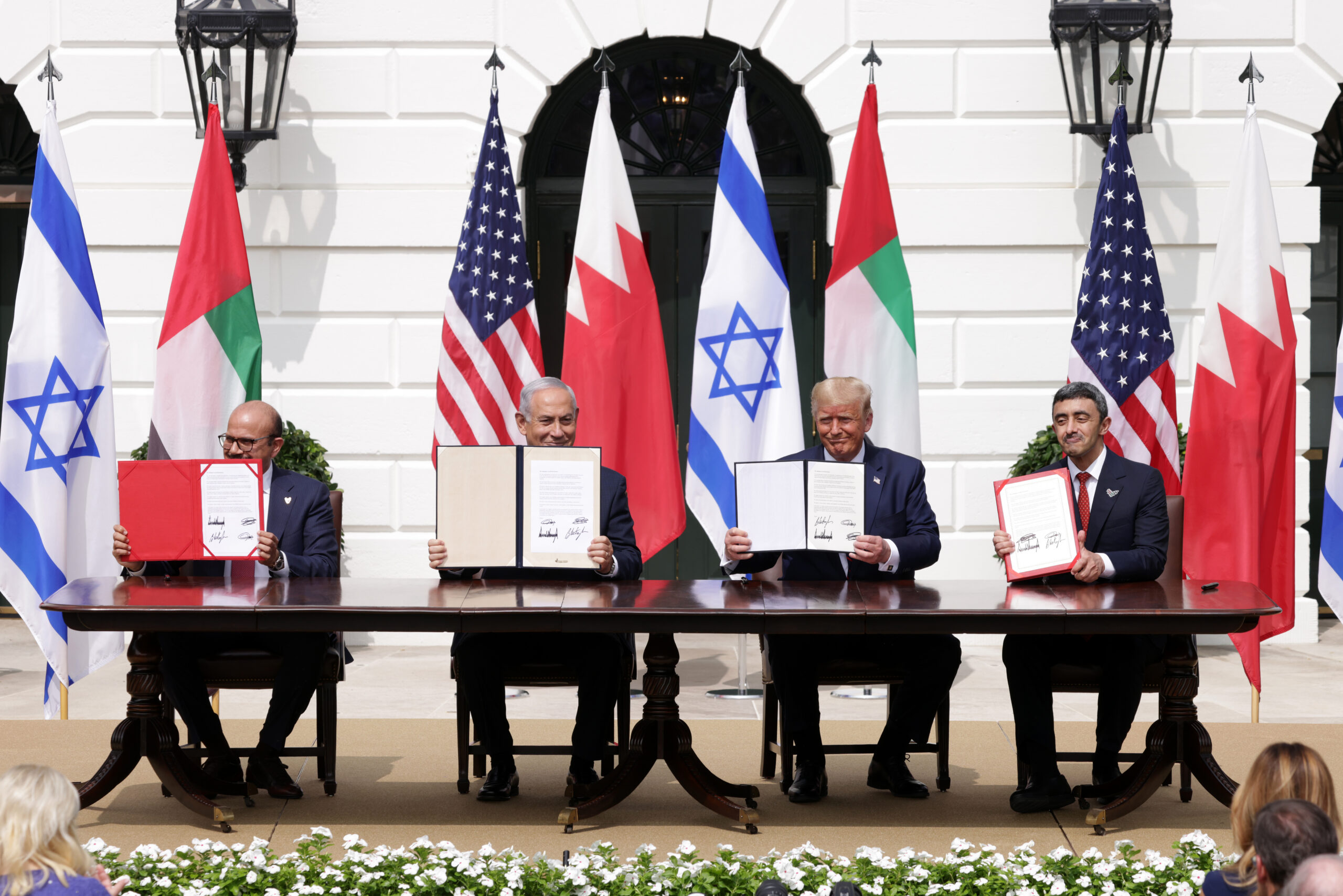
The Abraham Accords have represented a remarkable shift in U.S. Middle East policy. They reframed Arab-Israeli normalization as a result of shared interests – within the Middle East and directly with the US, rather than as a byproduct of Israeli-Palestinian peace. Signed in September 2020, on the last leg of the first Trump administration, the Accords brokered by Washington normalized relations between Israel and the United Arab Emirates (UAE) and Bahrain, followed by framework agreements with Morocco and Sudan. From the American perspective, the Accords were intended to break decades of diplomatic stagnation in the Middle East in order to establish a regional framework aligned with American strategic objectives.
The Abraham Accords were the first Trump administration’s most significant diplomatic achievement. They tackled at once several strategic objectives. They represented a means to consolidate a US-friendly regional bloc in the most anti-American region, a mechanism to counter Iranian influence, and a way to strengthen cooperation among US partners across domains, including in tech and defense. The change of paradigm sought to move the center of gravity away from the Palestinian issue.
Photo by Alex Wong/Getty Images
The Middle East Institute (MEI) is an independent, non-partisan, not-for-profit, educational organization. It does not engage in advocacy and its scholars’ opinions are their own. MEI welcomes financial donations, but retains sole editorial control over its work and its publications reflect only the authors’ views. For a listing of MEI donors, please click here.