تمت ترجمة هذا النص بواسطة الذكاء الاصطناعي وقد يحتوي على أخطاء.
تخطي إلى المحتوى

ندوة الدوسري

زميل مشارك

استفسارات الصحافة: [email protected]

ندوة الدوسري

Nadwa Al-Dawsari is a researcher and conflict analyst with over 20 years of experience in Yemen and the region. Her research focuses on the conflict in Yemen and its interaction with regional dynamics across the Middle East and the Horn of Africa. She is an Associate Fellow at the Middle East Institute and a Fellow with the Center on Armed Groups.

Nadwa examines how peacebuilding, counterterrorism, and aid efforts shape conflict and security amid the rise of non-state armed groups and proxy dynamics. Her work focuses in particular on the Houthis, their interaction with tribal and local dynamics, and their evolving cross-border networks, as well as the implications for Yemen and regional security.

She has advised US and European governments, regional actors, UN agencies, and defense institutions on Yemen and Red Sea security. Her work has been featured in leading think tanks, academic publications, and international media outlets including The Washington Post, The New York Times, CNN, BBC, and The Wall Street Journal.

Previously, she held senior roles including as Country Director for the Center for Civilians in Conflict, Executive Director of Partners Yemen, Senior Advisor to the World Food Programme, and Senior MENA Advisor at Partners Global.

Education
MA in Development Studies, University of Leeds, United Kingdom

Countries/Regions of Expertise
Yemen, the Arabian Gulf, the Horn of Africa

Issues of Expertise
Non-state armed groups, the Houthis, proxy dynamics, maritime security, tribal dynamics and informal governance, peacebuilding, protection of civilians.

Languages
Arabic, English

The Latest from Nadwa Al-Dawsari

تصفية حسب
18 Results
Running around in circles: How Saudi Arabia is losing its war in Yemen to Iran
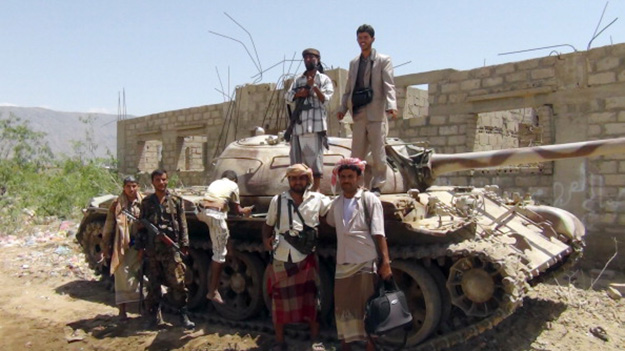
destroyed military vehicles are seen at Houthi-controlled areas following heavy fighting between them and forces loyal to the internationally recognized government on February 6, 2020 in Al-Jawf province, Yemen.
  • التحليل
  • Running around in circles: How Saudi Arabia is losing its war in Yemen to Iran

    On March 1, the Iran-backed Houthis took control of the city of al-Hazm, the capital of al-Jawf Province, after weeks of fierce clashes with local tribes and Yemeni government forces. Incompetence, lack of unified leadership, and the absence of a military strategy by the Yemeni government and the Saudi-led coalition have played into the hands of the Houthis.

    The Popular Committees of Abyan, Yemen: A Necessary Evil or an Opportunity for Security Reform?
  • التحليل
  • The Popular Committees of Abyan, Yemen: A Necessary Evil or an Opportunity for Security Reform?

    In early 2011, Yemeni youths took to the street to demand the downfall of the regime and much-needed democratic reforms. This eventually led to the removal of former president Ali Abdullah Saleh from power later the same year. The political turmoil associated with the uprising has resulted in an alarming deterioration of the security situation throughout the country, most notably the seizure of two major cities in the southern governorate of Abyan by Ansar al-Shariah (AAS), an offshoot of al-Qa`ida. Backed by the Yemeni government, the Popular Committees (PCs), local armed resistance groups, pushed AAS out of major cities in Abyan.