The tug of war over government formation in Iraq came to a surprising end on April 27, when the Coordination Framework (CF), the main Shi’a umbrella political alliance, broke a five-month deadlock by nominating Ali Falah al-Zaidi to lead a new Iraqi government. Within days, Zaidi received a congratulatory call from President Donald Trump and an invitation to Washington. On May 31, Trump appointed Ambassador Tom Barrack as special envoy to Iraq. Wasting no time, Barrack met with Zaidi in Baghdad on June 15 and invited him to visit Washington in mid-July. The US administration appears to have great expectations for Zaidi’s premiership. But the expectations need to be tempered.
The Emergence of Ali al-Zaidi
For months after Iraq’s November 2025 elections, outgoing Prime Minister Mohammed al-Sudani and former Prime Minister Nouri al-Maliki vied for the premiership, and their power struggle brought the CF close to a split. When President Trump publicly declared his displeasure with Maliki (and probably less publicly with Sudani), the parties duly proposed alternative candidates, but none secured a majority vote. As the godfather of the principal Shi’a political alliance, Iran was alarmed at the prospect of a breakup. It relayed a message through Esmail Qaani, head of the Islamic Revolutionary Guard Corps’ Quds Force: hold together at any cost.
In response, members of the CF found a compromise candidate in Zaidi. Under unprecedented US pressure, he was endorsed by a majority of the coalition in April 2026. Zaidi has no political history, but is well-connected to the political elite, judging by the swift and broad welcome he received from Shi’a, Sunnis, and Kurdish leaders. In his early forties, the new prime minister comes from a rising class of younger businessmen who have accumulated wealth and prominence through government contracts, commerce, and entrepreneurship. He was a founder and chairman of Al-Janoub Islamic Bank, which in February 2024 was banned from US dollar transactions by the Central Bank of Iraq, though the bank never came under US sanctions. Zaidi has numerous other business interests, including contracts with Iraqi ministries such as the Ministry of Trade, to procure foodstuffs for the rations distributed by the government. The process behind his nomination remains opaque. Reports claim that he was put forward by Faiq Zaidan, Iraq’s chief justice, and Qais al-Khazali, leader of Iran-backed militia Asa’ib Ahl al-Haq (AAH), and that behind-the-scenes negotiations were held with the US before the nomination.
Contentious Government Formation
This past May, Zaidi presented to parliament his government program and a slate of 19 ministerial candidates (out of an eventual 23). The program was ambitious and broad. Unlike the program of his predecessor, which led off with economic and social needs, the first section of Zaidi’s program dealt with state control over weapons and the enforcement of the rule of law. The second dealt with foreign policy and emphasized the need to strengthen relations with Gulf countries. But as a hedge against criticism, the program also, and somewhat ambiguously, referred to developing the capabilities and defining the role of the Popular Mobilization Forces (PMF), an umbrella group of largely Iran-backed armed militias, within Iraq’s security framework. Like the programs of previous prime ministers, it is aspirational, but Zaidi was signaling his priorities at a time when Washington was keeping a watchful eye.
In addition to its opposition to former Prime Minister Maliki, the US placed red lines around government formation: there should be no ministers connected to the armed militias. This meant excluding several partners within the CF coalition, including Zaidi’s backer, AAH. Of the 19 candidates presented to parliament, only 14 were approved during an acrimonious session. The voting left several parties dissatisfied and potentially hostile. When Maliki’s two candidates were rejected, his supporters accused Zaidi and his ally, Qais al-Khazali, of betrayal, breaking prior agreements, and plotting their exclusion. Militia partners in the CF have also been left out — at least for the time being. Two ministers proposed by the Sunni Azm Alliance, led by Muthanna al-Samarrai, were also shot down, as was a candidate from Masoud Barzani’s Kurdistan Democratic Party (KDP). Zaidi still needs to fill the sensitive posts of Interior and Defense, which traditionally go to a Shi’a and a Sunni respectively. The contentious formation of the new government foreshadows the challenges Zaidi will have to overcome to fulfill his primary agenda goals of restricting weapons, applying the rule of law, and improving relations with Arab neighbors.
Zaidi’s Political Constraints
Perhaps Washington embraced Zaidi so wholeheartedly because he is a pragmatic businessman who understands deal-making. Moreover, Washington undoubtedly backed him as much for what he is not: a tainted old hand. Experience with past officeholders has been disappointing for the United States. Despite American efforts to pull Iraq away from Iran, Shi’a leaders have remained under the influence of Tehran, and Iran-affiliated militias are growing stronger and bolder. Repeated US demands to control, disarm, or disband the militias have been futile. The expectation of the US seems to be that a new prime minister relatively outside the system may be able to do better — even one under the tutelage of Faiq Zaidan, a powerful, pragmatic figure who is also an important pillar of Iran’s influence in the country.
However, Zaidi is not entirely outside the system, and he faces obstacles internal to the political forces that brought him to office. He was nominated by the same Shi’a umbrella political alliance that nominated Sudani before him, and he is similarly answerable to them. Important leaders within the CF, like Maliki, are unhappy with his nomination and will try to undermine him. To reconcile his opponents, Zaidi is likely to use the remaining eight or nine open cabinet posts, especially Interior and Defense, to appease them, but there may be a political cost to concessions, and in any event the prime minister will have to watch US red lines in his appointments.
Moreover, most of his large number of new ministers were not chosen by him but nominated by Shi’a, Sunni, and Kurdish parties whose interests these ministers must serve. The cabinet is subject to the same muhassasa (political quota) system that has governed Iraq at least since 2010 and, in some ways, since 2003. The new cabinet, representing established political parties and interests, is unlikely to feature new thinking on political or economic reforms that will upset the status quo and the CF’s dominance in Iraq’s political life.
Measuring Up to US Expectations
For its part, the United States wants Iraq to pivot west, away from its current orientation toward Iran and China, and to transform institutions and policies. To achieve this, the Trump administration has three principal and interconnected objectives. The foremost is disarmament and demobilization of the PMF militias, which will require an act of parliament. The modalities of disarmament and demobilization are still undefined, but the central problem so far has been the absence of the political will and courage required to disarm groups that rely on their weapons to project power, intimidate the government, and reap economic benefits. The recent declaration that AAH, Muqtada al-Sadr’s Saraya al-Salam, and the smaller Imam Ali Brigades are preparing to hand over weapons to the government is a step forward. However, other powerful and belligerent militia groups loyal to Iran, such as Kata’ib Hizballah and Harakat al-Nujaba, have refused, considering their weapons “sacred” and preparing for further confrontation with the US. These militias will only lay down their arms if ordered to do so by Iran, or under considerably greater pressure from the United States.
Washington’s assumption is that the disbanding of the militias will have a cascading effect on Iraq’s orientation. The militias use their weapons to protect Iran’s interests in Iraq and attack US and Western assets. Disarming them would make it safer for US companies to operate in Iraq and decrease their ability to enforce Iran’s agenda. The US wants to see Iraqi political, economic, and diplomatic decision-making freed from Iranian influence, but the cascade assumption may not prove valid. At least in the short term, disarming or disbanding militias will not mean freedom from Iranian political influence. The new prime minister will face perhaps even greater resistance in dislodging long-standing pro-Iranian penetration of ministries, parliament, and the economic sector. Over two decades, Iran has built networks of intertwined financial interests in Iraq through contracts, money laundering, oil smuggling, and financial transactions, which in turn have translated into widespread political dependency. Such ties are not restricted to the Shi’a militias, but exist across the board, even among Kurdish and Sunni parties, benefiting not only Iran but also its Iraqi business partners. Prying Iraq loose from such economic and political entanglements will require time and bold action from Zaidi.
An associated priority for the Trump administration is creating a hospitable environment for American corporations working in Iraq and ensuring their safety. During the recent US-Israel-Iran war, American and European oil companies in Kurdistan and Basra were repeatedly targeted by militias, causing a halt in production and the evacuation of foreign employees. The US is looking not only for protection but an expansion of US corporate participation in the growth of the Iraqi economy.
Iraq’s relations with the Gulf countries should flow naturally from disarmament of militias and disengagement from Iran. As Syria has been released from Iranian dominance and turned to the Gulf, so the US wants to see Iraq step out from under the Iranian umbrella and integrate into the Arab milieu, including with Syria. Yet the hundreds of attacks by Iraqi militias against Saudi Arabia and Kuwait in support of Iran soured relations, generating anger and distrust instead. A rupture with the Gulf damages both Iraq’s security and economy, and thwarts US designs. Regaining the trust of Arab countries will be a hard task, as many Shi’a parties, and not only the Iran-allied militias, have historically resisted closer ties with (Sunni) Arab neighbors and looked upon Iran as a protector of the community.
A Window of Opportunity?
Following their meeting in Baghdad on June 15, Ambassador Barrack and Prime Minister Zaidi issued a joint statement setting out their aspiration for a “sovereign, secure, and prosperous Iraq” that can deliver “tangible benefits for Americans and Iraqis alike.” The statement expressed the “urgency” of “ensuring the complete disarmament and disbandment of all armed groups and formations operating outside the authority and control of the Iraqi state.” The statement also “reaffirmed the shared commitment to increase US-Iraq commercial cooperation,” especially in the energy sector. Barrack laid out an ambitious road map for Zaidi, which the prime minister appears willing to follow. Yet the political landscape makes the degree and pace of success uncertain.
The outcome of the US-Israeli war against Iran, and the result of the subsequent US-Iran negotiations, will have a potentially important impact on events in Iraq. If Iran believes it has won the war, and if its allies share this belief, Tehran will be more insistent on holding on to its assets in Iraq and will not give up influence in what it regards as its zone of vital interest. It will not easily relinquish the considerable political and economic rewards it has gained in Iraq over two decades. In a context of an emboldened Iran, the more aggressive and ideologically committed of the PMF militias will probably refuse to give up their arms or their political allegiance and seek to reinforce their role as the guardians of Iran’s hold on Iraq.
A countervailing factor will be the sustained attention and support of the Trump administration over the remainder of its term in office. The proposed transformations, if they are to happen at all, will require time. The US and Iraq need to agree on indicators of progress on the primary objectives and address roadblocks together. The first, disbanding militias, is the thorniest, and requires measurable verification. The decision by Iraq’s Supreme Judicial Council (led by Justice Zaidan) to extend the anti-terrorism law to “anyone who manufactures, uses, or possesses drones used for purposes contrary to the law” is a step in the right direction and indicative of how Prime Minister Zaidi might use it to bring the militias under control, although the proof will lie in implementation. The US should offer incentives to the groups that dissolve their military wings, hand over weapons to the government, and become political parties as defined by the constitution. These incentives could include the removal of sanctions or other designations that limit their activities and bar them from formal politics. But there should also be direct punitive measures against groups and individuals that reject the offer to disarm and remain outside government control.
The deeper, wider, and equally difficult question of Iranian penetration of the state system will require disabling Tehran’s economic, financial, and political networks within state institutions. Here Zaidi, as a political novice, will have greater challenges in maneuvering through the intricacies of political alliances, corruption networks, and the rules of the muhassasa. He will be greatly assisted if reforms bring tangible benefits to the broader Iraqi public, and if Iraqis can see that the transformation is in their best interest. The US can help in creating the conditions for a winning scenario.
Successive Iraqi governments have declared their wish to have good relations with both the US and Iran. In practice, this has meant tilting toward Iran. Such ambiguity is no longer acceptable to the Trump administration. The United States has provided a warm welcome to the new government and expects to see changes in governance that will enhance Iraq’s sovereignty and independence, while at the same time making it more friendly to the US and to surrounding Arab countries. If all goes well and Prime Minister Zaidi visits President Trump in Washington in July, he will be under scrutiny. Even assuming Zaidi’s best intentions, the US — and Iraqis — should be patient and withhold judgment for now.
Rend al-Rahim is the former president and co-founder of the Iraq Foundation, a Washington-based nonprofit promoting democracy, human rights, and civil society in Iraq. A leading expert on Iraqi politics and civic development, she served as Iraq’s first ambassador to the United States from 2003 to 2005, following the fall of Saddam Hussein. She is currently a Non-Resident Senior Fellow at the Atlantic Council Iraq Initiative.
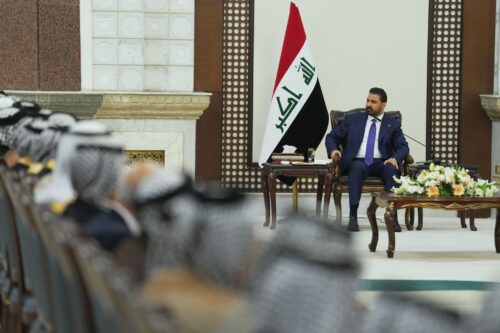
Photo by Iraqi Prime Minister Press Office/Handout/Anadolu via Getty Images
The Middle East Institute (MEI) is an independent, non-partisan, not-for-profit, educational organization. It does not engage in advocacy and its scholars’ opinions are their own. MEI welcomes financial donations, but retains sole editorial control over its work and its publications reflect only the authors’ views. For a listing of MEI donors, please click here.

The Americans Are Gone. Will Iraq’s Militias Disarm?