‘De Mistura Ideas to Reality Are Like Windmills to Don Quixote’: A UN Mediator in the Syrian Conflict
External Publication
May 8, 2024
Share
*This article was awarded the runner-up award for the Richard Gillespie Prize for best annual paper for 2025*
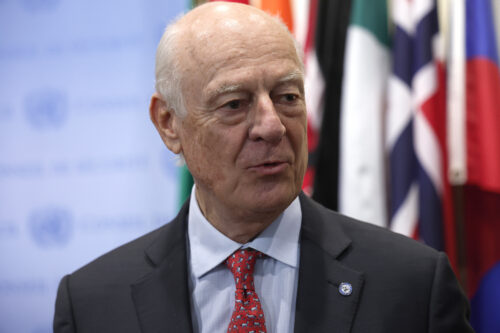
Despite their prestige and expert status, the degree of influence United Nations (UN) mediators have as decision-makers remains underexplored. This article assesses mediators’ individual agency by way of a single in-depth case-study of the degree of influence the UN mediator in Syria – Staffan de Mistura – enjoyed in conceiving, negotiating, and executing mediation policies advanced from his appointment in July 2014 until his resignation in October 2018. Our analysis bridges the literature on levels of analysis in International Relations (IR) and Foreign Policy Analysis (FPA) by allowing for an in-depth case study exposing the degree of individual agency decision-makers have within international organizations. Contributing to an emerging research agenda, we argue that UN mediators do have significant room of manoeuvre and thus the ability to conceive, negotiate, and execute key mediation policy-decisions.
Pinpointing the agency of mediators exposes the influence and leeway mediators, operating within the decision-making structure of the UN and the dynamic context of conflict, have over a mediation process. In brief, it determines the input of the individual mediator into the process of mediation. While our focus may ultimately benefit from the larger structure-agency debates in IR theory and FPA, here we more modestly hope to contribute to the literature on decision-making in mediation and conflict studies. In doing so, we push back against classical framings of mediation that tend to obscure the degree of agency and responsibility mediators have over the policies that shape the mediation processes they oversee. In addition, our study showcases a systematic way to empirically establish the agency of decision-makers in foreign policy that is relevant for theoretical approaches to IR and FPA that attribute significance to first-level analysis as their main premise.
The Middle East Institute (MEI) is an independent, non-partisan, not-for-profit, educational organization. It does not engage in advocacy and its scholars’ opinions are their own. MEI welcomes financial donations, but retains sole editorial control over its work and its publications reflect only the authors’ views. For a listing of MEI donors, please click here.