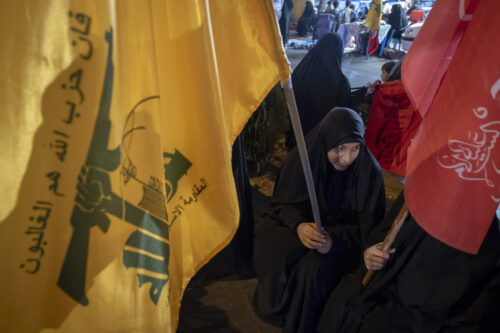
Hizballah’s Deep State: The Real Challenge of Disarmament in Lebanon
A Strategy to Win in Lebanon
July 15, 2026
Share
This article is part of a report outlining an actionable US roadmap to win in Lebanon, comprising eight chapters of specific policy interventions across the security, economic, and political dimensions needed to secure a sovereign Lebanon, lock in US gains against Iran, and permanently end the Israel-Lebanon conflict.
Hizballah’s enduring power stems from its financial, political, and institutional ecosystem — not its weapons alone.
As long as this ecosystem remains intact, Hizballah will retain the resources and state access needed to rearm despite sanctions or military setbacks.
US policy should pair disarmament with a sustained strategy to dismantle Hizballah’s financial networks, political influence, and parallel institutions.
Hizballah’s impunity rests on judicial infiltration and a weaponized military court; sanctioning complicit judges and reforming that court would erode its greatest political asset.
Efforts to strengthen the Lebanese state, accelerate economic recovery, and permanently reduce Iran’s influence through Hizballah would reinforce the creation of a credible path toward peace between Lebanon and Israel.
Introduction
In June, the United States signed two documents bearing on Lebanon: a memorandum of understanding with Iran, and a Trilateral Framework Agreement with Israel and Lebanon. Both included a cease-fire commitment between Israel and Lebanon, but the first emboldened the Iranian regime, while the second empowered the Lebanese state. Only one of these initiatives can prevail. The chances of Lebanon’s sovereignty triumphing over Iranian hegemony have increased with the signing of the June 26 framework agreement; however, the Lebanese state has a long fight ahead, and the Trump administration needs to help.
To successfully weaken Iran in Lebanon, all of Hizballah’s pillars of power must be targeted. The framework agreement largely focused on its weapons and military infrastructure — which present an immediate threat to the security of both countries — by establishing pilot zones and linking Israeli withdrawal to the disarmament of the Iran-backed group.
But Hizballah is not just a military structure. It survives because of a strong and sustainable financial and political ecosystem embedded deep within state institutions that ensures cash flow from Iran and, if left unchecked, will support the rebuilding of its arsenal and military infrastructure. Even in the best-case scenario, one in which Hizballah surrenders all its arms, the group will still have the capacity to rebuild because of its power system within the state. Dismantling Hizballah’s economic ecosystem is the key to sustainable disarmament and the establishment of an enduring peace — the strategic goal of the agreement. Achieving it would consolidate the end of the Iranian militia.
On this issue, point 11 of the 14-point framework agreement states that “Lebanon and the United States commit to preventing funds from flowing to any entity, organization, or individual affiliated with non-state armed groups and to take available legal measures to proscribe the activity of any such entity, organization or individual.”
Despite its military losses since October 2023, Hizballah has still managed to protect its cash flow and power structure within state institutions. According to the US Treasury, Iran’s Islamic Revolutionary Guard Corps (IRGC) managed to transfer over $1 billion to Hizballah in 2025, mostly through money exchange companies. The group used this money to import military materiel, produce more missiles and cheap drones, recruit more fighters, and pay salaries to its existing fighters and staff.
According to sources in Lebanon, it was Hizballah’s access to security and financial institutions that enabled these imports — and as long as Iran sells oil, Hizballah will use its institutional power to keep the cash flowing
Disarmament vs. Dismantlement
The framework agreement conditions Israeli withdrawal from southern Lebanon on the Lebanese Armed Forces (LAF) deploying throughout the country and verifiably disarming Hizballah, an effort that will require a political decision by the Lebanese government that could lead to confrontation with the group. The US would oversee and support implementation, with future assistance to Lebanon tied to measurable progress, transparency, verified milestones, and ongoing oversight.1 Lebanon must fulfill its commitment to disarm the militia, and US assistance should translate into more effective LAF operations. This is not a small task. It requires more than just a robust assistance program or a verification mechanism; it calls for institutional reform of the LAF, including the demotion and removal of officers who coordinate with the militia and help protect its interests. Currently, the LAF is infiltrated by Hizballah operatives, who share intelligence with the group and hinder the process of disarmament.
To make sure the group does not regenerate and rearm, Hizballah must be purged from the deep state — the institutions it inherited when Syria withdrew from Lebanon in 2005, and which are still run by its allies. The Trump administration could condition assistance to the LAF on benchmarks related to this process. Beirut, in turn, must implement the framework agreement in coordination with Washington, and most importantly, cooperate closely with the US and Israel to dismantle the IRGC’s ecosystem of military, financial, and political power in Lebanon.
Hizballah’s Non-Kinetic Pillars of Power
In addition to infiltrating the LAF and exploiting its capabilities, Hizballah has sustained its power and control through state financial, security, and judicial institutions:
Lebanon’s Cash Economy: Since the country’s financial crisis in 2020, the banking sector has been replaced by an unregulated, cash-based financial system, dominated by money service businesses (MSBs), exchange houses, and informal transfer networks. This transformation has been extremely useful to terrorist networks and has made counterterrorism efforts more difficult. Cash is harder to trace and regulate than the formal banking system and much easier to launder and circulate.
Hizballah has been exploiting this new system to move cash from Iranian oil sales through front companies and private networks in Lebanon and elsewhere in the region. The currency exchange network used by the group and its allies has helped circulate money in Lebanon without effective financial oversight, which collapsed along with the banking sector in 2019.
This cash system is protected by Hizballah’s allies in the state’s financial institutions, from the Ministry of Finance to the Council of the South to customs and public spending. Even as weapons were being collected and destroyed, cash to Hizballah was still flowing.
Lebanon committed to obstruct this flow by signing the framework agreement.
To counter Hizballah’s capture of the cash economy, the US should treat Lebanon’s economy as a national security battlefield. Escalating Treasury advisories and sanctions should be imposed on individuals and businesses facilitating the flow of cash to the group, and more pressure should be exerted on Lebanon to limit these illicit activities.
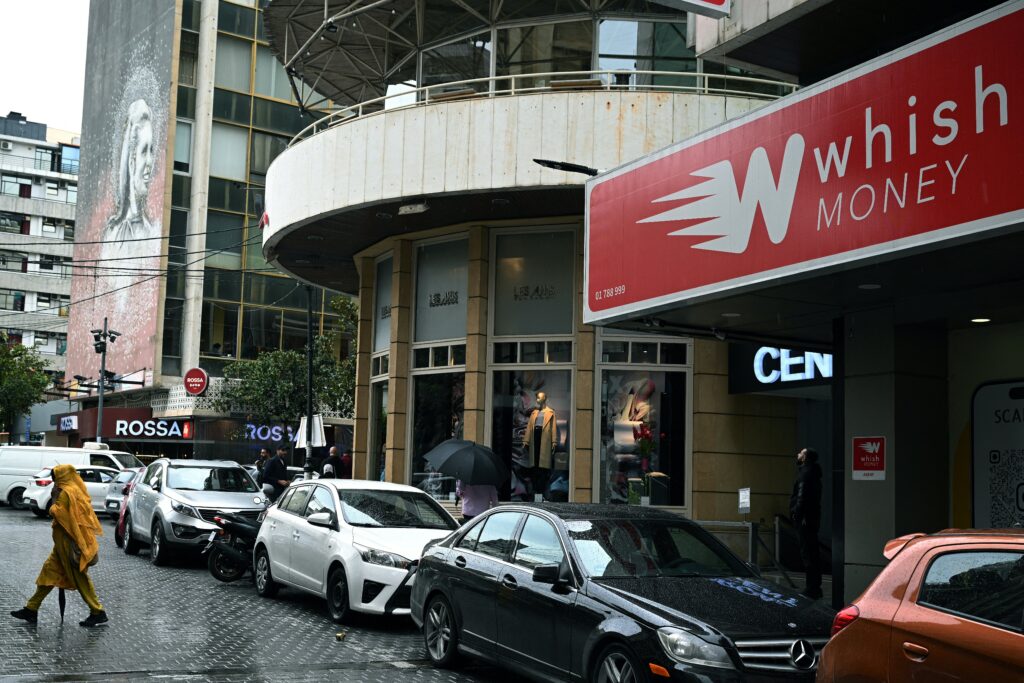
Bayt al-Mal and al-Qard al-Hassan (AQAH) are Hizballah’s core financial institutions — both sanctioned — but the group has been making extensive use of the MSB sector, such as Whish Money and OMT (Western Union). Whish Money transactions are mostly unregulated but operate under an informal agreement with Lebanese authorities, enabling it to act as a collection agent for various public sector dues, such as tax payments and utility bills, settled in Lebanese pounds (LBP). The collected LBP funds are exchanged for dollars on the black market on behalf of Hizballah or affiliated networks. The group also relies on individuals operating outside the formal financial system to conduct currency exchange and transfers. This system helps Hizballah to circulate cash to its members and institutions without hindrances.
The Judicial Sector: Impunity is Hizballah’s greatest political asset, and the militia’s deep reach into the state is protected by a thorough infiltration of the judicial system. Since its inception, Hizballah has enjoyed immunity from prosecution for every one of its crimes, including the assassination of opponents. The military court plays a significant role in targeting anti-Hizballah activists and journalists, with no oversight or legal protection for victims. A recent example is the prosecution of journalist Maria Maalouf and anti-Hizballah activists Joumana Gebara and Ahmad Yassine.
Since 1982, Hizballah has killed opponents, threatened adversaries, and used street violence to coerce political outcomes it could not achieve democratically. Most notably, it launched a military takeover of Beirut in May 2008 to defy the government’s decision to dismantle its communication network, forcing it to sign the Doha Agreement. This document, tantamount to a surrender, granted Hizballah minority veto rights within the Lebanese government, effectively handing over the state’s power to the militia. In 2019, the group again mobilized street violence to suppress widespread protests against economic mismanagement and to protect its corrupt allies.
Today, as Hizballah fights for its survival, many Lebanese fear the return of violence. Without judicial reform, Hizballah will keep calculating that it can coerce Lebanese and get away with crime and terror.
Sanctioning judges who are complicit in protecting the group and attacking its opponents can help change this dynamic, especially if it occurs in parallel with efforts by the Lebanese state to remove these judges and reform the military court to end civilian prosecutions. Once freed from the grip of the military court and the oppressive judiciary, Lebanese — and especially the Shi’a — will speak out openly against the group.
The Security System: Hizballah inherited the Assad regime’s capture of state institutions and the collusion of their allies when Syrian forces withdrew from Lebanon in 2005. Despite changes in government and parliament, these state institutions were never cleansed. Even after the formation of the new government in February 2025, Speaker of Parliament Nabih Berri, a key political ally of the group, managed to secure many vital appointments in security institutions.
The Lebanese General Directorate of General Security has historically been linked to Hizballah, and its close coordination with the group on domestic security, borders, and points of entry was underscored in May 2026 when the US Treasury Department sanctioned Brig. Gen. Khattar Nasser Eldin, a top security official, for sharing vital intelligence with the militia.
The Shi’a Community: Hizballahwould have no fighters, no voters, and no political representation without the support of the Shi’a community. That backing has eroded sharply as it became clear that the “resistance” has failed to liberate their land or protect them — dragging them instead into repeated wars with Israel, most recently in March 2026, that brought destruction, displacement, and occupation.
Reconstruction is not guaranteed, and Iran failed to save them. Not only was their father figure, Hizballah Secretary-General Hassan Nasrallah, killed, but much of the Shi’a community now realizes that the group cannot protect them. Yet dissent is still discreet and gradual, because there is no political force offering an economic and political alternative to Hizballah. Shi’a opposition groups are still politically immature and divided, and the state remains too weak to constitute an alternative.
That being said, the opportunity to support an economic alternative that would encourage and empower independent Shi’a businesspeople to invest in their communities is stronger today. Economic development in the south will require dismantling the Hizballah-Amal control of the Shi’a private sector and guaranteeing stability and peace between Lebanon and Israel.
A money transfer company office in Beirut on November 14, 2025. Photo by Joseph Eid/AFP via Getty Images.
The Hizballah-Amal Alliance
The Amal movement, headed by Speaker Nabih Berri, has been Hizballah’s main strategic ally since the end of the civil war in Lebanon. Without Amal, Hizballah would not have had sufficient access to state institutions, and without Hizballah, Amal would lose municipal and parliamentary elections and have limited access to Hizballah’s financial networks.
The speaker of parliament since 1992, Berri gives Hizballah critical political cover — blocking appointments and parliamentary decisions it opposes, securing ones it benefits from, and lending it institutional legitimacy.
However, Berri has presented himself to the international community as a mediator and an intermediary, a role he has used to empower his and Hizballah’s interests. For example, in 2025, he blocked efforts in parliament to address the group’s weapons and helped, via Amal ministers (such as Minister of Finance Yassine Jaber), to earmark $130 million for the Council of the South — a corrupt organization well-known for being controlled by Amal and Hizballah.
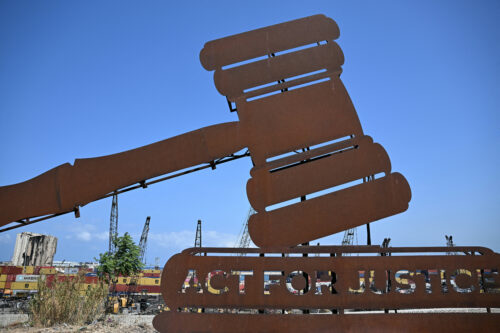
Following the 2020 Beirut port explosion, Berri publicly criticized and stymied the investigation into responsibility for the disaster. He also supported efforts to replace the supervising judge, Tarek Bitar, directing Amal to demand his removal. Amal politicians filed legal complaints that suspended Bitar’s investigation for more than a year.
Berri’s role grew exponentially after Nasrallah was killed. Militarily, the IRGC took over Hizballah’s command, but politically and financially, Berri was given a higher-profile leadership role, gaining many benefits in return. He is the only Lebanese figure who communicates with Iranian leadership, and therefore, he is the leader orchestrating Hizballah’s campaign to abolish or counter the framework agreement and help Iran take over the Lebanon file.
Speaking to the pro-Hizballah newspaper al-Akhbar, Berri said that the US-Iran talks are the only realistic opportunity to secure an Israeli withdrawal from the country and that any bid to separate Lebanon from the US-Iran track would sustain Israeli occupation. This followed a phone call with Iranian Parliament Speaker Mohammad Bagher Ghalibaf, who told Berri that “a cease-fire in Lebanon is of the same importance to us as a cease-fire in Iran.”
Hizballah-IRGC Tools
Without Berri and the IRGC, there is not much left of Hizballah today in Lebanon. Israel destroyed much of its military infrastructure and degraded its command structure significantly.
Hizballah has always been a de facto arm of the IRGC, in part because Iranian military leaders regard Lebanon as a central component of their strategic depth in the region. Yet the IRGC dramatically tightened the leash after Israel killed Nasrallah. According to sources close to the group, the IRGC began deploying hundreds of commanders to Lebanon in November 2024 to rebuild and restructure Hizballah. Israel has released the names of dozens of IRGC officers killed in action throughout Lebanon, and social media obituaries reveal various Syrian and Iraqi fighters killed there while operating in Hizballah units.
Meanwhile, the Iranian regime is trying to regain control of the Lebanese file and keep it on the negotiating table with the US in Switzerland — part of its strategy to empower Hizballah, its allies, and other regional proxies. Iran wants to ensure that Lebanon does not disarm its leading proxy and that Hizballah does not lose its financial, political, and security power. It is trying to regenerate the organization quickly to maintain a critical level of threat against Israel.
For now, the IRGC’s main priority is to ensure Hizballah’s survival and its financial capacity to rearm; that is, having sufficient funds to import material to rebuild its infrastructure, produce drones and missiles, pay fighters’ salaries, provide some social services, and resume compensations to those who lost homes and properties. For the Iranian regime, Hizballah’s financial infrastructure, 90% of which comes from Iranian oil sales, is of utmost importance.
The challenge — besides disarmament — is to stop this cash flow. Without it, Hizballah cannot rebuild, rearm, or regain the support of the Shi’a community.
Lebanon-United States Tools
The Trump administration must look beyond the issue of disarmament and address the group’s broader ability to restore itself. Several steps will be crucial to this effort:
Diplomatically, it will be important to maintain the separate diplomatic tracks between Lebanon and Iran. The Iranian regime may try to jeopardize the Lebanon-Israel framework agreement and put the Lebanese file back on the table as a condition to continue the talks to keep the Strait of Hormuz open. However, it is vital to empower the Lebanese state in its efforts to regain its sovereignty and agency over decisions of war and peace. Iran has always viewed Lebanon as its regional battlefield, but this agreement is the best chance to achieve lasting peace between Lebanon and Israel.
Financially, Lebanon should do more to rein in Hizballah’s control of the cash economy, restore trust in the banking sector, implement overarching financial and economic reforms, and cut its access to funds. The US Treasury Department could issue warnings or advisories — backed up by the threat of sanctions — to the companies facilitating Hizballah’s shadow economy and illicit finance network. Sanctions should target the officials and individuals helping the group raise, move, and store funds.
It should be communicated clearly to the Lebanese government that reforms must be comprehensive, directed at all state entities (such as the Council of the South), the judicial system (to preserve financial accountability), and the Customs Administration (to limit smuggling). Meanwhile, Washington should ensure all actors implicated in the financial collapse are held accountable.
Washington should also target Hizballah’s allies. Berri, in particular, should be made to understand that the risks of supporting Hizballah outweigh the benefits. The Trump administration’s most effective tool for swaying Berri and his circle is targeted sanctions — progressing from Amal officials to their family members and including personal financial assets.
Politically, Washington and its allies should find ways to empower the Shi’a community by supporting economic alternatives to dependency on Hizballah and encouraging independent Shi’a businesspeople to invest in Lebanon. This is important because Hizballah is already starting to prepare for the parliamentary elections in May 2028, and without a strong alternative, it (along with Amal) could regain a monopoly on Shi’a seats in parliament and maintain their ecosystem of political and financial power.
In addition, Washington should thwart plans to integrate Hizballah within Lebanese state institutions or provide it with more political power in return for disarmament. This kind of Faustian bargain would only strengthen its position and allow the group to rearm in the future.
To prevent Hizballah’s reconstitution, the group’s commanders and fighters should not be integrated into the LAF, and its social organizations should not be absorbed into state institutions, as militias were after the civil war. Iraq shows the cost: absorbing Shi’a militias into the army failed, and disarming them has only grown harder as the line between militias and state forces blurred. Integrating the IRGC within state institutions would only empower Iran and weaken the state. Hizballah must not be allowed to win politically what it failed to achieve militarily, thereby strengthening Iran’s control of Lebanon’s institutions.
Both Amal and Hizballah leaders have argued that the Shi’a community, widely considered Lebanon’s largest sect, is underrepresented in the political system. Over the years, they managed to increase Shi’a institutional sway by expanding the power of the speaker of parliament, putting the position on an equal footing with the president and the prime minister, and securing greater influence over government decision-making and major state appointments. This institutional power should not be unduly increased, as it would only solidify Iranian control of Lebanon.
Finally, reaching apeace deal is in the interest of both Lebanon and Israel, but it would also align with the Trump administration’s policy objectives. The framework agreement stresses peace as the ultimate goal and therefore confirms that an end to the conflict between Lebanon and Israel should not be separate from disarmament efforts.
Dismantling Hizballah’s economic ecosystem is the key to sustainable disarmament — and peace will consolidate the end of this Iranian militia. Lebanon is closer to achieving that objective, but will succeed only if US policy is firm, comprehensive, and willing to raise the cost of obstruction.
Ultimately, lasting disarmament depends on dismantling Hizballah’s entire ecosystem of power — not only its weapons, but also its financial networks, parallel institutions, political leverage, and illicit economic infrastructure that sustain its military capabilities. A credible path toward peace between Lebanon and Israel would reinforce these efforts by strengthening the state, supporting economic recovery, and making disarmament politically and strategically sustainable.
Hanin Ghaddar is the Friedmann Senior Fellow at The Washington Institute and author of Hezbollahland: Mapping Dahiya and Lebanon’s Shi’a Community.
Top photo by Joseph Eid/AFP via Getty Images.
The Middle East Institute (MEI) is an independent, non-partisan, not-for-profit, educational organization. It does not engage in advocacy and its scholars’ opinions are their own. MEI welcomes financial donations, but retains sole editorial control over its work and its publications reflect only the authors’ views. For a listing of MEI donors, please click here.