The outbreak of the US and Israeli war with Iran on February 28, 2026, shocked many observers. Yet the greater surprise was not the war itself, or Iran’s wider attacks on Arab Gulf states, but how effectively Iran closed the Strait of Hormuz and sustained that closure despite heavy damage to its navy and air force. Analysts had long anticipated that Tehran would move to shut the strait in a direct conflict with the US, but few expected it to hold it. Roughly 20% of the world’s oil supply flows through Hormuz, underscoring the strategic value of maritime chokepoints in Iran’s confrontation with the US.
A June memorandum of understanding (MoU) briefly paused the fighting and reopened the Strait of Hormuz. But the recent US-Iran escalation, beginning with Iranian attacks on cargo ships in the strait on July 7 and followed by the US decision to reimpose sanctions on Iranian oil sales and resume its own strikes, has sharpened that dynamic. Tehran’s pressure campaign has since extended beyond Hormuz. On July 20, Yemen’s Houthi movement announced a naval blockade targeting Saudi shipping in the Red Sea. The Iran-backed group followed the blockade by carrying out attacks on multiple Saudi oil tankers, prompting Saudi retaliatory strikes on Houthi military targets in Hodeidah and Kamaran Island. The Houthis then escalated further by launching missile attacks against Aramco facilities in Yanbu and Jizan.
As Riyadh increasingly relies on the East-West Pipeline to transport crude to the Red Sea port of Yanbu — bypassing the Strait of Hormuz — the Bab el-Mandeb has become a critical maritime outlet for the kingdom’s oil exports. Iran’s long-term investment in Yemen has positioned the Bab el-Mandeb, through which around 12% of world trade flows, as a second pressure point, extending Tehran’s ability to threaten global commerce and regional energy security beyond the Gulf.
On June 6, Ali Akbar Velayati, the international affairs adviser to Iran’s late supreme leader, spoke of a “new equation of power” in the Middle East and emphasized the importance of the Strait of Hormuz within that equation. Two days later, on June 8, Gen. Esmail Qaani, commander of the Islamic Revolutionary Guard Corps’ (IRGC) Quds Force, spoke of an emerging “security belt” for the Axis of Resistance — Iran’s term for its network of allied state and non-state actors across Iraq, Lebanon, Yemen, and beyond.
According to Qaani, this new security belt would stretch from the Strait of Hormuz to the Bab el-Mandeb, and from the Persian Gulf to the Red Sea. His remarks suggest that Iran is seeking to expand its leverage over key maritime chokepoints as a means of pressuring its adversaries. To achieve that aim, Tehran is relying heavily on its ally in Yemen, the Houthis.
Establishing a Tehran-Sana’a Air Link
On July 3, a flight from Iran’s Mahan Air landed in Sana’a for the first time in more than a decade. Direct flights between Tehran and Sana’a have not operated since the Saudi-led coalition’s intervention in March 2015. The Mahan Air plane picked up a Houthi delegation traveling to Tehran to attend Ayatollah Ali Khamenei’s state funeral, delayed for months for security reasons. The flight came a little over two weeks after the signing of the US-Iran MoU, an agreement also meant to pave the way for renewed talks on Iran’s nuclear program. The Houthis accused the Saudis of flying fighter jets over Sana’a to prevent the Iranian aircraft from landing. They declared that direct flights between Tehran and Sana’a would continue, warning that any future Saudi attempt to stop them would be met with a “comprehensive response targeting airports and vital interests on land and at sea.” Less than two weeks later, Iran dispatched a second Mahan Air flight to return the delegation. Although the Yemeni government struck Sana’a International Airport to prevent the aircraft from landing, Tehran diverted the flight to Hodeidah, demonstrating its determination to establish a direct air link despite repeated warnings. In addition to the Houthi delegation, reports indicate that the Mahan Air flights transported IRGC commanders, military advisers, and missile and drone parts into Yemen.
The Houthis have since made clear that they are prepared to defend this emerging Tehran-Sana’a air corridor through direct retaliation against Saudi Arabia. In a speech delivered following the second Mahan Air flight, Houthi leader Abdulmalik al-Houthi declared, “Sana’a Airport for Riyadh Airport; airports for airports, ports for ports, and blockade for blockade.” The Houthis subsequently followed through on these threats by announcing a blockade of Saudi shipping in the Red Sea and later expanding their attacks against Saudi Arabia’s Abha airport as well as its maritime and energy infrastructure. Rather than mere rhetoric, Abdulmalik’s statement appears to have laid out a ladder of escalation as part of Iran’s broader strategy. By using the Houthis to raise the costs for a key US partner, Saudi Arabia, Tehran creates additional leverage over Washington.
From Confrontation to Consolidation
The Houthis’ threat to use force against Saudi Arabia to protect their newly restored air connection with Iran should not be viewed in isolation. Rather, it reflects a broader feature of Tehran’s evolving strategy: the increasingly coordinated use of the Axis of Resistance to transform periods of confrontation into opportunities to consolidate gains, reshape facts on the ground, and strengthen Iran’s regional leverage. In this case, Iran aims to establish a regular air corridor between Tehran and Sana’a. If sustained, this would give it easier access to Houthi-controlled Yemen, facilitating the movement of IRGC personnel and advisers while strengthening the political, logistical, and operational connectivity that deepens Iran’s foothold in the country. More broadly, this effort reflects Tehran’s long-running objective of transforming the Axis of Resistance from a network primarily designed for asymmetric deterrence into a more tightly coordinated “unified resistance front” (wahdat al-sahat), capable of synchronizing military, political, and strategic pressure across multiple theaters.
The latest war demonstrated how far this transformation has progressed. As Iran and its allies sought to broaden the conflict with the US, Hizballah entered the war from Lebanon under the banner of avenging Ayatollah Ali Khamenei, killed in an Israeli strike at its onset, opening a new front against Israel. At the same time, Iraqi militias expanded the conflict by launching attacks against US forces and interests across Iraq, Syria, Jordan, and the Gulf. These attacks demonstrated Tehran’s ability to activate multiple Axis partners simultaneously and mobilize them in pursuit of shared objectives.
Although these actions did not fundamentally alter the military balance in Iran’s favor, they significantly increased the perceived costs of further escalation. Strategically, they demonstrate that the conflict could spiral out of control and plunge the region into a wider crisis. By using the Strait of Hormuz as a source of leverage, and then extending that coercive pressure to the Bab el-Mandeb through the Houthis, Iran aims to pressure Washington into making concessions in the implementation of the MoU, including recognizing its leading role in the future administration of the Strait of Hormuz.
The Houthis and Iran’s Evolving Regional Strategy
Developments since the cease-fire indicate that Tehran is wasting little time in consolidating these gains. Even as it was negotiating the implementation of the MoU with the US, Iran was simultaneously working to strengthen the ties that bind the Axis of Resistance together. Within that evolving strategy, the Houthis have emerged as a central player, with Yemen increasingly serving as the principal hub for the next phase of the Axis.
During the recent war, the Houthis’ role remained limited to sporadic strikes against Israel and threats to disrupt maritime traffic. This has often been interpreted as evidence that the group sought to avoid being drawn into a costly regional conflict, but a closer look suggests a different explanation. The Houthis’ limited involvement may have reflected an Iranian calculus that there was little value in fully mobilizing the group, rather than any reluctance on the Houthis’ part to become involved. Through coordinated activation of Hizballah and Iran-aligned Iraqi militias, Tehran had already strengthened its negotiating position with Washington and ultimately secured a cease-fire and an MoU without opening the Bab el-Mandeb front. Rather than unnecessarily expending one of its most valuable regional assets, Iran may have deliberately preserved the Houthis for a more strategic role in the future.
Shortly after the MoU was signed, Quds Force Commander Qaani described the Bab el-Mandeb Strait as one of the Axis of Resistance’s “winning cards,” warning that additional capabilities could be revealed if necessary. The statement’s significance lies less in the threat to maritime traffic than in what it says about Iran’s thinking: Tehran increasingly views the Houthis not merely as a force capable of disrupting shipping, but as a platform through which it can sustain, coordinate, and expand the next phase of the Axis of Resistance.
These efforts build on a strategy that has evolved over the past decade. Long before the current war, Iran was already working with the Houthis to expand its influence across the Red Sea and the Horn of Africa while gradually strengthening the group’s maritime capabilities. According to Houthi expert Adnan al-Gabarni, Iran began training Houthi personnel in maritime warfare as early as 2014. Yemen had become so important to Iran that Abdolreza Shahlai, a senior commander in the IRGC Quds Force, was reportedly already operating in Saada by January 2014, where, according to a prominent tribal leader from the governorate, he was assigned to oversee the Yemen file and the Houthis’ recruitment, training, arming, and military operations. He appears to have spent considerable time in the region and played an important role in deepening Iran’s ties with the Yemeni group. Iran’s investment in the Houthis “entered a more strategic phase in 2019 through supplying the group with anti-ship capabilities, maritime systems, and naval mines while deploying experts to adapt missiles for maritime use,” according to Gabarni. From 2021 onward, the Houthis began publicly showcasing these increasingly sophisticated maritime capabilities.
Beyond strengthening these capabilities, Iran’s investment in the Houthis formed part of a broader evolution in its regional strategy. Over the past decade, Tehran has gradually transformed the Axis from a hub-and-spoke network into a more integrated ecosystem. Rather than relying primarily on transfers of weapons and financial support, Iran has increasingly invested in the technology, expertise, procurement networks, manufacturing capabilities, and operational know-how that enable partners to generate capabilities of their own and reinforce one another.
This approach is already evident across the Horn of Africa. Since 2023, reports have pointed to growing collaboration between the Houthis and Somalia-based al-Qaeda affiliate al-Shabaab. Hundreds of al-Shabaab fighters have reportedly received training in Yemen, while Houthi operatives have been deployed to Somalia to provide instruction in drone adaptation and manufacturing of explosive devices. The Houthis have also reportedly established an operational presence in parts of Somalia. Beyond collaboration with al-Shabaab, the Houthis have been recruiting assets from communities across the Horn of Africa, laying the groundwork for longer-term political, logistical, and operational networks in the region.
The Houthis are also playing an increasingly important role in advancing Iran’s objectives in Sudan. Following the outbreak of the civil war in 2023, Tehran restored relations with Khartoum and sought to establish a permanent naval base on Sudan’s Red Sea coast while simultaneously cultivating ties with Islamist factions aligned with the Sudanese Armed Forces. Recent reports indicate that Houthi operatives were deployed to Sudan alongside IRGC personnel to train these factions in drone manufacture and operation. The Houthis have also allegedly transported weapons to them on Iran’s behalf.
Creating a Yemen Corridor
The recent escalation with the US has reinforced the growing importance of the Bab el-Mandeb and the Red Sea in Tehran’s regional strategy. Iran’s efforts to establish direct air links with Houthi-controlled Yemen, deepen the Houthis’ operational reach across the Red Sea, and expand their presence in the Horn of Africa point to a broader aim: establishing a durable logistical and operational corridor centered on Yemen. Such a corridor would allow Tehran to move personnel, expertise, and materiel as well as project influence across the Red Sea — ultimately enabling it to threaten disruption at both the Strait of Hormuz and the Bab el-Mandeb, and to hold leverage over a far greater share of global energy and commercial shipping than either chokepoint could provide alone.
Tehran is already translating this strategy into coercive leverage. The rapid progression from the announced blockade of Saudi shipping to attacks on Saudi oil tankers and energy infrastructure shows that the Bab el-Mandeb is no longer a contingency for future crises but an active instrument of Iranian strategy — in line with earlier reports that Tehran instructed the Houthis to prepare to close the Bab el-Mandeb should the US strike Iranian infrastructure.
While international attention remains fixed on the Strait of Hormuz and Iran’s nuclear activities, Tehran and the Axis of Resistance are already adapting to the post-war environment and laying the groundwork for the next phase of regional competition. The Houthis’ limited role in the recent conflict should not be mistaken for a diminished threat. The greater challenge extends beyond Iran’s nuclear and missile programs to the quiet construction of a decentralized, self-sustaining network — one capable of generating military capabilities, supporting proxy operations, and creating multiple, interconnected sources of strategic leverage across the Middle East and the Red Sea. Less visible and more resilient, this model is increasingly capable of surviving the loss or degradation of individual partners, making it far harder to disrupt through conventional military or economic pressure.
Nadwa Al-Dawsari is an Associate Fellow at the Middle East Institute.
Arman Mahmoudian is a research fellow at the University of South Florida. He is the author of the forthcoming book The Lion, the Bear, and the Eagle: Iran, Russia, and the United States and Their Struggle over the Modern Middle East. Follow him on X at @MahmoudianArman.
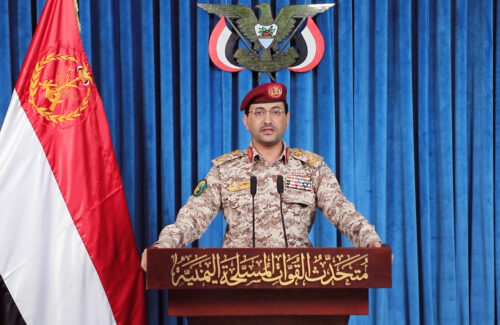
Photo by Handout/Houthi Media Center/Getty Images
The Middle East Institute (MEI) is an independent, non-partisan, not-for-profit, educational organization. It does not engage in advocacy and its scholars’ opinions are their own. MEI welcomes financial donations, but retains sole editorial control over its work and its publications reflect only the authors’ views. For a listing of MEI donors, please click here.
The Mecca Joint Défense Agreement: A New Geometry of Middle Eastern Power?