This article is part of a collection of short essays written by the Fellows of the Middle East Institute to explore aspects of the ongoing war with Iran. The intent of the collection is to help readers see new and unexpected elements of the dynamics and impact of the ongoing hostilities and to think harder, deeper, and broader about the implications of the conflict. To read the other essays from this collection, as well as download the full report, please click here.
The major wars Iran fights become the prism through which its leaders interpret future threats and opportunities. For four decades, Iranian foreign policy has reflected lessons learned from the Iran-Iraq war of 1980-88. Similarly, the US-Israeli wars of 2025 and 2026 will shape how Tehran thinks about deterrence, diplomacy, regional relationships, and the use of military power.
Understanding Iran’s future foreign policy options requires looking back in time. Iranian leaders increasingly portray the Iran-Iraq war, the 2025 12-day war, and the 2026 war not as isolated confrontations but as successive phases of a prolonged struggle with the United States and Israel over regime survival. Whether outside observers share this view is unimportant. What matters is that the narrative has become embedded within Iran’s strategic culture and will likely shape its foreign policy long after the current conflict subsides.
Rather than abandoning the lessons from the earlier devastating hostilities with Iraq, Iran has been adapting them to its current circumstances and conflicts. These adaptations form a baseline from which to posit possible future scenarios. The lessons of the Iran-Iraq war counseled caution, risk aversion, indirect competition, and strategic ambiguity. The lessons of the 2025 and 2026 wars point the other way, with Iran emerging more overt and direct, having a greater propensity for risk, and placing less value on ambiguity. Iran will likely emerge from the current conflagration more confident, hawkish, and strident toward the United States, its Gulf Arab neighbors, and Israel, believing that ambiguity and caution are construed as weakness and invite further aggression. The failed initial US-Israeli attempt to overthrow the regime in 2026 means that Iran is unlikely to ever again take diplomatic overtures on issues like nuclear disarmament at face value; instead, Tehran will suspect all such future talks to be a cover for efforts to weaken the regime.
Strategic Lessons From War
Lesson One: Regime Survival Remains the Organizing Principle of Iranian Strategy
For many Iranian officials, the United States’ (and to a lesser extent, the Soviet Union’s) support for Iraq during the Iran-Iraq war was an attempt to overthrow the revolutionary regime in Tehran. This belief outlived the war, shaping debates over whether accommodation with the West was possible. While some, like President Akbar Hashemi Rafsanjani, argued that Iran could preserve the regime while pursuing economic engagement with the West, others, particularly those close to Supreme Leader Ali Khamenei, remained convinced that engagement would only create new avenues for external pressure on the Islamic Republic.
The 2015 Joint Comprehensive Plan of Action (JCPOA) briefly let Tehran test whether the dispute with Washington centered on the nuclear program rather than the regime itself. Subsequent events discredited that interpretation in Tehran’s view: the 2018 US withdrawal from the JCPOA, the “maximum pressure” campaign that followed, the 2020 killing of Major General Qassem Soleimani, and the 2025-26 wars came to be seen as successive stages of an effort to weaken or overturn the Islamic Republic. The corollary became that the nuclear file was never the core issue.
The aftermath of the 2026 war is likely to dispel any possible doubts within Tehran’s foreign policy establishment about Washington’s true intentions. The killing of Ayatollah Khamenei and most of Iran’s top security leadership, coupled with the many statements made by both President Donald Trump and Prime Minister Benjamin Netanyahu that regime change was their objective, has settled that debate for Iranians. With Iranian leaders increasingly convinced that regime change is ostensibly the enduring objective of US policy toward their country, Tehran will judge future diplomacy vis-à-vis Washington primarily through that lens rather than on specific issues. Negotiations may still occur, but as mechanisms for managing conflict and preserving deterrence rather than as vehicles for strategic reconciliation.
This has profound implications for Iran’s future foreign policy and options for the United States. Rather than expecting diplomacy to transform relations with Washington, Tehran is likely to treat agreements as temporary understandings within a perpetual strategic rivalry, believing the US is chronically predisposed against the regime, regardless of who occupies the White House.
Lesson Two: Breaking Out of Strategic Loneliness
The Iran-Iraq war reinforced a second enduring lesson: Iran ultimately stands alone. Nearly every Arab government supported Iraq, while both the United States and the Soviet Union also tilted toward Baghdad. This hardened into the notion of strategic loneliness, a perceived structural feature of Iran’s position, reinforced by its long history of domination by great powers. The Islamic Republic’s alienation was largely self-inflicted, as its rhetoric about exporting the revolution threatened most of its neighbors. Nevertheless, the perception of strategic isolation became part of the Iranian mindset.
This notion shaped Iranian strategy for decades. Instead of relying on formal alliances with states, Tehran sought security through shadowy non-state actors and embedded itself into the political and security structures of fragile states, including Lebanon, Iraq, Syria, and Yemen. The resulting “Axis of Resistance” was not merely ideological; it was a strategic response to what Iranian leaders viewed as permanent geopolitical isolation.
This strategy carried real costs. While it expanded Iran’s regional influence and created a semblance of deterrence, it deepened Gulf Arab animosity, as many viewed Tehran less as a defensive power than as a revisionist actor undermining Arab sovereignty. Paradoxically, Iran’s antidote for strategic loneliness reinforced its isolation.
The June 2025 12-day war, in which the United States and Israel jointly attacked Iran, decimating a layer of the regime’s security personnel and several nuclear enrichment assets, reinforced this sense of isolation. Although Russia and China maintained strong relations with Iran, both remained on the sidelines, offering only sparing rhetorical and diplomatic support.
The question is whether Iran coming out of the 2026 war places sufficient priority on economic recovery to engage in constructive diplomacy with its Gulf Arab neighbors. Iran’s actions during the war have done serious damage to its relations with the Gulf Cooperation Council (GCC) states, but Tehran may try to exploit Arab doubts about US reliability and play up the fact that Washington started the war to get them to see the necessity of engaging with the Islamic Republic. Tehran will try to make the GCC states feel the full weight of being both dependent on Washington and geographically vulnerable to Iran. If, however, the war persists and Iran’s wartime attacks on Gulf states become its defining legacy, strategic isolation could deepen rather than diminish.
Lesson Three: From Strategic Ambiguity to Overt Deterrence
The third major lesson of the Iran-Iraq war was that Iran could not compete directly with adversaries possessing superior conventional military and economic power. Tehran instead pursued a course of indirect competition, strategic ambiguity, and asymmetric capability, projecting influence through the shadowy world of regional proxies while maintaining a level of vagueness about its own role. This “hiding in plain sight” approach let Iran deter attacks without inviting direct confrontation. And for four decades it underpinned Iran’s forward defense doctrine, shifting confrontation away from the Iranian heartland and into fragile regional states while affording plausible deniability. This deterrence strategy also dovetailed with Iran’s desire to project power into the region, challenge US influence, and keep Israel permanently surrounded by a “ring of fire.” Support for non-state proxies accomplished these objectives: it created deterrence and imposed multiple pressure points on Israel, the United States, and its Arab allies, while providing Tehran with varying degrees of plausible deniability and ambiguity.
After Hamas’ October 7, 2023, attack on Israel, the assumptions underpinning the deterrent element of this strategy began to erode. Israel’s willingness to take greater risks, expand military operations regionally, and strike senior Iranian personnel showed that ambiguity no longer restrained Tehran’s adversaries as it once had.
The 2025 and 2026 wars further eroded confidence that indirect, proxy-based deterrence alone could prevent direct Israeli and American attacks on the Iranian heartland. The likely lesson: deterrence now requires pivoting toward more aggressive, overt, and direct demonstrations of state power, such as missiles, drones, and cyber-attacks, and the specter of a chokehold on the Strait of Hormuz. Meanwhile, the war has also demonstrated that Iran’s own missile and drone forces can have a far greater effect by targeting the Gulf states and interrupting regional energy exports through the Strait of Hormuz.
The objective of this direct approach is not conventional victory but rather the creation of deterrence. Where this once rested on the anticipated response of Iran’s regional partners, it will now likely lean on coercive capability directly attributable to Iran itself. Whether this shift strengthens Iran’s security or exposes it to greater danger remains uncertain. Overt coercive capacity may convince adversaries that future attacks will be prohibitively costly, but it could also raise escalation risk by reducing the flexibility ambiguity once provided. Managing that tradeoff is likely to become one of the defining challenges of Iranian foreign policy after the war.
Iran After the War: Three Strategic Scenarios
The lessons Iran has learned from the war and its aftermath give us a baseline from which to think about how Iran’s foreign policy might adapt going forward. These lessons suggest that the 2025-26 wars are unlikely to produce a complete break from the past in Iran’s foreign policy, at least in the short to medium term. Therefore, Iran’s future foreign policy will likely reflect continuity through adaptation rather than wholesale transformation.
Iranian decision-making is famously opaque, and it is far too early to state conclusively how the war will reorient Tehran’s strategic thinking. However, the lessons the regime appears to have drawn so far suggest a range of scenarios that might be pursued. Which scenario approximates reality will depend on Iran’s domestic politics, leadership dynamics, and the reactions of its neighbors as well as those of the United States and Israel. All scenarios point to Iran being extremely hawkish toward the US and its allies, at least in the near term. Where they differ is in how Iranian officials believe regime security is best achieved after the war.
Scenario One: Fortress Iran
In this scenario, the Islamic Republic concludes that the 2025 and 2026 wars confirmed its darkest assumptions about American and Israeli intentions toward regime change, and emerges more dangerous, threatening, and intent on extracting concessions from its GCC neighbors. Iran remains willing to accept and even embrace strategic isolation, judging that the long-term risks and costs of rapprochement with the United States and its regional allies outweigh the marginal short-term benefits. Diplomatic initiatives, when they occur, are tactical, aimed at buying time rather than reducing strategic hostility. The goal is to convince the GCC states they need to hedge against the United States and “buy” security from Iran. Iran uses the GCC states as hostages in its struggle with Washington, periodically reminding the world of its ability to close the Strait of Hormuz. Pushing the United States out of its forward GCC positions would be Iran’s long-term goal.
Such an Iran relies more on coercive signaling than diplomacy. Economic development is important, but only insofar as it funds the state’s ability to thwart the efforts of the United States and Israel. Rather than a liability, isolation is treated as a necessity, alongside closer ties with Russia and China, and continued investment in missile forces, cyber capabilities, and the Axis of Resistance.
Though the Iranian state of this scenario might look like a continuation of the past, it would be much worse for American and regional interests: namely, an Iran that is more confident, challenging, and demanding, believing a more strident, aggressive foreign policy is necessary to create deterrence.
While in some quarters this scenario is seen as the most likely outcome, it also carries the greatest attendant risks for Iran. Greater reliance on coercion would deepen its regional isolation, incentivize the GCC states to find a way around the threat Iran holds over them, and risk repeated military crises. A strategy designed to maximize deterrence could ultimately undermine the stability necessary for Iran’s own long-term security and economic recovery.
Scenario Two: Active Deterrence With Regional Engagement
This second scenario has many of the same characteristics as the first: Iran believes that to sustain deterrence, it needs an aggressive, hawkish, direct, and forward-leaning foreign policy, and that it needs to try to reduce Washington’s hold over its GCC allies. It also assumes that the US and Israel have not given up their goal of regime change. The difference is that here Iran combines robust deterrence and overall hawkishness with pragmatic regional diplomacy as a means to ensure regime survival.
This does not assume that Iran becomes more conciliatory toward the GCC or abandons its aspiration to force the United States to retreat from its bases in the region. Rather, in this scenario, the leadership surmises that economic engagement is the more effective strategy for strengthening the regime. The objective remains above all else regime survival and Iranian regional influence; only the means change, with the economy viewed as an essential component of regime security.
Another goal of Iranian diplomacy is to try to nudge the GCC states further out of the US orbit rather than to seek to establish a mutually beneficial regional security framework. Given US presence in the GCC states, Iran sees regional security in zero-sum terms. In this scenario, diplomacy becomes another instrument of rivalry, not an alternative to it.
Under the second scenario, Iran likely endeavors to persuade Gulf Arab governments that their security and economic interests are better served by a stable relationship with Tehran than by exclusive dependence on Washington. But believing that the tug of war for GCC alignment with Washington will continue after the war, the Iranians without compunction will exploit GCC insecurity, pressuring the Gulf states to “buy” insurance against Iran’s own threats of possible aggression. Diplomacy is not pursued because Iran sees the GCC states as regional equals but because it serves Iran’s post-war economic needs and ambitions.
Over time, it is possible that economic realities counterbalance the imperative of pursuing a hard-edged foreign policy toward the GCC states. Iran could prioritize economic recovery and the need for foreign investment, while also remaining committed to sustaining deterrence and maintaining a willingness to respond forcefully to perceived threats. Yet in both the short and medium terms, Iran in this scenario remains simultaneously menacing and inclined to use diplomacy to advance an economic agenda. Economic and security considerations are linked and seen as mutually reinforcing: a functioning economy could be necessary for long-term regime survival, keeping in mind the protests motivated by economic concerns that occurred throughout Iran right before the 2026 war.
Scenario Three: Long-Term Strategic Normalization
This scenario is the least likely in the short term but potentially the most significant over the long term. It would not necessarily involve regime change but would require significant regime adaptation. It would likely be a gradual evolution comparable to Vietnam’s transformation after decades of conflict and regional infiltration.
The Vietnam analogy does not imply similar political systems or historical experiences. But both countries emerged from long wars convinced they had resisted a militarily superior United States, and both were animated by revolutionary ideology and regional interventionism. In Vietnam’s case, confidence eventually opened political space for economic reform and broader regional integration without abandoning one-party rule. The catalysts were leadership changes within the regime plus the economic pull of the Association of Southeast Asian Nations (ASEAN), the collapse of the Soviet Union, and the rise of China.
A similar dynamic could eventually emerge in Iran. Under this scenario, the current or future government concludes that regime survival is secure and, therefore, gradually shifts away from resistance against the United States and Israel and toward economic modernization and regional integration. Strategic confidence, paradoxically, creates greater flexibility rather than greater rigidity. But critically, such an outcome assumes that Iran sees itself as coexisting in a region among equals rather than as the dominant player. History both before and since the Iranian revolution suggests that this is a stretch.
Whether Iran can move in this direction is highly uncertain, and perhaps even doubtful, which is why this scenario remains speculative. It would depend on sustained regional stability, a reprioritized domestic agenda, and willingness on the part of external actors to test whether Iranian behavior is capable of gradual evolution. It would also require an understanding by regional and global actors that while Iran may have been motivated by an ambition for regional influence, its behavior has also been shaped by perceptions of threat, legitimate security concerns, and a sense of strategic isolation.
As far-fetched as it may seem today, the third scenario should not be dismissed. History teaches us that states emerging from traumatic wars often redefine their strategic priorities in ways that appeared improbable during and immediately after the conflict. While it may seem unlikely from where we sit now, the death of Ali Khamenei opens opportunities, as narrow and remote as they may be, for a fundamental change in direction.
Implications
The three scenarios presented here differ not only in how Iran seeks to ensure regime survival but also in their implications for regional stability and the welfare of the Iranian people. Iran’s foreign policy since the Iran-Iraq war created a measure of deterrence — though at considerable cost to regional stability and to Iran’s own economic development.
The Fortress Iran scenario would likely amplify those costs. Whereas Iran’s earlier strategy of indirect deterrence imposed many of its costs on fragile states such as Lebanon, Syria, Iraq, and Yemen, a strategy built around direct coercive deterrence would increasingly place economically dynamic Gulf Arab states at risk. The consequences would extend well beyond the region, threatening global energy markets, investment, and broader international economic stability. Such a course could also further delay Iran’s own economic recovery, leaving the Iranian people to bear many of the long-term costs of continued confrontation.
The Active Deterrence With Regional Engagement scenario presents a more mixed outcome. Iran would remain coercive and continue to use deterrence aggressively; however, it would also have stronger incentives to pursue diplomacy with the Gulf Arab states as part of a broader strategy of regime consolidation and economic reconstruction. Competition and coercion would not necessarily disappear, but economic recovery could gradually create incentives for a less confrontational regional environment over time. Whether that dynamic ultimately proves self-reinforcing would depend on decisions made in Tehran as well as in the Gulf Arab capitals, Washington, and Jerusalem.
The Long-Term Strategic Normalization scenario offers the greatest potential benefits for both regional stability and the Iranian people. It assumes not a fundamental change in Iran’s security concerns but a gradual evolution in the means through which those concerns are pursued, placing greater emphasis on economic modernization and regional integration. This would be the best-case scenario for the Iranian people, who are hungry for integration into the global economy and for a better future for their country. Whether that comes through regime adaptation, as occurred with Vietnam in the 1990s, or via a different regime remains to be seen.
For the United States, the policy implications follow naturally from these scenarios. Washington should seek to deter and contain the first scenario, adapt pragmatically to the opportunities and risks presented by the second, and, over the longer term, help create conditions that increase the likelihood of the third. Washington cannot determine which of these scenarios Iran ultimately pursues, but its policies can influence which path becomes more attractive to Tehran.
Ross Harrison is a Senior Fellow and Book Series Editor at the Middle East Institute. He is the author of the book Decoding Iran’s Foreign Policy, published by Bloomsbury in 2025.
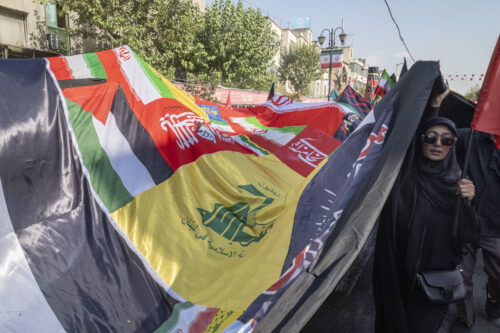
Top image: A banner depicting flags of Iran, Palestine, and Lebanon’s Hizballah, during a rally in southern Tehran, Iran, on August 4, 2026. Photo by Morteza Nikoubazl/NurPhoto via Getty Images.
The Middle East Institute (MEI) is an independent, non-partisan, not-for-profit, educational organization. It does not engage in advocacy and its scholars’ opinions are their own. MEI welcomes financial donations, but retains sole editorial control over its work and its publications reflect only the authors’ views. For a listing of MEI donors, please click here.

Special Episode: Saudi Oil After the East-West Pipeline Attack
The Mecca Joint Défense Agreement: A New Geometry of Middle Eastern Power?