This study proposes a model for constraining and verifying Iran’s ballistic missile arsenal by employing a layered Strategic Verification Model with seven components: comprehensive baseline declarations; missile test and launch monitoring; intrusive inspections; quantitative and qualitative limits on missile capabilities; production controls, especially on solid-fuel manufacturing; a robust enforcement and compliance architecture; and regional confidence building measures.
This study proposes a model for constraining and verifying Iran’s ballistic missile arsenal in the aftermath of the recent war with the US and Israel. While the war significantly reduced Iran’s missile inventory and degraded key elements of its missile-industrial base, Tehran retains a substantial residual capability and, more importantly, the expertise, infrastructure, and motivation necessary to rebuild. The central challenge for policymakers is therefore not simply reducing Iran’s current arsenal, but creating a verification system capable of detecting, deterring, and constraining future reconstitution.
Missile verification presents challenges fundamentally different from those encountered in nuclear arms control. Unlike the nuclear domain, there is no binding international regime governing missile proliferation, no permanent international inspection organization, and no equivalent to fissile material that can serve as a quantifiable verification measure. Missiles are mobile, can be concealed, are frequently produced in dual-use facilities, and can be reconstituted even after large-scale destruction. Verification must therefore focus not only on inventories, but on the broader industrial and operational ecosystem that sustains missile production and deployment.
Drawing on lessons from Iraq, Libya, North Korea, and past arms-control agreements, the study proposes a layered Strategic Verification Model based on seven pillars: comprehensive baseline declarations; missile test and launch monitoring; intrusive inspections; quantitative and qualitative limits on missile capabilities; production controls, especially on solid-fuel manufacturing; a robust enforcement and compliance architecture; and regional confidence building measures.
The model is intentionally ambitious and should be understood as an ideal type — a conceptual framework designed to identify the measures most likely to constrain and verify Iranian missile reconstitution. In practice, Iran has consistently rejected limitations on its missile forces and any negotiated agreement would almost certainly fall short of this ideal type. Nevertheless, the value of the model lies precisely in establishing a comprehensive benchmark to guide the thinking of American negotiators and against which they can assess tradeoffs.
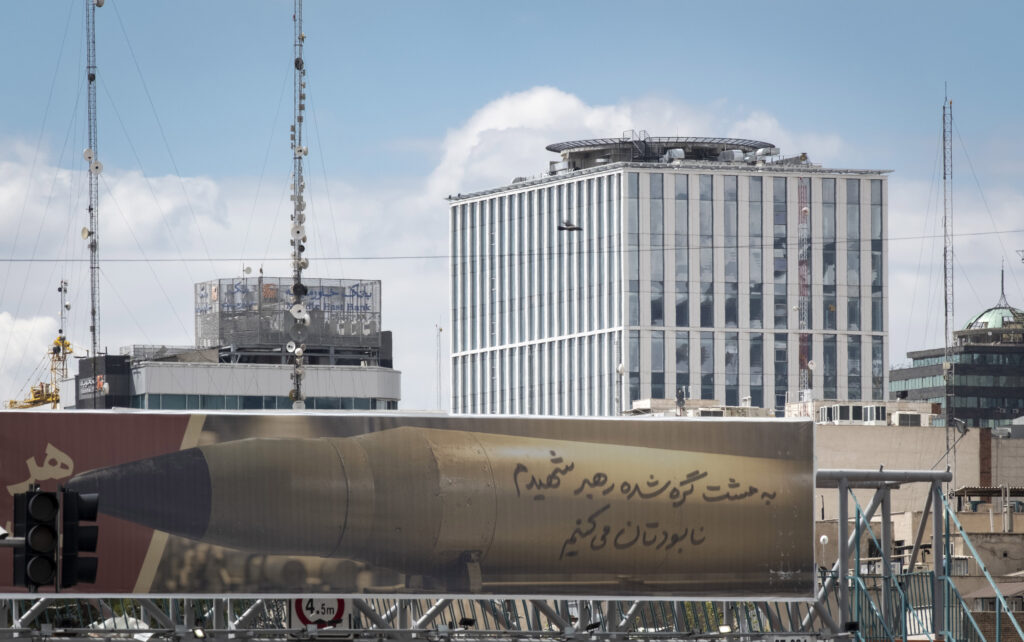
Photo above: A banner depicting an Iranian ballistic missile in Tehran, Iran, on March 30, 2026. Source: Morteza Nikoubazl/NurPhoto via Getty Images.
Introduction
In the aftermath of the US and Israeli war with Iran, one of the thorniest issues facing Washington will be how to ensure and verify that Tehran’s ballistic missile arsenal remains significantly reduced from its prewar size. Ballistic missile verification is fundamentally different and, in many respects, more difficult than nuclear arms control because it lacks three foundational pillars of the latter: there is no binding international regime or other prohibition governing missile possession; no standing international inspections mechanism; and no equivalent to fissile material as a quantifiable, trackable unit that anchors verification.1
To these fundamental problems, one must also add Iran’s staunch opposition to the imposition of any limitations on its missile arsenal and the difficulties facing the American negotiating position. The challenge is then to craft a verification model that can serve American negotiators, in the expectation that not all elements will survive the negotiating process.
Prior to the recent war, Iran possessed the largest ballistic missile arsenal in the Middle East, supported by a dispersed industrial base and increasingly reliant on solid-fuel propulsion. Its force structure emphasized survivability and reconstitution, incorporating underground “missile cities,” mobile transporter-erector-launchers (TELs), and dual-use production infrastructure.2 US and Israeli intelligence reportedly estimate that Iran’s overall missile inventory has been roughly halved, yet Tehran retains thousands of short-range missiles (under 1,000 kilometers) that place the Gulf states within range and more than 1,000 of the estimated 2,500 medium-range missiles (1,000-3,000 kms) capable of hitting Israel and central Europe that it had at the start of the war. The war significantly degraded Iran’s industrial and technological base, whose reconstitution will be more difficult this time than after the 12-Day War in 2025. Nevertheless, the regime’s demonstrated ability to rapidly rebuild its missile arsenal following the June war caught the US and Israel by surprise.3
In the absence of binding international instruments for the regulation and verification of ballistic missile arsenals, a special Strategic Verification Model is proposed below. The model draws upon concepts and mechanisms from previous arms control treaties, such as the Intermediate-Range Nuclear Forces Treaty (INF), the Strategic Arms Reduction Treaty (START) and New START, the Chemical Weapons Convention (CWC), and the 2015 Iran nuclear deal (officially the Joint Comprehensive Plan of Action, or JCPOA), to address the specific challenges of Iran’s highly mobile and dual-use missile and space program. The model includes a layered architecture for missile oversight, combining baseline declarations, continuous monitoring, intrusive inspections, production controls, a credible enforcement framework, and regional confidence building measures (CBMs). No single mechanism is sufficient, and at least some degree of Iranian cooperation will be required, but their combination can generate a verification model in which violations are detectable, attributable, and of political consequence.
Why Missile Verification Is Different
Nuclear verification rests on an institutionalized architecture based on an internationally recognized and binding regime, the Treaty on the Non-Proliferation of Nuclear Weapons (NPT), standardized accounting methodologies, and a permanent international verification mechanism in the form of the International Atomic Energy Agency (IAEA). By contrast, there is no comparable global regulatory regime for ballistic missiles. Existing arrangements, notably the Missile Technology Control Regime (MTCR) and the Hague Code of Conduct Against Ballistic Missile Proliferation (HCoC), are voluntary arrangements, limited in scope, and lacking in intrusive verification provisions.4 Further complicating the picture, missiles are inherently mobile, allowing rapid dispersal and concealment; share critical dual-use technologies with civilian space-launch vehicles; are reproducible so that destruction of arsenals does not eliminate future capability; and are an accepted part of conventional warfare, thereby complicating the imposition of external political constraints on their build up or the sharing of this technology between countries.5 These characteristics fundamentally alter the logic of missile verification.
In nuclear arms control, verification was often viewed as a problem of fissile material accountancy, ensuring that nuclear material is declared, safeguarded, and not diverted. In practice, however, modern nuclear verification already extends well beyond this, to encompass production facilities and capacity along with elements of the broader fuel cycle. The distinctive challenge in the missile domain is the absence of a single, organizing verification anchor. Without an equivalent to fissile material, missile verification must integrate multiple, imperfect indicators: tracking systems, limits on capabilities, the monitoring of production capacity, and detection of qualitative improvements through testing and deployment. The result is a verification mechanism that requires continuous, system-wide monitoring of an industrial and operational ecosystem rather than — as in the case of nuclear arms control — focus on any single metric or chokepoint.6
The Search for a Missile Equivalent to Fissile Material
A central challenge in designing a verification regime for ballistic missiles lies in the absence of an analogue to fissile material. Nuclear verification is anchored in the accounting of a scarce, indispensable, and physically measurable input — highly enriched uranium or plutonium — whose production, storage, and diversion can be monitored with relatively high confidence.7 This material anchor provides both a conceptual and operational foundation for verification: it defines the object of measurement, establishes quantifiable thresholds, and enables the construction of inspection regimes oriented around containment, surveillance, and material balance.8
No equivalent exists in the missile domain. Ballistic missiles are not defined by a single indispensable input but by the integration of multiple industrial components, including propulsion, airframe, guidance, and launch systems, each of which can be produced, procured, modified, stored, or concealed in a variety of ways. As a result, missile verification must contend with a distributed industrial ecosystem that resists simple quantification.9
The closest functional analogue lies in the production of solid rocket propellant, particularly the composite solid fuels used in modern short- and medium-range ballistic missiles. Systems such as Iran’s Fateh-110 and the Sejjil family of missiles depend on solid propellant formulations typically composed of ammonium perchlorate oxidizer, aluminum powder fuel, and polymer binders such as hydroxyl-terminated polybutadiene. These materials are produced and processed in specialized facilities requiring distinctive mixing, casting, and curing equipment, creating identifiable nodes within the missile production chain.10
Monitoring propellant production capacity can provide insight into the scale of missile production. This can be done through a variety of measures, such as portal and perimeter monitoring, environmental sampling, and accounting of precursor input.11 Nevertheless, this approach has a number of important limitations.
Unlike fissile material, solid propellant precursors are not inherently scarce or uniquely identifiable. Ammonium perchlorate and aluminum powder have significant civilian applications, and their production can be embedded within broader chemical industries.12
Missile production lacks a single bottleneck input. While solid propellant is essential for certain types of missiles, others use liquid fuels or hybrid systems; and even within solid-fuel systems, multiple designs and supply chains exist.13 This multiplicity reduces the effectiveness of any single-point control strategy and enables diversification as a hedge against monitoring.
Stockpiling dynamics differ fundamentally from those of fissile material. Chemical precursors and partially processed propellant can be stored, dispersed, and concealed with relative ease.14 Even effective monitoring of ongoing production may not account for pre-existing inventories or hidden reserves.
Missile capability is not reducible to propellant alone. Airframes, guidance systems, and integration processes are equally critical and, in many cases, more technologically sensitive.15 A regime that successfully constrains propellant production may still fail to prevent qualitative improvements in accuracy, survivability, or payload delivery.
Missile verification cannot, therefore, replicate the material-centric logic of nuclear safeguards and must rely instead on a set of partially observable industrial indicators. Taken together, these indicators provide a composite picture of capability, including not just propellant production but also motor casing fabrication, guidance system development, test activity (including telemetry), and deployment patterns. Each element is individually imperfect; collectively, together with a robust verification regime and confidence building measures, they can provide a sufficiently comprehensive basis for assessing compliance.16
Iran as a Particularly Hard Case
Iran represents one of the most demanding cases for missile verification due to the scale, structure, and doctrinal role of its missile program. Iran’s production facilities are geographically dispersed and embedded within dual-use industrial sectors, complicating identification and verification. Its arsenal includes short-range systems such as the 200-300 km Fateh-110 and medium-range systems like the 1,300-2,000 km Shahab-3 and 2,000-2,500 km Sejjil. These systems increasingly rely on solid-fuel propulsion, which significantly reduces launch preparation time, thereby complicating detection and enhancing survivability. Moreover, Iran has developed an extensive network of underground storage and launch tunnels, known as “missile cities,” explicitly designed to ensure survivability even against bunker busters.17 US and Israeli bombing during the 2026 war repeatedly collapsed the entrances to the tunnels, only to find that the Iranians had developed the means to rapidly dig them out and restore missile fire.18
Prior to the 12-Day War in June 2025, Iran reportedly possessed well over 1,000 solid-fueled Fateh-family missiles, several hundred Shahab and other medium-range ballistic missiles, and a considerably smaller force of Sejjil missiles, probably numbering in the tens. During the eight months between the 2025 and 2026 wars, Iran appears to have replenished roughly 1,000 missiles, implying production rates on the order of 100-125 missiles per month. The 2026 US-Israeli campaign targeted Iran’s missile-industrial infrastructure extensively, disrupting production. By May 2026, however, US and Israeli intelligence reportedly assessed that missile manufacturing had resumed in surviving and improvised facilities, although no authoritative public estimate of current production rates, or exact inventories, has been released.19
Iran’s missile program is also part a broader regional strategy. Transfers of missile systems and technologies to non-state actors, such as Hizballah in Lebanon and the Houthis in Yemen, extend the verification problem beyond Iranian territory, creating a wider and networked proliferation challenge.20
These features generate four core verification challenges: concealment of undeclared systems, rapid reconstitution through industrial capacity, qualitative transformation through incremental technological improvements, and the degree to which China and Russia prove willing to respect the limitations placed on Iran’s arsenal and/or a way to track and block, or deter, their assistance to Tehran. Any viable verification regime must address all four challenges.
Limits on Iran’s missile arsenal would be based on the MTCR criteria: a ban on missiles capable of carrying a warhead of more than 500 kilograms (kg) and a range of over 300 kms.21 Expanding on UN Security Council resolutions 1929 and 2231, a full ban would be placed on nuclear missiles of any range.22 These limitations would still leave all Gulf countries within the MTCR missile range from Iran, with the exceptions of central and western Saudi Arabia, western Iraq, and parts of the UAE, Bahrain, and Kuwait.
Ideally, Iran would not have any missiles whatsoever. However, in the absence of any international norms or regimes to this effect, the legitimate use of missiles in conventional warfare, and Iran’s emphatic protestations that it cannot be denied “defensive” capabilities accorded to other states — and now President Donald Trump’s recognition of this position — this is not a realistic objective.23 To assuage the Gulf countries’ understandable fears, following Iran’s repeated missile attacks against them during the 2026 war, a limit might be imposed on the number of conventional missiles Iran is allowed to possess, even within the MTCR restrictions.
Comparative Lessons: Iraq, Libya, and North Korea
Historical precedents demonstrate that missile verification is not primarily a technical problem but a political and operational one, in which effectiveness depends on the interaction between inspection mechanisms, state cooperation, concealment strategies, and enforcement credibility. The experiences of Iraq, North Korea, and Libya illustrate three distinct cases: intrusive but contested verification, verification collapse, and cooperative rollback, respectively. Each offers concrete lessons for the design of a post-war missile regime for Iran.
Iraq: Intrusive Verification Under Adversarial Conditions
The Iraqi case, particularly under the United Nations Special Commission (UNSCOM) and its successor, the United Nations Monitoring, Verification and Inspection Commission (UNMOVIC), represents the most extensive attempt to verify and dismantle a missile program under conditions of hostility and concealment. Following the 1990-91 Gulf War, Iraq was subjected to an intrusive inspection regime that combined on-site inspections, aerial surveillance, and monitoring of dual-use industrial infrastructure.24
Inspectors achieved significant successes. UNSCOM identified and oversaw the destruction of large numbers of proscribed missile systems, including extended-range Scud variants, and uncovered previously undeclared production facilities and support infrastructure. The organization also developed innovative verification techniques, including no-notice inspections, document exploitation, and cross-referencing of industrial inputs, which allowed inspectors to reconstruct elements of Iraq’s missile program even in the absence of full disclosure.25
At the same time, Iraq systematically pursued concealment. The regime employed denial and deception measures, including the dispersal of equipment, falsification of records, and use of dual-use civilian facilities to mask prohibited activities. Iraqi authorities also manipulated access, delayed inspections, and exploited political divisions within the Security Council to weaken enforcement. The result was a partial but incomplete verification outcome.26 For Iran, this implies that inspection authorities must assume concealment as a baseline condition and be prepared to address it, particularly through challenge inspections, industrial monitoring, and integration with national intelligence.
North Korea: Verification Breakdown and Unconstrained Development
North Korea represents the opposite extreme: a case of verification failure followed by unconstrained capability development. Early efforts to limit North Korea’s missile and nuclear programs, including the 1994 Agreed Framework and subsequent negotiations, failed to establish durable monitoring and enforcement mechanisms.27
In the missile domain, the absence of sustained verification allowed North Korea to develop a progressively more advanced arsenal, including solid-fuel systems, road-mobile launchers, and intercontinental ballistic missiles (ICBMs). Testing proceeded largely unhindered, enabling rapid qualitative improvements in range, accuracy, and survivability.28 Crucially, North Korea invested heavily in mobility, concealment, and underground infrastructure, paralleling many features of Iran’s current missile enterprise. Without continuous monitoring or inspection, external actors were forced to rely on national technical means, which proved insufficient to constrain development.29 The lesson for Iran is clear: verification must be continuous and resilient, not episodic or politically contingent.
Libya: Cooperative Disarmament and Rapid Transparency
Libya’s decision in 2003 to abandon its weapons of mass destruction programs presents a contrasting model of cooperative rollback. Unlike Iraq and North Korea, Libya chose to disclose its programs and permit external verification, enabling inspectors to quickly identify, secure, and remove sensitive materials and equipment.30
In the missile domain, Libya’s capabilities were limited relative to Iraq’s or Iran’s, consisting primarily of Scud-class systems and nascent efforts to acquire longer-range technologies. The absence of an extensive industrial base and the regime’s willingness to provide access enabled rapid verification and dismantlement. External actors, including the United States and the United Kingdom, played a direct role in securing and removing key components.31
Libya demonstrates the obvious, that verification is most effective when it is accompanied by a strategic decision by the inspected state to cooperate, enabling inspectors to focus on confirmation rather than discovery. However, a future Iranian verification regime cannot assume the degree of access or voluntary disclosure that characterized the Libyan case and must be designed to function effectively even in the absence of full cooperation.
These cases yield three central lessons for the design of a verification regime for Iran.
Intrusiveness is necessary but not sufficient. Even highly intrusive inspection regimes can be undermined by concealment unless backed by sustained international enforcement. Verification mechanisms must therefore be designed to operate, to the extent possible, under conditions of non-cooperation.
Transparency is critical but cannot be assumed. Comprehensive declarations and immediate access can dramatically improve verification outcomes, but Iran’s strategic posture suggests that any such transparency would be partial and contested. The regime must therefore be robust to compensate for incomplete disclosure.
Verification failure enables rapid missile development and becomes increasingly difficult to contain. This underscores the importance of maintaining continuous verification and credible enforcement mechanisms over time.
Source: Designed by the author.
The Strategic Verification Model
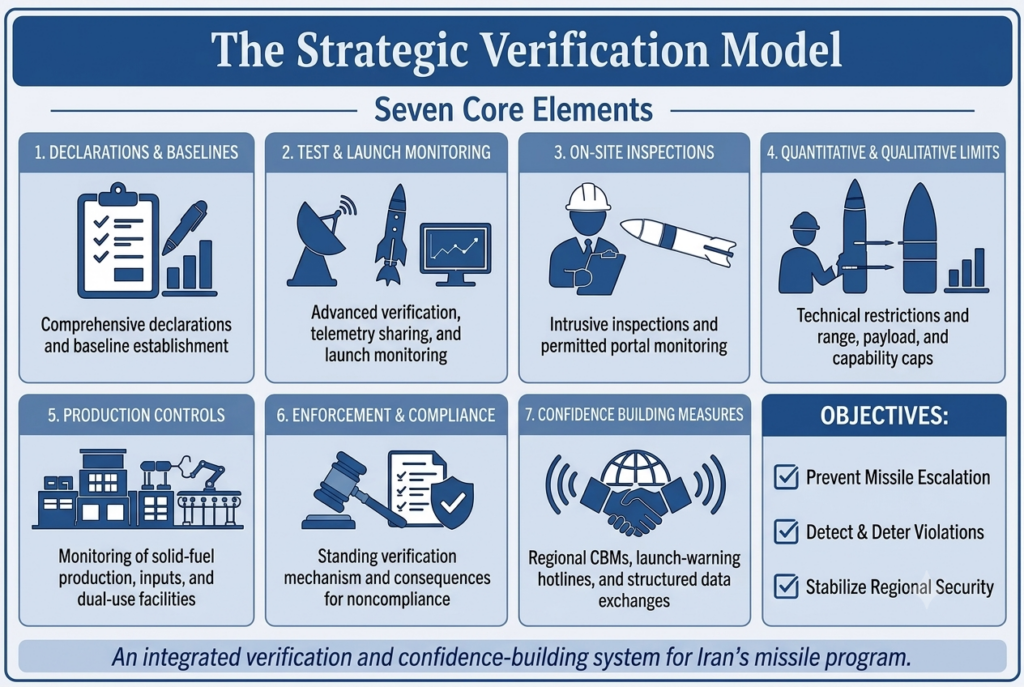
In light of the historical lessons from the above cases, the experience gained from a variety of nuclear and other weapons of mass destruction arms control agreements explicated below, and present-day political realities, a workable ballistic missile verification model for Iran would be based on the following seven primary components: declarations and baseline transparency; test and launch monitoring; on-site inspections; quantitative and qualitative limits; production controls; enforcement and compliance architecture; and regional confidence-building measures. Each of these components is further broken down into a number of sub-components, as laid out in the following section. A conceptual overview of the model appears in the following figure.
I. Declarations and Baseline Transparency
Comprehensive Baseline Declarations
Missile programs thrive on opacity. The foundation of any verification regime is thus the establishment of a credible baseline, without which inspectors cannot fully determine compliance or detect violations.32 A complete baseline declaration by Iran would need to be unusually comprehensive and rapid, to minimize concealment, including: missile types, quantities by serial number, ranges and payloads, storage sites (including tunnels), production facilities, test ranges, command structures, and associated entities like the Islamic Revolutionary Guard Corps (IRGC) and the Aerospace Force and Aerospace Industries Organization (AIO), the central state entity responsible for Iran’s missile and aerospace programs. Each missile and launcher should be individually identified through unique identifiers and linked to specific locations.33
This requirement draws directly on the above experience of UNSCOM in Iraq. Although Iraq’s declarations were both intentionally and unintentionally incomplete, misleading, and false, they still provided an important basis that enabled inspectors to challenge discrepancies and gaps in the information provided, demand repeated clarifications and elaborations, and produce a working, if still incomplete, baseline. The requirement also draws on the IAEA’s experience with nuclear verification in Iran itself, which encountered similar obstacles, and on the experience of strategic arms control agreements such as START and New START, which mandated detailed data exchanges covering deployed and non-deployed systems, as well as the CWC, which requires the declaration of all relevant facilities.34
Regular Data Updates
Given the inherent mobility and dispersal of missile systems, static baseline declarations quickly lose relevance. Continuous reporting is thus required to ensure alignment between declared and extant capabilities and should include all changes in inventory, movements between facilities, and production, regardless of warhead weight and missile range. This type of reporting requirement is well established in existing verification practice. Under IAEA safeguards, states must provide ongoing inventory change reports and submit to continuous monitoring. The JCPOA combined regular declarations with continuous surveillance of key facilities. The New START Treaty mandated regular data exchanges and detailed notifications regarding the status, movement, and deployment of strategic systems. The INF Treaty complemented baseline declarations with extensive inspections and continuous portal monitoring at designated missile production facilities.35
II. Test and Launch Monitoring
Advance Notification of Missile Tests
Tests are critical for improving missile accuracy, range, and payloads, and monitoring them is therefore essential to constraining capability development. Advance notification requirements (e.g., 45 days ahead) should be mandatory and detailed, including launch location, trajectory, payload characteristics, and test purpose, and international observers should be allowed. The notification requirement strengthens the voluntary Hague code (HCoC) ballistic missile anti-proliferation guidelines into a binding mandate that would address opaque tests serving as cover for upgrades.36
Telemetry Sharing
Under START I, restrictions on telemetry encryption enabled independent verification of missile capabilities. Telemetry — the electronic data transmitted from a missile during flight testing — can provide direct insight into propulsion performance and flight characteristics, such as velocity, acceleration, altitude and trajectory, payload configurations, improvements in accuracy and guidance systems, solid-fuel innovation parameters, and the potential for carrying multiple independently targetable reentry vehicles (MIRVs).37 These factors cannot be reliably inferred through external observation and are important for purposes of verification.38
III. On-Site Inspections
Perimeter and Portal Monitoring
Once deployed, missiles can be dispersed and concealed, making tracking them highly unreliable. The mobility of missile systems thus necessitates intrusive inspection mechanisms at the manufacturing, assembly, and deployment stages. Under the INF Treaty, continuous monitoring at production facilities allowed inspectors to track missile output in real time. This “portal monitoring” model provides a direct precedent for verifying missile production in Iran. It includes inter alia placing continuous cameras, seals, and sensors at declared sites (production sites, storage bunkers), scanning exiting vehicles for missile signatures (e.g., propellants), as well as measuring seismic/acoustic signals at Iran’s “missile cities.”39
Regular and Challenge Inspections
In addition to regularly scheduled inspections, which provide opportunities for concealment and deception, “challenge inspections,” which give inspectors access to sites on short notice, are essential. The CWC’s challenge-inspection provisions mandated access to suspect sites within 120 hours, although various inspection procedures, including the establishment of a perimeter monitored by inspectors, could occur much earlier.40 For Iran’s missile program, a more effective mandatory inspection window might be 12-24 hours.
IV. Quantitative and Qualitative Limits
Warhead Separation
The separation of warheads from missile airframes, and verification of this through tagging, sealing, and on-site inspections, can constrain operational readiness and create observable indicators of escalation. Under START and New START, warheads and delivery systems were treated as distinct accountable entities, distinguishing between deployed and non-deployed systems and increasing the likelihood that efforts to ready missiles for launch would generate detectable signatures and warning indicators.41
Range, Payload, and Capability Caps
The Gulf states are all well within range of Iran’s short-range missiles, but restricting longer-range systems would place western Saudi Arabia, western Iraq, Jordan, Egypt, and Israel beyond their reach. Verification would require linking range limits to parameters such as telemetry, propulsion characteristics, and test data. The MTCR established strict controls on the transfer to third parties of systems capable of delivering a 500-kg payload over a range of at least 300 km. The verification regime could scale this to the agreed-upon cap, using counting rules and payload definitions adapted from New START. Qualitative curbs might also block hypersonic or MIRVed missiles.42
V. Production Controls
Monitoring of Solid-Fuel Production
Solid-fuel missiles, which can be launched far more easily and rapidly than the liquid-fueled variety, constitute a growing part of Iran’s arsenal. But production of solid fuels requires key precursor chemicals and highly specialized equipment, such as “planetary mixers,” for which Iran has historically relied on imports; that said, it may be developing limited indigenous production capacity. Production capacity is the central determinant of Iran’s ability to reconstitute its missile arsenal. Limits on the import of key precursor chemicals and equipment would provide inspectors with observable indicators of production capability, surge activity, and potential breakout. Caps might also be imposed on total output. This approach mirrors the logic of the JCPOA, which emphasized monitoring manufacturing capabilities, such as centrifuge production and uranium stockpiles.43
Tags and Unique Identifiers
The application of tags and unique identifiers would enable tracking of individual missiles and components and ensure that an already known missile cannot be secretly swapped out for a newly manufactured, covert one. They are thus essential for maintaining continuity of knowledge. The use of unique identifiers and fiber-optic seals is standard to the IAEA’s containment and surveillance methodology. These techniques have also been developed further under the International Partnership for Nuclear Disarmament Verification (IPNDV), a multinational initiative designed to develop practical methods and technologies for verifying nuclear disarmament and arms-control agreements.44
VI. Enforcement and Compliance Architecture
No verification regime can function without credible enforcement. Technical monitoring, inspections, and transparency measures can generate information, but they cannot compel compliance in the absence of mechanisms that impose costs for violations. A post-war missile verification regime for Iran must therefore incorporate a robust enforcement and compliance system, combining institutional oversight, intelligence integration, and pre-agreed response mechanisms designed to operate with speed and credibility.
Standing Verification Mechanism
A standing verification mechanism responsible for implementing inspections, managing data exchanges, and adjudicating compliance questions would be at the core of this system. While no direct analogue exists for missile verification, relevant precedents can be found in both nuclear and chemical weapons control regimes. The IAEA and the Organization for the Prohibition of Chemical Weapons (OPCW) demonstrate the importance of permanent, technically capable institutions with standardized procedures and established inspection mechanisms.45 Such a body in the Iranian case would ideally require a hybrid structure, combining international inspectors with US and European partners, given their intelligence capabilities and political leverage, although Iran is likely to object to their participation, especially that of the US.
Intelligence Oversight
Unlike nuclear safeguards, which rely heavily on declared material accountancy, missile verification depends on monitoring a geographically dispersed network of production facilities, storage depots, transportation systems, launch units, and support infrastructure. This makes the integration of national intelligence capabilities into the verification process indispensable, including satellite imagery, signals intelligence, and cyber capabilities.46 The experience of Iraq under UNSCOM is instructive: monitoring visits were significantly enhanced by intelligence-sharing arrangements, which allowed inspectors to target sites, detect concealment, and reconstruct undeclared activities.47
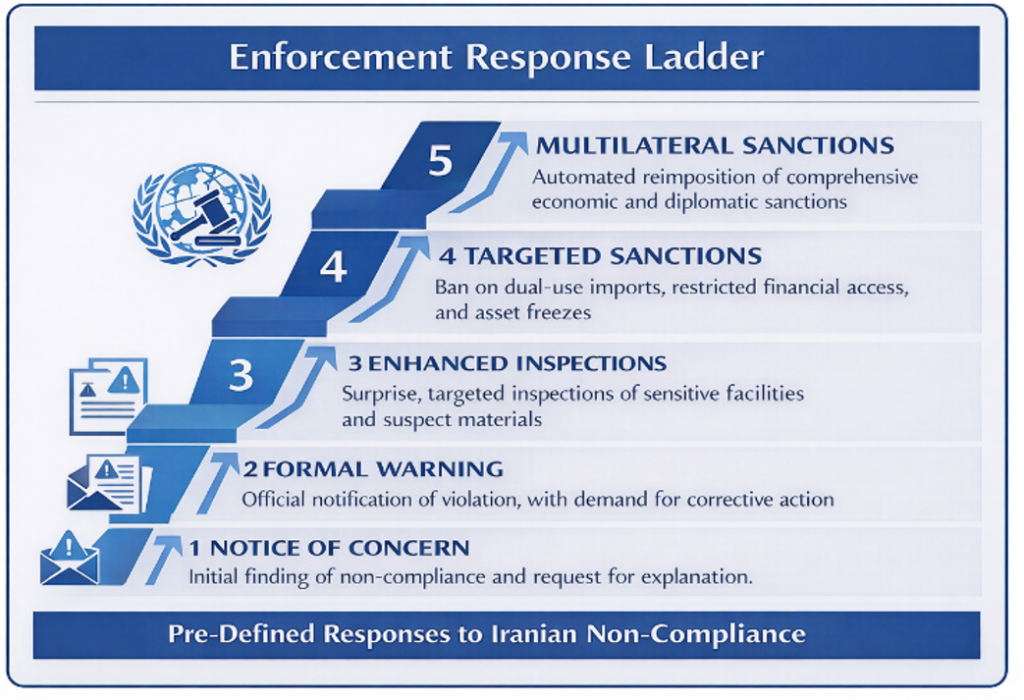
Predictable and Automatic Consequences for Non-Compliance
A structured response mechanism that defines the consequences of non-compliance in advance, based on predictable and automatic penalties, is critical. The JCPOA offers a relevant precedent through its “snapback” provision, which provided for the automatic reimposition of UN sanctions in response to significant non-compliance, without need for a new Security Council resolution.48 Inclusion of this pre-authorized pathway for action addressed a central weakness of earlier regimes: the ability of political divisions within the Security Council to block enforcement.
For missile verification, a graduated enforcement ladder could be established, ranging from formal warnings and enhanced inspection requirements for limited violations to targeted sanctions and restrictions on dual-use imports for more significant ones, and at the upper end, for the most severe violations, multilateral economic and diplomatic measures. The key principle is that response triggers should be pre-defined and linked to specific categories of violation, reducing ambiguity and limiting opportunities for political delay. Since not every possible violation cannot be foreseen in advance and defining them in detail might merely serve to encourage Iran to test the international response by conducting violations at the edge of each violation level, they should not be spelled out.
Source: Designed by the author.
Violations in the missile domain, particularly those involving production surges or covert deployments, can rapidly translate into operational capability. Enforcement mechanisms must therefore be able to respond swiftly enough to affect behavior before violations produce irreversible outcomes. This argues for streamlined decision-making procedures and the delegation of certain authorities to the verification body or to a designated group of states.49
The duration of the enforcement and compliance architecture is also a critical factor. Unlike short-term confidence-building arrangements, missile verification must address long-term reconstitution dangers. Iran’s industrial base, technical expertise, and strategic incentives suggest that constraints would need to remain in place for an extended period, on the order of decades rather than years, although there would be various mechanisms for lifting them, such as a verified end to the missile program, peace with Israel and the Gulf states, and more.50 A timeframe such as this would align with the logic of other long-duration arms control arrangements, allowing sufficient time to shape industrial capabilities, institutionalize transparency practices, and reduce incentives for rapid breakout. Durability must be balanced with adaptability. Over such a prolonged period, technological developments — particularly in areas such as solid-fuel production, guidance systems, and unmanned delivery platforms — may alter the nature of the missile threat. The enforcement architecture should therefore include review and adjustment mechanisms, enabling periodic reassessments of obligations, verification tools, and response thresholds.51
Finally, enforcement must be understood as part of a broader system of deterrence and signaling. The credibility of the verification regime depends not only on formal mechanisms but also on the perceived willingness of key actors to act on violations. Enforcement requires clearly defined rules as well as sustained commitment by the United States and its partners to uphold those rules over time.
VII. Regional Confidence-Building Measures
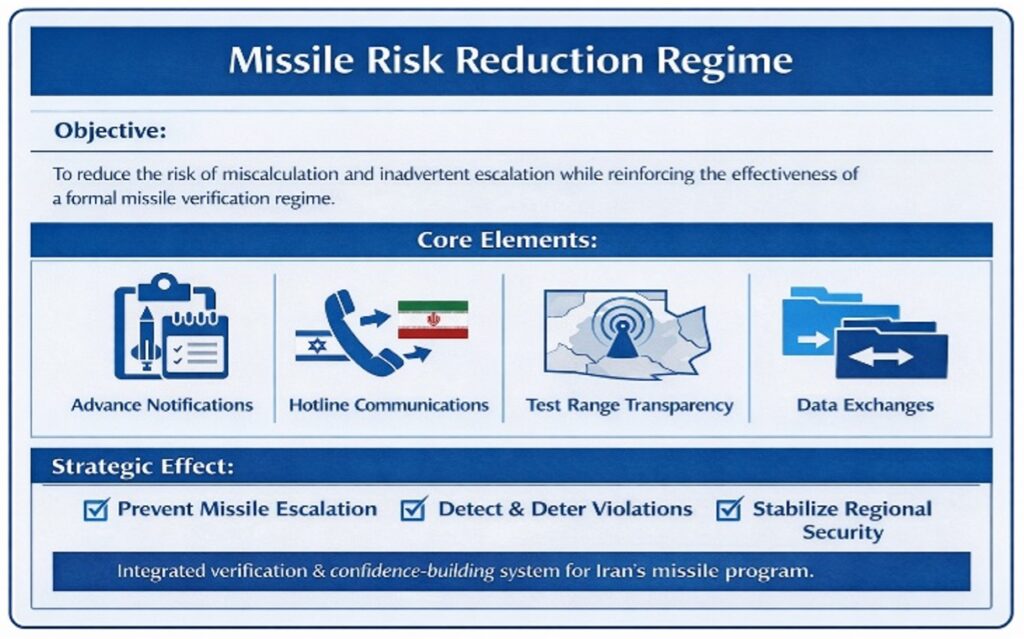
To be most effective, verification should be embedded within a broader regional security framework. Technical monitoring alone cannot eliminate uncertainty in a missile environment characterized by mobility, concealment, and exceedingly short decision times. CBMs, such as advance notification of missile tests, launch-warning hotlines, and structured data exchanges, establish expected patterns of behavior and in so doing enhance detectability and attribution. Deviations from these expectations, e.g., unannounced launches, unexplained disruptions in communication, or inconsistencies in declared activity, can serve as early indicators of non-compliance. CBMs can thus serve as an important complement to formal verification by reinforcing transparency, reducing the risk of miscalculation, and strengthening the evidentiary foundation for enforcement actions.52
The logic of such measures is well established in prior arms control experience. During the Cold War, US-Soviet agreements institutionalized measures explicitly designed to prevent misinterpretation of military activities. The 1971 Agreement on Measures to Reduce the Risk of Outbreak of Nuclear War and subsequent arrangements, including the 1988 Ballistic Missile Launch Notification Agreement, required advance notification of missile launches and established communication channels to clarify ambiguous events.53 Additional precedent can be found in the HCoC, which established voluntary commitments to pre-launch notifications and annual declarations regarding ballistic missile policies and activities.54
In the Middle Eastern context, the most relevant precedent is the Arms Control and Regional Security (ACRS) process from 1992 to 1995. Although the ACRS did not result in a formal agreement, it did develop a substantial body of proposals for regional CBMs.55 Conversely, the ACRS’s ultimate collapse underscored that CBMs cannot be sustained in isolation from deeper political understandings and credible enforcement mechanisms.
Source: Figure design by the author.
Within a post-war Iranian context, these precedents suggest the value of a regional CBM architecture involving Iran, the Gulf states, the US, and other international actors, as agreed. Israel should be part of this architecture, too, but given Iran’s likely refusal to participate in any regional arrangement in which it is involved, this might only come at some later date. Iran would presumably also object to American involvement, but the prospects for adoption of this model, if at all, are only likely in the context of some broader easing of US-Iranian tensions. The regional architecture would mandate advance notification of missile tests and space-launch activities, including disclosure of launch windows, trajectory corridors, primary test ranges, and basic payload categories. Regular data exchanges would add to transparency. This would be reinforced by dedicated communication channels and an incident-notification mechanism, linking Iranian, Gulf, and US command structures, thereby enabling rapid clarification of ambiguous events, including failed tests or unintended launches.56
A framework such as this would help stabilize the regional security environment by reducing the likelihood of inadvertent escalation; support verification by providing behavioral context for technical monitoring and inspection findings; and facilitate enforcement by clarifying thresholds for identifying violations and justifying responsive measures.57 Even partial implementation could yield meaningful benefits by increasing predictability and lowering the risk of miscalculation, which are of particular value in managing crises and signaling intent under conditions of persistent uncertainty. CBMs, however, are dependent on political will and reciprocity, and cannot substitute for robust verification or credible enforcement.58
Conclusion
Missile verification is inherently imperfect, but it is not futile. A layered system combining the elements outlined herein can significantly constrain capabilities. For the United States, a credible missile verification regime would complement post-war arrangements with Iran in the nuclear and other domains, support regional stability, reinforce nonproliferation norms, and reduce the likelihood of repeated military confrontations. For US allies in the region, for whom Iran’s missile arsenal represents a direct threat to their security, effective verification would enhance early warning, reduce uncertainty, and shape escalation dynamics.
Arguably the greatest obstacle to an effective missile verification regime for Iran is not the manifold technical and operational complexities set out in this study, but the need to secure at least some measure of Iranian cooperation — or the “what’s in it for Iran” question. This question is particularly salient for two reasons: the way the war ended with the April cease-fire, with a strong sense in Iran that it had prevailed, and the terms of the recently signed MoU, which can be understood, if only implicitly, to preclude negotiations on issues not specifically mandated in it, such as Iran’s ballistic missile arsenal.
In the end, there is no good or simple answer to the question of what’s in it for Iran. The US has likely missed its opportunity to make the missile issue part of the current 60-day negotiating process and given up many of its sources of leverage over Iran. Conversely, if, as is most likely, a final deal cannot be reached within 60 days and possibly considerably beyond that, Washington might then have the basis for contending that the Iranians have not met their commitments and for reopening some of the MoU’s terms. In these circumstances, were the US to offer Iran even greater positive inducements, were it to assume a more coherent and steadfast negotiating posture, backed up — in the event of a collapse of the talks — by a greater willingness to resume significant military operations as a means of diplomatic coercion, it might not be too late to reintroduce the missile issue. As it is, there is no assurance that the current negotiating process will end in an agreement. Indeed, one plausible outcome is that there will be no agreement, but a de facto cease-fire that will hold, for the most part, until one of the sides decides to substantially change the situation.
Even assuming Iranian willingness to accept the principle of a missile verification architecture, there is little doubt that not all of the elements of the proposed model will survive the negotiating process. American negotiators will face the difficulty that is at the heart of all negotiations: what to insist on, where to compromise, and what to concede. The proposed model should thus be viewed as an ideal type, as an overall menu to guide the thinking of negotiators, who will then have to assess the available tradeoffs, not as a take it or leave it monolithic whole.
A further question facing the US is which countries should be invited to participate in this initiative. A mechanism endorsed by the Security Council would, by definition, enjoy Chinese and Russian support and the broadest international legitimacy. Chinese and Russian backing, whether through the Security Council or otherwise, would also increase the pressure on Iran to cooperate. However, China’s and Russia’s questionable willingness to support the proposal, and the price of their support, might make an extra-UN, unilateral US-led mechanism the preferable path to follow. Conversely, both countries have the ability to extend significant technological assistance to Iran and in so doing undermine the entire effort. China, unburdened by a war in Ukraine, also has the ability to provide it with entire missile systems.
The US interest in expanding the initiative beyond Iran in the future, as a Middle East-wide regime that would include all countries of the region, including Israel, is a further consideration. The participation of countries such as Turkey, Pakistan, Qatar, and more would complicate this objective.
A potential solution to the participation question lies in the formulation of a formal set of principles whose adoption by prospective participants would be the qualifying factor. In addition to the fundamental principles undergirding this proposal, participants (other than Iran) would have to commit to recognizing and living in peace with all states in the region. In the future, Iran, too, would have to commit to this, if the proposal was to become a regional missile regime, but this would likely be a bridge too far for now.
2 International Institute for Strategic Studies, The Military Balance 2025, Routledge, February 12, 2025, pp. 344-348; Pavel Podvig, ed., “Exploring Options for Missile Verification,” United Nations Institute for Disarmament Research, March 15, 2022, pp. 22-27.
4“MTCR Annex Handbook (2017),” Missile Technology Control Regime (MTCR), updated April 25, 2024; “Hague Code of Conduct against Ballistic Missile Proliferation (HCOC),” Text of the Hague Code of Conduct, 2002.
5 Podvig, ed., “Exploring Options,” 2022, pp. 12-18.
6 Podvig, ed., “Exploring Options,” 2022, pp. 30-34.
7 IAEA, “IAEA Safeguards Glossary,” 2022, pp. 3-7.
8 “The IAEA and Nuclear Disarmament Verification,” 2015, pp. 11-18.
9 Podvig, ed., “Exploring Options,” 2022, pp. 12-18, 30-34; IISS, Military Balance 2025, pp. 346-348.
10 IISS, Military Balance 2025, 2025, pp. 346-348; Podvig, ed., “Exploring Options,” 2022, pp. 38-41.
11 “The IAEA and Nuclear Disarmament Verification,” 2015, pp. 19-24; Woolf, “New START Treaty,” 2022, 10-15.
12 Podvig, ed., “Exploring Options,” 2022, pp. 22-32.
13 Podvig, ed., “Exploring Options,” 2022, pp. 33-36.
22 Resolution 1929 (2010), United Nations Security Council, Resolution 1929 (2010), S/RES/1929, June 9, 2010, para. 9. The relevant language is in paragraph 9: “Iran shall not undertake any activity related to ballistic missiles capable of delivering nuclear weapons…”. This language was weakened in UNSC Resolution 2231 (2015), S/RES/2231, July 20, 2015, Annex B, para. 3. The relevant language is in Annex B, paragraph 3: “Iran is called upon not to undertake any activity related to ballistic missiles designed to be capable of delivering nuclear weapons…”
25 UNMOVIC, “Compendium,” 2004, pp. 112-118; “The IAEA and Nuclear Disarmament Verification,” 2015, pp. 21-25.
26 UNMOVIC, “Compendium,” 2004, pp. 120-130; Richard Butler, The Greatest Threat: Iraq, Weapons of Mass Destruction and the Growing Crisis in Global Security, PublicAffairs, June 2000, pp. 85-102, 170-180.
27 Victor Cha and David Kang, Nuclear North Korea, Columbia University Press, 2003, pp. 110-125.
28 Panda, Kim Jong Un and the Bomb, 2020, pp. 45-70, 120-150.
29 IISS, Military Balance 2025, 2025, DPRK section.
30 Wyn Bowen, Libya and Nuclear Proliferation: Stepping Back from the Brink, Adelphi Paper Routledge, 2006, pp. 45-60.
31 IISS, Military Balance 2004, Libya section; Bowen, Libya and Nuclear Proliferation, 2006, pp. 72-85.
32 “The IAEA and Nuclear Disarmament Verification,” 2015, pp. 15-19.
36 “Hague Code of Conduct against Ballistic Missile Proliferation,” 2002.
37 MIRV technology enables a single ballistic missile to deliver several nuclear or conventional warheads, with each warhead capable of striking a separate target, significantly increasing the missile’s destructive potential and complicating verification and arms-control efforts.
48 UN Security Council Resolution 2231 (2015), Annex V (JCPOA “snapback” mechanism).
49 UNMOVIC, “Compendium,” 2004, pp. 966-1005; International Partnership for Nuclear Disarmament Verification (IPNDV), Phase III Deliverable: Verification of Declarations of Missiles, Missile Components, Launchers, and Production Facilities, Nuclear Threat Initiative, 2022, pp. 16-26; Jozef Goldblat, Arms Control: The New Guide to Negotiations and Agreements, Sage, 2002, pp. 283-289.
50 Woolf, “New START Treaty,” 2022, pp. 10-15; IAEA, “IAEA Safeguards Glossary,” 2022, pp. 3-7.
51 Podvig, ed., “Exploring Options,” 2022, pp. 50-55.
52 Michael Krepon, “Conflict Avoidance, Confidence-Building, and Peacemaking,” Confidence-Building Measures in the Cold War, Stimson Center, March 1, 1998.
53Agreement on Measures to Reduce the Risk of Outbreak of Nuclear War, United States-Soviet Union, September 30, 1971; Agreement on Notifications of Launches of Intercontinental Ballistic Missiles and Submarine-Launched Ballistic Missiles, United States-Soviet Union, May 31, 1988.
54 “Hague Code of Conduct against Ballistic Missile Proliferation,” 2002.
55 Emily B. Landau, Arms Control in the Middle East: Cooperative Security Dialogue and Regional Constraints, Sussex Academic Press, 2006, pp. 45-65; Peter Jones, Track Two Diplomacy in Theory and Practice, Stanford University Press, 2015, pp. 120-145.
56 Podvig, ed., “Exploring Options,” 2022, pp. 56-60.
57 “The IAEA and Nuclear Disarmament Verification,” 2015, pp. 31-34.
Professor Chuck Freilich served for over 20 years in Israel’s national security establishment, as a senior analyst and a deputy national security adviser. After leaving government, he was a long-time senior fellow at Harvard’s Belfer Center and taught political science at Harvard College. He continues to teach political science at Tel Aviv University, Columbia, and NYU. He is the senior editor of the Israel Journal for Foreign Affairs. Freilich specializes in Israel’s national security strategy and policymaking processes, US Middle East policy, and US-Israeli relations.
Freilich is the author of Zion’s Dilemmas: How Israel Makes National Security Policy (Cornell Press 2012); Israeli NationalSecurity: A New Strategy for an Era of Change (Oxford Press 2018); and Israel and the Cyber Threat: How the Startup NationBecame a Global Cyber Power (Oxford Press 2023). He is currently working on a new book on the US-Israeli strategic and military relationship. He has published numerous academic articles and over 250 op-eds, appears frequently in the Israeli and international media, and speaks before a wide range of audiences. Freilich was born in New York and made aliyah (immigrated) to Israel as a teenager.
Additional Photos
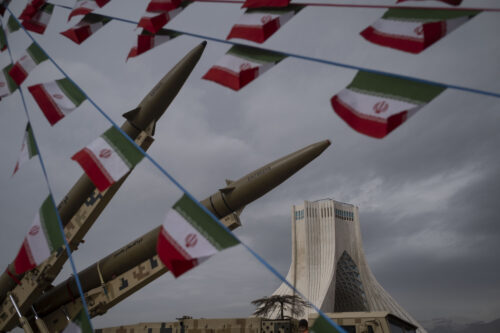
Cover photo: Two Iranian ballistic missiles, Zolfaghar (L) and Zolfaghar Basir, are displayed during a rally commemorating the 47th anniversary of the Islamic Revolution in Azadi (Freedom) Square in western Tehran, Iran, on February 11, 2026. Source: Morteza Nikoubazl/NurPhoto via Getty Images.
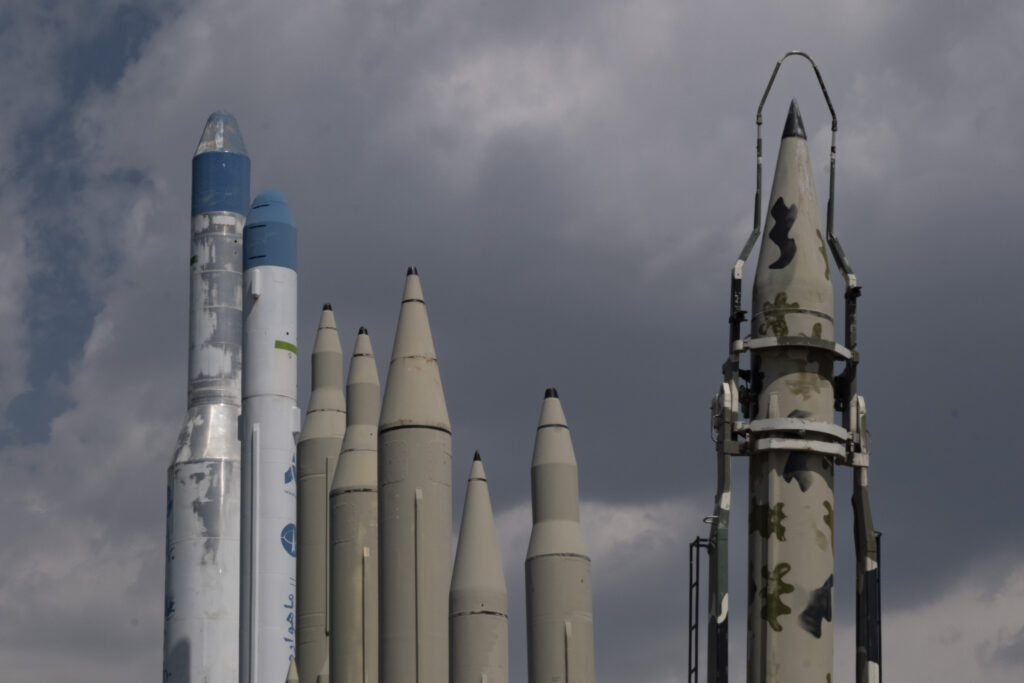
Contents photo: Iranian ballistic missiles and two satellite carriers are displayed at a war museum in Tehran, Iran, on April 2, 2026. Source: Morteza Nikoubazl/NurPhoto via Getty Images.