This text has been translated by AI and may contain errors.
Skip to Content

Research & Commentary Results

Filter by
804 Results
The Huawei Wars and the 5G Revolution in the Gulf
Middle East Institute
  • Analysis
  • The Huawei Wars and the 5G Revolution in the Gulf

    The fifth generation of mobile phone networks (5G) is poised to become a key enabler of the digitalization of economies and societies. Digital transformation is at the heart of GCC nations’ ambitions to accelerate economic diversification, deliver public services more effectively and efficiently, and promote sustainable growth. GCC ambitions to accelerate the large-scale deployment of 5G dovetail with those of China’s hi-tech giant Huawei, which is competing for market share in infrastructure and smartphones. However, the US push to stymie Huawei’s efforts to expand the reach of its networking technologies has emerged as a potential stumbling block to more extensive ties between that company and GCC wireless carriers and customers.

    OPEC+ agrees to production-cut extension and new charter amid rising Middle East tensions
    Oil ministers attend the 176th meeting of the Organization of the Petroleum Exporting Countries (OPEC) conference and the 6th meeting of the OPEC and non-OPEC countries on July 1, 2019 in Vienna, Austria.
  • Analysis
  • OPEC+ agrees to production-cut extension and new charter amid rising Middle East tensions

    OPEC+ nations have ended speculation about whether they would continue oil production cuts by agreeing to a nine-month extension. Led by the global petroleum powers Saudi Arabia and Russia, the group agreed on July 2 to extend the current level of cuts until the second quarter of 2020.

    July 24, 2019

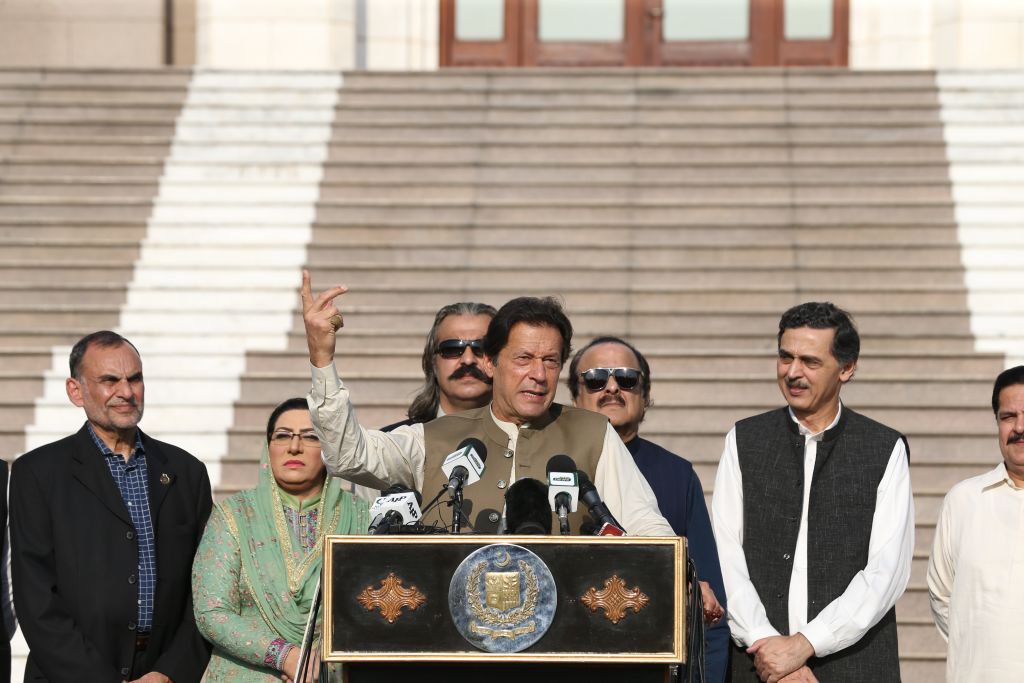
    Monday Briefing: Pakistani PM Khan heads to the White House
  • Analysis
  • Monday Briefing: Pakistani PM Khan heads to the White House

    This week’s briefing on recent news and upcoming events in the region including Imran Khan’s visit to the White House, tensions between President Trump and Congress over Turkey’s new S-400 system, escalation in the Straits of Gibraltar and Hormuz, military restructuring in Iraq, increased collaboration on the region’s power supply, and changes to Egypt’s social safety net, featuring Arif Rafiq, Gonul Tol, Ruba Husari, Robert S. Ford, Dr. Ibrahim Saif, and Mirette F. Mabrouk.

    Iran, Russia, and the impact of US sanctions
    Iranian pipelines on Khark Island
  • Analysis
  • Iran, Russia, and the impact of US sanctions

    When it was signed four years ago, the Iran nuclear deal was widely perceived as a diplomatic triumph, a move that would help reintegrate Iran into the global economy and restore its relations with the West. Things haven’t quite turned out that way, however.

    July 17, 2019

    The untapped potential of a Levant Union
    A picture taken on February 7, 2018 shows a view of container cranes and port machinery at the Tripoli Free Zone in the port of the same name in northern Lebanon. (Photo by IBRAHIM CHALHOUB / AFP) (Photo credit should read IBRAHIM CHALHOUB/AFP/Getty Images)
  • Analysis
  • The untapped potential of a Levant Union

    The idea of establishing a Levant Union — one not unlike the European Union (EU), but composed of the Levantine states of Lebanon, Syria, Iraq, Palestine, Jordan, and by extension, Egypt and Cyprus — is one that ought to be explored. Such an arrangement would offer untapped potential for trade, supported by the growing trend toward greater regionalization, fueled by the rise in protectionism, increasing multipolarity, and corporate regionalization.

    July 11, 2019

    Freshwater Resources in the MENA Region: Risks and Opportunities
    A young Palestinian draws water from a tank
  • Analysis
  • Freshwater Resources in the MENA Region: Risks and Opportunities

    A reliable supply of freshwater is a prerequisite for sustainable socioeconomic development, as well as for sociopolitical stability and human prosperity, especially in semi-arid and arid regions of the world. The Middle East and North Africa’s freshwater resources are under immense pressures and are facing significant risks to their sustainability due to overexploitation, climate change, and interstate competition over their use that extends beyond the region’s boundaries.

    July 10, 2019

    Interconnected: Trade, food security, and stability in the GCC and MENA
    An Emirati man reads the front of a package of Indian Basmati rice in a supermarket in Dubai on July 19, 2008. Faced with the scarcity of fertile land and water, and the surging world prices of food, the wealthy Gulf states are seeking to secure food supplies through agricultural investments abroad.
  • Analysis
  • Interconnected: Trade, food security, and stability in the GCC and MENA

    It is easy to overlook the fact that food security could be an issue of concern in the Gulf Cooperation Council. After all, its member states have some of the world’s highest per capita income levels. Food supplies in the Gulf are normally abundant and stable. Were they to be disrupted, however, it could lead to food security challenges and a chain of adverse consequences for human security throughout the region.

    July 9, 2019

    Monday Briefing: Bahrain workshop is little more than a kabuki show
  • Analysis
  • Monday Briefing: Bahrain workshop is little more than a kabuki show

    In this week’s Monday Briefing, MEI experts Gerald Feierstein, Guney Yildiz, Nathan Stock, Elizabeth Dent, and Eran Etzion provide analysis on recent and upcoming events including this week’s Bahrain “workshop” on Palestine’s economic development, an opposition victory in Istanbul’s rerun election, the release of a portion of the Trump administration’s Israel-Palestine peace plan, the fracturing of the Global Coalition to Defeat ISIS, and Tuesday’s trilateral meeting between the U.S., Israel, and Russia.

    June 24, 2019

    The stakes are high in Istanbul’s election rerun
    People watch a live broadcast of a televised debate between Istanbul's mayoral candidate Binali Yildirim (R) of Turkey's ruling AKP, and Istanbul's deposed mayor Ekrem Imamoglu (L) of the CHP, is shown on a screen at a tea house in Diyarbakir on June 16, 2019.
  • Analysis
  • The stakes are high in Istanbul’s election rerun

    Istanbulites are only few days away from delivering their verdict on who will run the city for the next five years. The June 23rd election marks the second time in the last three months that local voters will choose their mayor, and the stakes are high for both sides.

    Saudi Arabia looks abroad to LNG and petrochemicals to hedge its bets
    Sultan Ahmed al-Jaber(R), the director general and CEO of ADNOC, shakes hands with Saudi Aramco CEO Amin Nasser after signing a cooperation deal in Abu Dhabi on November 12, 2018.
  • Analysis
  • Saudi Arabia looks abroad to LNG and petrochemicals to hedge its bets

    In late May, Saudi Aramco signed an agreement to buy 5 million tons per annum of liquefied natural gas (LNG) from San Diego-based Sempra Energy’s planned LNG terminal in Port Arthur, Texas. The deal exemplifies Saudi Aramco’s determination to boost the share of LNG and petrochemicals in its portfolio before its long-awaited public offering in 2021.

    June 5, 2019

    An awkward triangle: Iraq, Iran, and Saudi Arabia
    Saudi flag flying over the gatehouse to the new Saudi consulate headquarters in the high security
  • Analysis
  • An awkward triangle: Iraq, Iran, and Saudi Arabia

    Over the past few months, an awkward courtship has been going on between Iraq and its two most polarizing neighbors, as Tehran and Riyadh attempt to convince Baghdad of the merits of their respective orbits. While both sides make compelling points, the fact is that Iraq is exceedingly happy to occupy the middle ground, geopolitically and economically, between the two regional powers.

    May 23, 2019

    Understanding the Fatemiyoun Division: Life Through the Eyes of a Militia Member
  • Analysis
  • Understanding the Fatemiyoun Division: Life Through the Eyes of a Militia Member

    Approximately 10,000-20,000 Afghan men, mostly from the Hazara ethnic group, have fought in Syria in support of the government of President Bashar al-Assad. Organized by Iran and led by the Islamic Revolutionary Guard Corps and other affiliated groups, they have gathered under the banner of the so-called “Fatemiyoun” Division. This is the story of one of those men, Mohammed Jalil Dinsta, told through selections from his writings, alongside relevant analysis.

    May 22, 2019

    If at first you don’t succeed: Turkey gears up for Istanbul election rerun
    Ekrem Imamoglu speaks to press members outside the headquarters of CHP after party's extraordinary caucus meeting in Ankara, Turkey on May 7, 2019.
  • Analysis
  • If at first you don’t succeed: Turkey gears up for Istanbul election rerun

    The March 31st local elections in Turkey were a breath of fresh air for those long resigned to the fact that the ballot box doesn’t matter anymore and that President Recep Tayyip Erdogan was invincible. To the surprise of many, the opposition captured all of Turkey’s major cities, but the decision by the Supreme Election Council on May 6th to nullify the results of the Istanbul mayoral election and call for a new vote quickly changed the mood. The election is now set to be rerun on June 23rd.

    The Middle East and its role in the global economy
    Dubai skyline
  • Analysis
  • The Middle East and its role in the global economy

    Too many of the world’s economies are still struggling. Who right now can help them and in the process most help itself? We suggest it’s the Middle East, but only once the region takes on a long overdue leadership role in the global economy’s financial regulatory and development bodies.

    May 13, 2019

    How will the end of US sanctions waivers impact Iran and global energy markets?
    An oil tanker is pictured off the Iranian port city of Bandar Abbas, which is the main base of the Islamic republic's navy and has a strategic position on the Strait of Hormuz on April 30, 2019.
  • Analysis
  • How will the end of US sanctions waivers impact Iran and global energy markets?

    The Trump administration’s decision on April 22 to stop waiving sanctions on eight countries that purchase Iranian crude sent oil prices to their highest levels in six months and resulted in defiance and hand-wringing from the three biggest buyers. Meanwhile, Iran said it would retaliate by shutting the Strait of Hormuz, a move that would make it difficult for other Persian Gulf countries to get their crude to market.

    April 30, 2019