The shock waves of Hosni Mubarak’s resignation have just started to roll across the Middle East, but in Egypt the upheaval has barely begun. The country now embarks on what the protesters in Tahrir square hope will be a transition to a true, civilian-led democracy. In the meantime, Egypt is headed for a period of military rule in some form, with the ultimate intentions of the armed forces leadership still in doubt. Will the military act to effect the “genuine transition” now demanded by the Obama Administration and the protesters themselves?
Improvement of Air Quality in Egypt: The Role of Natural Gas
Egypt has had more than four decades of intensive natural gas exploration and development activities, which have become the main focus of the country’s hydrocarbon industry.
We are entering the era of water scarcity throughout the world. Water scarcity is different from mined resources that become scarce when the lode runs out. Water is almost always renewable. The scarcity applies to expansion. For thousands of years, supply has been expanded through engineering. Nowhere is that more obvious than in Egypt, where water demand has been met by increasing supply. Expansion accelerated during the 19th and 20th centuries, but has now ground to a halt as there is no more water to collect, store, and distribute.
If the current crisis in Egypt is to be resolved peacefully, the Egyptian military will play a central role. Few, if any outside the Egyptian armed forces, however, truly understand the Egyptian military. The following is an attempt to begin the process of better understanding this crucial institution.
This Commentary first appeared in the American Interest's Middle East Blog on January 31, 2011.
The end is now at hand for the government of Hosni Mubarak, ruler of Egypt for the last thirty years. Two outstanding questions face us now: What will the army do? And how should the United States react?
Few question the desirability of finding a political resolution to the Afghan conflict or doubt Pakistan’s pivotal role. The growing divide of opinion in this country is over how best to achieve that outcome. One camp led by our military strategists insists that various political agreements are likely to result from accumulated military successes, sustained by Afghan governance reforms and economic improvements. Visible counterinsurgency gains are expected to gradually wean fighters away from the ranks of the insurgency.
This Commentary first appeared in McClatchy News on January 5, 2011.
The assassination of Salman Taseer, the governor of Punjab, Pakistan's largest province, has illustrated the increasingly chaotic environment in that country, which only promises to get worse in the new year. Weeks before his death, Taseer had the courage to say what his fellow politicians were unwilling to: that Pakistan's blasphemy law must be repealed in order for Pakistan to enter the community of modern nations.
With Pakistan caught up in four wars during the past nine years — the Afghanistan war, the War on Terror, the insurgency in the tribal areas, and the wave of terrorism unleashed by the Tehrik-i-Taliban (TTP) and the Punjabi Taliban in the rest of the country — it has often been said that the country is facing an existential threat. If this was a cliché before, it is no more so after the catastrophic floods. Pakistan had been living dangerously in the past, but the wars and floods threaten to wash away its future.
The Middle East Institute is proud to host Mr. Habibullah Khan, current head of the Federally Administered Tribal Areas (FATA) Secretariat, to discuss the security, policy, and cultural challenges surrounding the integration of FATA into Pakistan's mainstream political system. In his talk, Mr. Khan will highlight the primary characteristics of life in the tribal areas and outline the present governance system.
This piece first appeared as a Commentary on McClatchyDC.com, August 24, 2010
It is hard to imagine a government that faces more existential threats to its people, state, and democracy than the current civilian government in Pakistan.
This Commentary first appeared as an op-ed on Foreign Policy's AfPak Channel, August 18, 2010.
The desperate plight of over 20 million Pakistani citizens displaced and dispossessed by the most ferocious flooding in the history of the young state is heartbreaking. Nature is extracting a cruel price on a population already racked by debilitating poverty and a brutal insurgency.
This Commentary first appeared as an op-ed in McClatchy News, July 6, 2010.
The misuse and abuse of language is yet another obstacle to obtaining peace in the Middle East. In recent weeks the media, government officials and commentators have so garbled the use of the words “blockade” and “embargo” to describe events in Gaza that understanding what is occurring, the legal implications, and developing a reasonable policy are almost impossible.
Introduction to The State of the Arts in the Middle East: Volume V
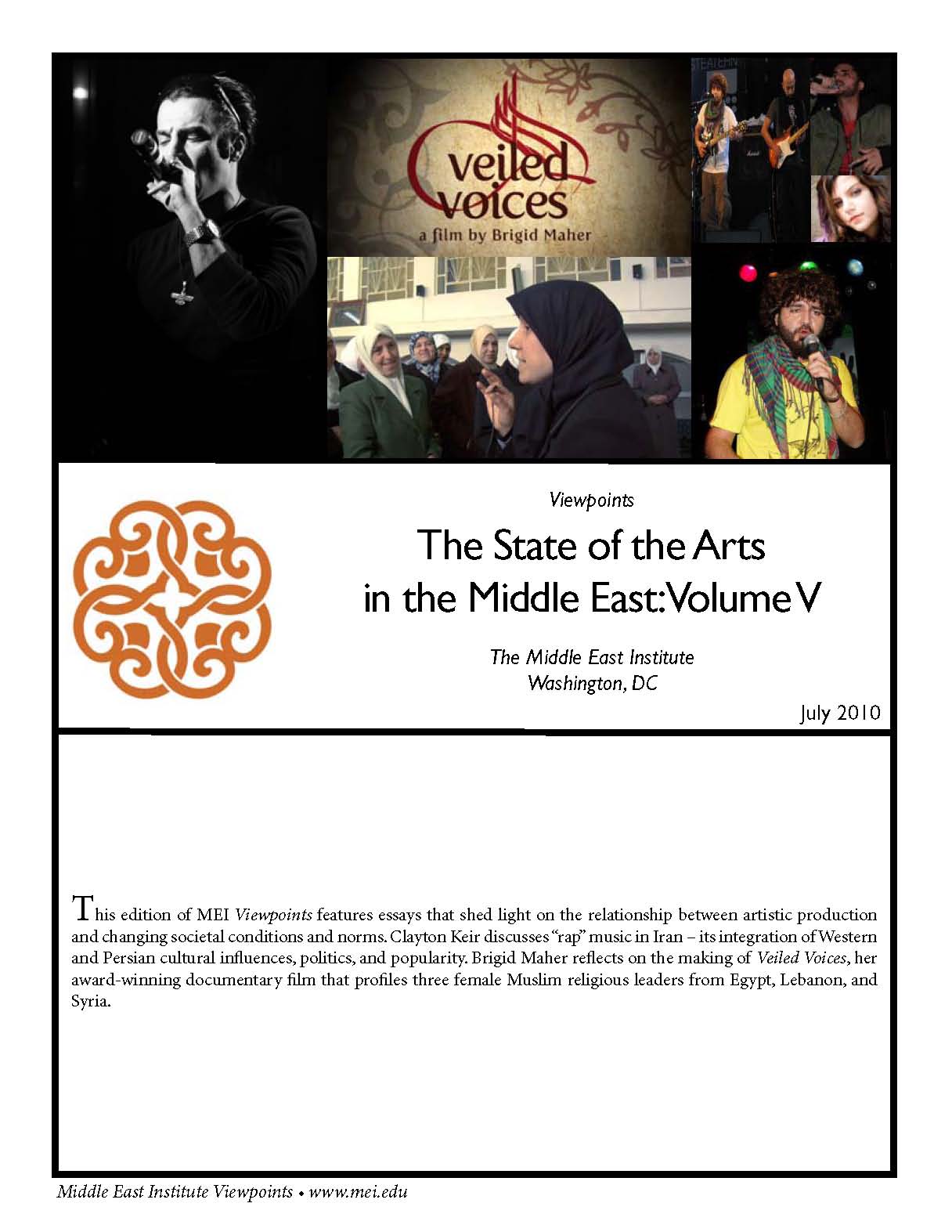
This edition of MEI Viewpoints features essays that shed light on the relationship between artistic production and changing societal conditions and norms. Clayton Keir discusses “rap” music in Iran – its integration of Western and Persian cultural influences, politics, and popularity. Brigid Maher reflects on the making of Veiled Voices, her award-winning documentary film that profiles three female Muslim religious leaders from Egypt, Lebanon, and Syria.