تمت ترجمة هذا النص بواسطة الذكاء الاصطناعي وقد يحتوي على أخطاء.
تخطي إلى المحتوى

الأبحاث والتعليقات

اقرأ الأبحاث والتحليلات والتعليقات المتعمقة من زملاء وخبراء معهد الشرق الأوسط عن الشرق الأوسط. 

Trump’s Family Business Deals Risk Further Undermining the Credibility of US Middle East Policy
  • التحليل
  • Trump’s Family Business Deals Risk Further Undermining the Credibility of US Middle East Policy

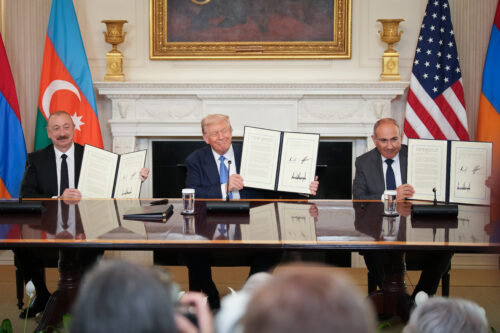
    President Trump’s family businesses are once again in the spotlight as a new financial disclosure showed they earned $2 billion in income in 2025 — a dramatic increase on the year before, with much of it coming from Gulf entities, raising emoluments concerns. Mounting perceptions of corruption, combined with unresolved crises in Iran and Israel-Palestine, are eroding trust among key partners in the Middle East. With the 2026 midterms approaching, these entanglements could represent a major political vulnerability and further undermine America’s already-strained standing in the region.

    Do the Gulf States Need a New Playbook?
  • Podcast
  • Do the Gulf States Need a New Playbook?

    After the US-Israel-Iran war — and the strikes that followed the cease-fire — the Gulf states find themselves dangerously exposed. Host Alistair Taylor is joined by MEI Associate Fellow Gregory Gause to discuss the war’s impact on the Gulf, their partnership with the United States, and whether the turmoil of recent months will push Gulf leaders to reassess their alliances and international engagement.

    July 2, 2026

    Additional Research & Commentary

    معلومات أساسية

    The Houthis
  • معلومات أساسية
  • The Houthis

    The Houthis are a political-military faction and Zaydi religious movement founded in northwestern Yemen in the 1980s. A key member of Iran’s Axis of Resistance with links to other militant organizations in the Arabian Peninsula and the Horn of Africa, the group has continued to pose a threat to Western interests on a global scale.

    May 15, 2026

    The Abraham Accords
    الصورة من تصوير أليكس وونغ/Getty Images
  • معلومات أساسية
  • The Abraham Accords

    تقدم هذه الوثيقة المعلوماتية لمحة عامة عن كيفية التوصل إلى اتفاقيات أبراهام، والمصالح الأمريكية المعنية، وعواقبها الاقتصادية والاستراتيجية، وآفاق التوسع في المستقبل.

    17 نوفمبر 2025

    Turkish Foreign Policy
  • معلومات أساسية
  • Turkish Foreign Policy

    After a decade of post-Arab Spring isolation, Turkey’s leaders have recognized that their ambition to position the country as an agenda-setter on the world stage requires active engagement in all directions. President Recep Tayyip Erdoğan’s consolidation of executive authority has centralized foreign policy decision-making and tied it to his domestic political priorities, transforming the country’s revisionist approach to one shaped primarily by personal and pragmatic interests.

    April 23, 2026

    الصحراء الغربية: لماذا لا يزال الصراع مهمًا
  • Video
  • الصحراء الغربية: لماذا لا يزال الصراع مهمًا

    مع دخول نزاع الصحراء الغربية عقده الخامس، لا يزال النزاع الإقليمي دون حل وغير معروف إلى حد كبير. تحلل إنتصار فقير من معهد الشرق الأوسط (MEI) التاريخ المعقد للصحراء الغربية والمطالبات المتنافسة من قبل المغرب والجمهورية العربية الصحراوية الديمقراطية. وتبحث في التطورات الأخيرة، مثل اعتراف الرئيس ترامب بسيادة المغرب على الإقليم وانهيار وقف إطلاق النار الذي دام 30 عامًا، بالإضافة إلى الأسئلة الجوهرية التي لا تزال دون إجابة بعد نصف قرن.

    7 أغسطس 2025

    المدونات الصوتية

    التركيز على الشرق الأوسط

    البودكاست الأسبوعي الرائد لمعهد الشرق الأوسط حول السياسة الخارجية الأمريكية والقضايا السياسية والاجتماعية المعاصرة في الشرق الأوسط.

    إزالة الحافة من الشرق الأوسط

    براين كاتوليس، زميل أول في معهد الشرق الأوسط كاتوليس يشارك الأصدقاء والزملاء وخبراء السياسة في محادثات غير رسمية حول أهم الأحداث في الشرق الأوسط. 

    إعادة التفكير في الديمقراطية

    زميل أول في معهد الشرق الأوسط غونول تول تستضيف كبار العلماء وقادة الفكر حول اتجاهات الديمقراطية العالمية وحالة النظام الدولي الليبرالي. 

    تصفية حسب
    8748 Results
    25 Years In Iraq, With No End In Sight
  • التحليل
  • 25 Years In Iraq, With No End In Sight

    This article was first published on NPR’s Parallels blog.

    It started so well. When Saddam Hussein’s Iraq invaded Kuwait on Aug. 2, 1990, the United States swiftly cobbled together a broad coalition, unleashed a stunning new generation of air power and waged a lightning ground offensive that lasted all of four days. Iraqi troops were so desperate to quit that some surrendered to Western journalists armed only with notebooks.

    August 4, 2015

    Middle East Dialogue Report: Beirut
  • التحليل
  • Middle East Dialogue Report: Beirut

    The Middle East Dialogue on New Political and Security Dynamics Shaping the Arab Region met in Beirut May 30-31 to consider the situation in Syria, which has deteriorated further since the last meeting of the Dialogue in Berlin last December. Violence has risen, government-controlled territory has been lost to both opposition and extremist forces, Syrians are suffering and the Syrian government is reaching the limits of its military and civilian capabilities.

    July 30, 2015

    Education: The Key to Women’s Empowerment in Saudi Arabia?
    معهد الشرق الأوسط
  • التحليل
  • Education: The Key to Women’s Empowerment in Saudi Arabia?

    In recent news from Saudi Arabia: religious police filmed berating a fully veiled woman for not wearing gloves; a cleric’s fatwa against women watching football to prevent them from staring at men’s thighs; and a woman sentenced to 70 lashes for insulting her husband on WhatsApp.[1] At the same time, the Saudi education ministry released statistics showing that women constitute almost 52 percent of university graduates inside the kingdom, while more than 35,000 female Saudis studied abroad in 2014.

    July 30, 2015

    The Military Muzzling of Thailand and the Quandary of Demilitarization
    معهد الشرق الأوسط
  • التحليل
  • The Military Muzzling of Thailand and the Quandary of Demilitarization

    Over a year has passed since the latest military coup in Thailand. On May 22, 2014, then-Army Commander Gen. Prayuth Chan-ocha led a putsch against civilian Prime Minister Yingluck Shinawatra. The coup followed six months of demonstrations against Yingluck and her brother, fugitive ex-Prime Minister Thaksin Shinawatra. The protests, centered in Bangkok, were reportedly protected by military elements.

    July 29, 2015

    The Truth in Criticisms of the Iran Deal
  • التحليل
  • The Truth in Criticisms of the Iran Deal

    This article was first published on Peacefare.net.

    Here are some criticisms of the Iran deal that contain at least a kernel of truth; they are worth addressing for the sake of clarifying some of the arguments pro and con.

    July 29, 2015

    Responding to Assaults on Health Care in the Middle East
    معهد الشرق الأوسط
  • التحليل
  • Responding to Assaults on Health Care in the Middle East

    The conflicts and political crises in the Middle East have brought anguish, suffering, and severe declines in health to people throughout the region. The most catastrophic case by far is Syria, where more than a million people have experienced traumatic injuries, once-rare infectious diseases have returned, chronic disease goes untreated, and the health system has collapsed. In Yemen, Libya, Gaza, and Iraq as well, violence has limited access to health care and grievously harmed the population.

    July 28, 2015

    Improved Egypt-Israel Relations through Sinai Crisis: Will They Last?
  • التحليل
  • Improved Egypt-Israel Relations through Sinai Crisis: Will They Last?

    Egyptian diplomats rarely have a good word to say about U.S. policies these days. In contrast, they are enthusiastic in their praise of the close relations between Cairo and Jerusalem—centered on counterterror security and intelligence cooperation in Sinai—and effusive in their acknowledgement of Israel’s response to the bloody insurgency there, led by Egypt’s ISIS affiliate in the “Sinai Province,” Ansar Beit al-Maqdis.

    “Relations with Israel are great,” observed an Egyptian official recently.[1]

    July 24, 2015

    Salafism Infiltrates Turkish Religious Discourse
    معهد الشرق الأوسط
  • التحليل
  • Salafism Infiltrates Turkish Religious Discourse

    Salafi discourse has made considerable inroads in Turkey over the past 30 years, making contributions to sectarianism in ways that have yet to be fully studied and understood.

    July 23, 2015

    Caring for the Most Vulnerable Populations Affected by Conflict in the Middle East
  • التحليل
  • Caring for the Most Vulnerable Populations Affected by Conflict in the Middle East

    Imagine your child is bleeding from a severe wound. The hospital lacks the necessary medical equipment to stop it, and you are told that amputation is the only option, but the hospital has no anesthesia. Imagine losing a newborn baby, not for any medical reason, but because a power outage cut off the heat to your child’s incubator. Sadly, these are not infrequent tragedies in a number of Middle Eastern countries. In Syria, as in other areas of conflict across the region, it’s not just bombs, bullets, and shells that are killing and maiming children and others.

    July 22, 2015

    Liberalism in the Arab World: Accounts from the Region
  • التحليل
  • Liberalism in the Arab World: Accounts from the Region

    Ismael Mohammed of Egypt recalls the moment he lost his religion. It happened four years ago, at the age of 26, when he heard about the theory of evolution for the first time. He had come across it online by watching YouTube videos and reading all the material he could fit through Google Translate. He sent query emails to evolution scientists around the world, asking them if what they were saying was true. Some responded, sending him the nuts and bolts of Darwin’s work.

    July 21, 2015

    The Syrian Refugee Crisis: What’s Next?
  • التحليل
  • The Syrian Refugee Crisis: What’s Next?

    “What’s going to happen to the Syrian refugees?” This was the question I asked of everyone I met during a recent trip to Lebanon and Turkey to research Syrian displacement. Without exception, those I asked—government and UN officials, academics, business and NGO representatives, Syrian diaspora groups, and Syrian refugees—responded with the same answer: “I don’t know” (or sometimes “‘God only knows”). When pressed, almost everyone said that the war in Syria would continue for the foreseeable future and that more people would likely leave or try to leave.

    July 20, 2015

    Sectarianism and the Search for New Political Orders in the Arab World
    معهد الشرق الأوسط
  • التحليل
  • Sectarianism and the Search for New Political Orders in the Arab World

    In many Arab countries, the homogenizing, authoritarian, centralized state is a relic of a bygone past. However, what will replace it is not yet clear. The popular Arab uprisings that exploded in December 2010, and their overlap with already-underway geopolitical battles unleashed by the 2003 U.S. invasion and occupation of Iraq, combined to torpedo the political orders of a number of Arab states.

    July 17, 2015

    اقرأ مجلة الشرق الأوسط

    تُعد المجلة الرئيسية لمعهد الشرق الأوسط أقدم مطبوعة محكّمة مكرّسة لدراسة الشرق الأوسط الحديث، وتغطي المجلة الرئيسية في المعهد السياسة والمجتمع والثقافة في المنطقة.