تمت ترجمة هذا النص بواسطة الذكاء الاصطناعي وقد يحتوي على أخطاء.
تخطي إلى المحتوى

الأبحاث والتعليقات

اقرأ الأبحاث والتحليلات والتعليقات المتعمقة من زملاء وخبراء معهد الشرق الأوسط عن الشرق الأوسط. 

Trump’s Family Business Deals Risk Further Undermining the Credibility of US Middle East Policy
  • التحليل
  • Trump’s Family Business Deals Risk Further Undermining the Credibility of US Middle East Policy

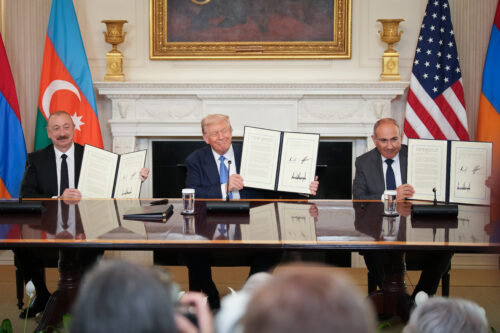
    President Trump’s family businesses are once again in the spotlight as a new financial disclosure showed they earned $2 billion in income in 2025 — a dramatic increase on the year before, with much of it coming from Gulf entities, raising emoluments concerns. Mounting perceptions of corruption, combined with unresolved crises in Iran and Israel-Palestine, are eroding trust among key partners in the Middle East. With the 2026 midterms approaching, these entanglements could represent a major political vulnerability and further undermine America’s already-strained standing in the region.

    Do the Gulf States Need a New Playbook?
  • Podcast
  • Do the Gulf States Need a New Playbook?

    After the US-Israel-Iran war — and the strikes that followed the cease-fire — the Gulf states find themselves dangerously exposed. Host Alistair Taylor is joined by MEI Associate Fellow Gregory Gause to discuss the war’s impact on the Gulf, their partnership with the United States, and whether the turmoil of recent months will push Gulf leaders to reassess their alliances and international engagement.

    July 2, 2026

    Additional Research & Commentary

    معلومات أساسية

    The Houthis
  • معلومات أساسية
  • The Houthis

    The Houthis are a political-military faction and Zaydi religious movement founded in northwestern Yemen in the 1980s. A key member of Iran’s Axis of Resistance with links to other militant organizations in the Arabian Peninsula and the Horn of Africa, the group has continued to pose a threat to Western interests on a global scale.

    May 15, 2026

    The Abraham Accords
    الصورة من تصوير أليكس وونغ/Getty Images
  • معلومات أساسية
  • The Abraham Accords

    تقدم هذه الوثيقة المعلوماتية لمحة عامة عن كيفية التوصل إلى اتفاقيات أبراهام، والمصالح الأمريكية المعنية، وعواقبها الاقتصادية والاستراتيجية، وآفاق التوسع في المستقبل.

    17 نوفمبر 2025

    Turkish Foreign Policy
  • معلومات أساسية
  • Turkish Foreign Policy

    After a decade of post-Arab Spring isolation, Turkey’s leaders have recognized that their ambition to position the country as an agenda-setter on the world stage requires active engagement in all directions. President Recep Tayyip Erdoğan’s consolidation of executive authority has centralized foreign policy decision-making and tied it to his domestic political priorities, transforming the country’s revisionist approach to one shaped primarily by personal and pragmatic interests.

    April 23, 2026

    الصحراء الغربية: لماذا لا يزال الصراع مهمًا
  • Video
  • الصحراء الغربية: لماذا لا يزال الصراع مهمًا

    مع دخول نزاع الصحراء الغربية عقده الخامس، لا يزال النزاع الإقليمي دون حل وغير معروف إلى حد كبير. تحلل إنتصار فقير من معهد الشرق الأوسط (MEI) التاريخ المعقد للصحراء الغربية والمطالبات المتنافسة من قبل المغرب والجمهورية العربية الصحراوية الديمقراطية. وتبحث في التطورات الأخيرة، مثل اعتراف الرئيس ترامب بسيادة المغرب على الإقليم وانهيار وقف إطلاق النار الذي دام 30 عامًا، بالإضافة إلى الأسئلة الجوهرية التي لا تزال دون إجابة بعد نصف قرن.

    7 أغسطس 2025

    المدونات الصوتية

    التركيز على الشرق الأوسط

    البودكاست الأسبوعي الرائد لمعهد الشرق الأوسط حول السياسة الخارجية الأمريكية والقضايا السياسية والاجتماعية المعاصرة في الشرق الأوسط.

    إزالة الحافة من الشرق الأوسط

    براين كاتوليس، زميل أول في معهد الشرق الأوسط كاتوليس يشارك الأصدقاء والزملاء وخبراء السياسة في محادثات غير رسمية حول أهم الأحداث في الشرق الأوسط. 

    إعادة التفكير في الديمقراطية

    زميل أول في معهد الشرق الأوسط غونول تول تستضيف كبار العلماء وقادة الفكر حول اتجاهات الديمقراطية العالمية وحالة النظام الدولي الليبرالي. 

    تصفية حسب
    8748 Results
    The Energy Revolution’s Impacts on the Arab World
  • التحليل
  • The Energy Revolution’s Impacts on the Arab World

    Profound changes are occurring throughout the global energy system, including an increase in the production of hydrocarbons in the Americas and a shift in demand in which oil is giving way to gas and, to a lesser extent, coal. How are these changes affecting the Middle East and North Africa (MENA) region, and what might the MENA countries do to meet the challenges posed by this “energy revolution?” Robert Springborg addresses these issues in this MEI Policy Focus.

    June 10, 2014

    Korea and the Middle East: Religious Encounters
    معهد الشرق الأوسط
  • التحليل
  • Korea and the Middle East: Religious Encounters

    On the surface, it is difficult to identify the common ground between Korea and the Middle East in terms of religious heritage: Shamanism, Buddhism, Confucianism, and Christianity are the major religions of Korea, while Islam predominates in the Middle East. However, rapid globalization and the increased frequency of exchange between Koreans and the peoples of the Middle East are beginning to challenge common assumptions about the religious composition of each region. This essay will describe the history and current status of Islamic expansion in Korea, as well as Korean Christian missions in the Middle East.

    June 10, 2014

    1,500 Years of Contact between Korea and the Middle East
    معهد الشرق الأوسط
  • التحليل
  • 1,500 Years of Contact between Korea and the Middle East

    Islamic history in Korea and Korea-Middle East relations predate the Korean War by more than a millennium. Yet, many Koreans are not aware of this long history of cultural and commercial interaction. Furthermore, there are widespread misconceptions in Korea about the Middle East and aspects of Islam.

    June 7, 2014

    Korea and the GCC: Reaching a Sustainable Economic Partnership
    معهد الشرق الأوسط
  • التحليل
  • Korea and the GCC: Reaching a Sustainable Economic Partnership

    Over the past four decades, economic relations between the Republic of Korea (hereafter Korea) and the Gulf Cooperation Council (GCC) countries have been focused on two sectors. Given the lack of energy resources in Korea, the GCC countries have provided oil and gas for Korean manufacturing, electricity, transport, and related activities. These countries have also provided Korea with business opportunities in the construction sector, including the building of expressways, seaports, and industrial plants.

    June 6, 2014

    Rouhani’s Saudi Challenge
  • التحليل
  • Rouhani’s Saudi Challenge

    This week’s visit to Tehran by the Kuwaiti emir, Sheik Sabah al-Ahmad al-Sabah, is about more than Iranian-Kuwaiti relations. It might even be a pivotal moment in the shaping of Iran’s ties with the Arab countries across the Gulf. Kuwait, which currently holds the rotating presidency of the Gulf Cooperation Council (GCC), is acting as a conduit for the collective unease that the GCC’s six member states, particularly Saudi Arabia, have about Iran’s regional policies.

    Turkey at a Crossroads
  • التحليل
  • Turkey at a Crossroads

    Turkish Prime Minister Recep Tayyip Erdogan secured his eighth big win in 14 years when his ruling AK Party won over 45 percent of the vote in local elections on March 30. After facing down corruption charges, mass protests, and accusations of authoritarianism, Erdogan may feel emboldened to run for president in Turkey’s first direct presidential election in August.

    Prospects for an Iran Nuclear Agreement
  • التحليل
  • Prospects for an Iran Nuclear Agreement

    Allen Keiswetter is a scholar at the Middle East Institute and an analyst at the law firm of Dentons. This is an updated version of a paper originally published by Dentons-GPS.

    June 3, 2014

    The Iran Sanctions and South Korea’s Balancing Act
    معهد الشرق الأوسط
  • التحليل
  • The Iran Sanctions and South Korea’s Balancing Act

    Following the recent progress on the Iranian nuclear issue and the subsequent easing of sanctions, South Korean businesses are reengaging the Iranian market. A South Korean trade delegation visited Iran on March 9, 2014 to expand bilateral trade ties in the mining, industrial, and food sectors. On March 17, South Korea’s Finance Ministry lifted a ban, allowing South Korean auto, construction, pharmaceutical, and telecommunications industries to resume trade with Iran, though sanctions remained in the shipbuilding, shipping, and harbor sectors.

    June 2, 2014

    68th Annual Awards Banquet and Conference
    معهد الشرق الأوسط
  • التحليل
  • 68th Annual Awards Banquet and Conference

    Save the Date!

    The Middle East Institute’s 68th Annual Awards Banquet and Conference

    When:
    Wednesday, November 19 & Thursday, November 20, 2014

    Where:
    Grand Hyatt Hotel
    Washington, D.C.

    June 2, 2014

    Sabbahi, Spoiled Ballots, and the Egyptian Election
  • التحليل
  • Sabbahi, Spoiled Ballots, and the Egyptian Election

    Egyptian presidential elections underdog Hamdeen Sabbahi achieved the impossible: he came in third in a two-horse race. The 60-year-old leftist politician and sole rival to the country’s ex-army chief Abdul-Fattah el-Sisi secured just under 757,000 votes in the preliminary count as opposed to Sisi’s more than 23 million votes—as well as to the votes of a last-minute unexpected entrant: the spoiled ballot.

    May 30, 2014

    The Quest to Eradicate Polio in Pakistan
    معهد الشرق الأوسط
  • التحليل
  • The Quest to Eradicate Polio in Pakistan

    Pakistan is only one of three countries—the others being Afghanistan and Nigeria—in which polio has never been eradicated. Polio in Pakistan has been a particular worry recently, with a disturbing spike in cases. According to the World Health Organization (WHO), 61 out of 77 cases of polio reported worldwide from January through mid-May 2014, or 79 percent, were in Pakistan.[1]

    May 29, 2014

    The Role of a Middle Power South Korea in Iran, Syria, and Egypt
    معهد الشرق الأوسط
  • التحليل
  • The Role of a Middle Power South Korea in Iran, Syria, and Egypt

    This article examines how South Korean foreign policy deals with Iran, Syria, and Egypt, with the overarching argument that because South Korea is pushing to build its middle power presence, it should clearly articulate its position on key security issues in the Middle East. As a non-permanent member of the UN Security Council, South Korea should support international norms such as nonproliferation, humanitarian protection, and democracy. Unless the South Korean government consistently upholds these norms, it will encounter setbacks in finding international support in its dealings with North Korea.

    May 23, 2014

    Egypt's Election: Beyond the Foregone Conclusion
    معهد الشرق الأوسط
  • التحليل
  • Egypt's Election: Beyond the Foregone Conclusion

    Egyptians have headed to the polls to elect a president for the second time since the January 2011 revolution. Field Marshal Abdul-Fattah el-Sisi is expected to win by a wide margin over the only other contender, leftist politician Hamdeen Sabahi. The magnitude of that victory, however, will have an important impact on Sisi’s electoral mandate, and many questions remain about what he plans to do with it once in power.

    May 22, 2014

    Kuwait: At the Crossroads of Change or Political Stagnation
  • التحليل
  • Kuwait: At the Crossroads of Change or Political Stagnation

    Though Kuwaitis have been striving for change, particularly since 2011, their country’s political structures remain more or less unaltered.  Yet change is inevitable, writes Shafeeq Ghabra in this MEI Policy Paper. At issue is a semi-democratic system that has proven ineffective at dealing with problems such as government mismanagement, corruption, a lack of economic transparency, and inequality toward tribes and undocumented immigrants.

    May 20, 2014

    اقرأ مجلة الشرق الأوسط

    تُعد المجلة الرئيسية لمعهد الشرق الأوسط أقدم مطبوعة محكّمة مكرّسة لدراسة الشرق الأوسط الحديث، وتغطي المجلة الرئيسية في المعهد السياسة والمجتمع والثقافة في المنطقة.