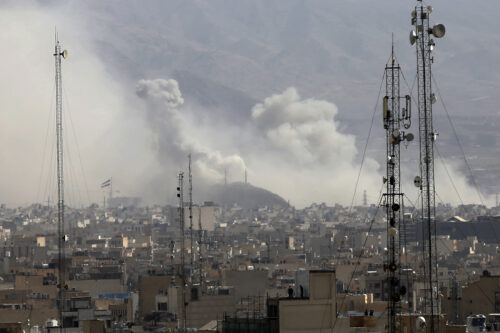
On February 28, 2026 the United States and Israel began strike operations against Iran. The Middle East Institute's experts are monitoring the situation and providing analysis in real time as events unfold.
TEHRAN, IRAN - FEBRUARY 28: Smoke rises over the city center after Israel launches 2nd wave of airstrikes on Iran on February 28, 2026. (Photo by Fatemeh Bahrami/Anadolu via Getty Images)
“The US/Israeli move to military operations was foreseeable, as were the punitive Iranian strikes on US Gulf partners; the widest-possible war aims from President Trump (“freedom for Iran”) were less so and are disquieting in the extreme. Fomenting a popular uprising from the air is both high-risk (be careful what you aim for — Libya 2011) and, ironically, in the current circumstance, likely low-impact. Where is the day-after thinking undergirding this campaign? Not in evidence.”
Barbara Leaf
Distinguished Diplomatic Fellow
Middle East Institute
“President Trump’s stated objective for these attacks — imminent threat — isn't believable, and his real reason — regime incapacitation if not regime change — isn't likely. More downside than upside.”
Alan Eyre
Distinguished Diplomatic Fellow
Middle East Institute
“Without a wider, intelligence-driven plan for political transition, airstrikes alone are unlikely to generate sustained internal momentum against the Khamenei-IRGC leadership, particularly in the absence of an organized opposition ready to act. That could change quickly, as the leadership is widely blamed for the crisis, but the window is narrow, and Trump’s appetite for a prolonged conflict remains uncertain.”
Alex Vatanka
Senior Fellow
Middle East Institute
“Buckle up — things are about to get bumpier in the Middle East. The war will have unpredictable ripple effects across the region in places like Lebanon, Iraq, Syria, Yemen, Israel, and Palestine. What happens inside of Iran won't stay there. The Islamic Republic of Iran's regime was at its weakest and most vulnerable point on the eve of this military action, and the main thing to watch for is how events unfold inside of Iran over the next few weeks.”
Brian Katulis
Senior Fellow
Middle East Institute
“US reliance on strike, rather than invasion, forces may reduce US casualties in Iran, but airpower alone has a poor track record of toppling governments or extracting significant concessions from adversaries.”
Jason H. Campbell
Senior Fellow
Middle East Institute
“Israel and the US are pursuing a longstanding goal of regime change in Iran. The coming days will show whether Tehran’s regime, institutionally built for resilience, can withstand the attacks.”
Ross Harrison
Senior Fellow
Middle East Institute
“This does not seem like previous military operations during Trumpʼs first or second term. This appears to be a war with an undefined duration and an unclear endgame. It appears to be a gamble that by using military force, more favorable dynamics will emerge — or at least that the Iranian regime can be badly weakened at an acceptable cost.”
Daniel Benaim
Distinguished Diplomatic Fellow
Middle East Institute
“The Israeli leadership views the past 2.5 years as one ‘seven-front war.’ All fronts, they believe, feature foes backed by one actor: Iran — Hamas, Hizballah, the Houthis, Syrian and Iraqi militias, Iranian influence in the West Bank, and Iran itself. Israelis thus treat the current high-stakes campaign as taking this war to its core: the regime in Tehran.”
Natan Sachs
Senior Fellow
Middle East Institute
“The US achieved tactical surprise, and the timing was likely cued by sensitive intelligence information in order to be more successful in targeting Iranian leadership...The initial Iranian response that we are seeing, that has included targeting of US regional bases and infrastructure and Israel, was expected and likely scripted. However, now that the Iranian regime knows they are the direct target of this military action, further Iranian retaliation could become more desperate, less discriminate, and include attempts to close the Straits of Hormuz and Red Sea.”
Vice Admiral Kevin Donegan, USN (ret.)
Distinguished Military Fellow
Middle East Institute
“It's early for assessment and can change quickly, but so far it's not an energy infrastructure, transit or production war... The fact that Iran attacked its Gulf neighbors without cause raises the risk of energy and civilian targets being attacked across the region. Iran is making this a regional war. We will have to see how events evolve and the nature of damage to Iranian leadership before we can predict how escalation might proceed.”