This individual is a guest contributor. MEI is not able to assist with contact requests.
Geoffrey Aronson writes about Middle East affairs. He consults with a variety of public and private institutions dealing with regional political, security, and development issues. He has advised the World Bank on Israel’s disengagement and has worked for the European Union Coordinating Office for the Palestinian Police Support mission to the West Bank and Gaza.
Negotiations shepherded by Egypt appear to be making progress in establishing a new, more stable chapter in the ongoing conflict, but instability remains at the heart of the Gaza standoff.
There are numerous, unmistakable signs that the crisis in Syria is moving to a new phase, one that will push Washington further to the sidelines. Not least among these fresh developments is the rapidly evolving situation in Syria’s northeast, where Washington’s Kurdish allies are slowly but surely reconciling with the Assad regime.
Netanyahu's ambition a test for US-Israel relations
After U.S. Vice President Mike Pence laid out the Trump administration’s agenda in a speech earlier this year before Israel’s parliament, the Knesset, one attendee asked, “was that the messiah or the vice president of the United States?”
The bombs continue to fall over Syria to the consternation of all concerned. Syrian president Bashar al-Assad warns of a conflict on Syrian soil that will embroil Israel, Iran, and Russia. “Things,” he says, “could spin out of control.”
The escalating violence between Iran and Israel in recent days is clear evidence of a new post-“Assad must go” phase in Syria’s ongoing misery.
The way forward for Palestine: Fatah, Hamas and Dahlan
As Palestinians confront U.S. President Donald Trump’s “deal of the century,” the debilitating effect of endemic, internal division within their ranks continues to define their domestic political landscape.
It should be no surprise that Washington’s Syrian Kurdish allies—who have long had daggers drawn and pointed at our fellow NATO member Turkey—are now reconciling with our Syrian enemy President Bashar al-Assad.
The latest evidence of the evolving nature of the war in Syria was on display Saturday, Feb. 10, when Israel mounted what a senior Israeli officer called “the biggest and most significant attack the air force has conducted against Syrian air defenses” since the 1982 Lebanon war. The unprecedented encounter was precipitated by the intrusion of an Iranian drone into Israeli airspace and led to the downing of a top-of-the-line Israeli F-16 by Syrian air defenses.
Donald Trump’s promise of “a deal of the century” to end the conflict between Israel and the Arabs is getting legs. After a year of discussions led by Trump’s son-in-law Jared Kushner, the main elements of the president’s design are coming into view. But it’s not exactly what the Palestinians want to see.
Israel has weathered the campaign to oust Bashar al-Assad far better than its neighbors. Unlike many others, Israel was never a true believer in the failed effort to topple the Assad regime, preferring an opportunistic rather than a principled strategy that aimed at keeping Israel out of harm’s way.
The challenges of postwar Syria, however, may prove more daunting. Israel must now deter any interest by Syria’s Arab and Iranian allies to deploy military forces in Syria against it.
Red Sea Islands Deal Undermines Arab Peace Initiative
The Saudi-led Arab Peace Initiative is losing its value in the wake of Egypt’s decision to return the Red Sea islands of Tiran and Sanafir to Saudi Arabia, and the latter’s participation as a security guarantor of the Egypt-Israel peace treaty.
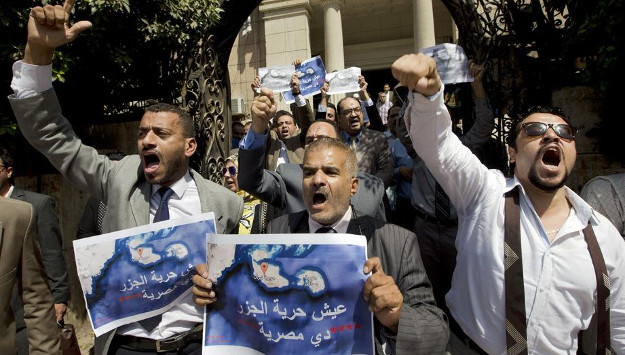
Last month, the Egyptian parliament, bucking widespread public and institutional opposition, acknowledged Saudi sovereignty over the islands.
Most attention has focused on the dispute over sovereignty, which has been under Egyptian administration for more than half a century. But the real significance of the deal lies elsewhere.
Israel and Hezbollah have recently raised the profile of their long quiescent front across the Blue Line border. Warnings have increased that a conflict will soon engulf Lebanon, and perhaps even draw in the United States. Hezbollah’s leader Hassan Nasrallah has threatened to attack Israel’s nuclear reactor at Dimona and Israeli chemical installations in Haifa.
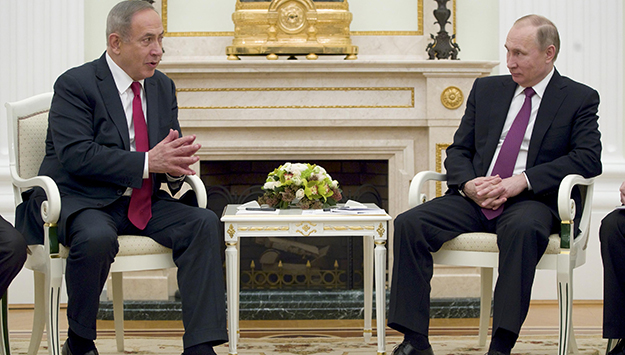
The Israeli prime minister’s visit to Moscow last week offered Israel and Russia an opportunity to ‘synchronize watches’ as a new phase in the Syrian war unfolds.
The visit was short and business-like. Prime Minister Benjamin Netanyahu left Tel Aviv in the morning and was back in Jerusalem that same evening. But his meeting with President Vladimir Putin, their fourth since the Russian intervention in September 2015, was long enough to reaffirm the principles that have enabled both Russia and Israel to protect their core interests in Syria.
Saudi Interest in the Red Sea Islands of Tiran and Sanafir Grows as Its Security Interests Expand
Notwithstanding Egypt’s political and judicial contretemps, the Egyptian parliament is expected to vote soon in favor of the return of Tiran and Sanafir islands to Saudi Arabia. The decision, after months of controversy in Egypt, will fulfill the April 2016 agreement reached between Egyptian president Abdel Fattah al Sisi and Saudi King Salman bin Abdul Aziz Al Saud that formally acknowledged Saudi sovereignty over the two small islands and provided for their return to Riyadh’s control.