Gulf Energy Markets: The Region’s Edge Will Survive — At a Price
September 28, 2026
Share
This article is part of a collection of short essays written by the Fellows of the Middle East Institute to explore aspects of the ongoing war with Iran. The intent of the collection is to help readers see new and unexpected elements of the dynamics and impact of the ongoing hostilities and to think harder, deeper, and broader about the implications of the conflict. To read the other essays from this collection, as well as download the full report, please click here.
Across the Gulf, views differ widely on how the Iran war can and should end, and what the region will look like once it does. Yet on the crisis over the closure of the Strait of Hormuz, the view is near-unanimous that a repeat is not only possible but likely.
That expectation, more than any single incident over the past year, is becoming a major driver of decision-making in industry and policy circles alike. Nowhere does it weigh more heavily than on the energy sector, where there has been intense debate since the war’s earliest days over what “resilience” means — for oil and gas production, export routes, and domestic energy infrastructure. Two responses are taking shape: one turned inward, toward domestic energy security, and one turned outward, toward the terms on which both international investment and a competitive advantage in markets can be sustained.
Buying Insurance Against a Repeat
The first is inward. Energy security considerations were already becoming increasingly important in several Gulf states even before the conflict, shaping decisions for national oil companies (NOCs) and domestic infrastructure alike; that trend is now set to accelerate. While Qatari liquefied natural gas (LNG) supply within the Gulf presents little risk for importers such as Kuwait, Bahrain, and eventually Iraq, these states may now be more inclined to address single points of failure from outside their countries, or within them. The United Arab Emirates still imports gas and may now be more inclined to renew the Dolphin Pipeline agreement with Qatar, which expires in 2032 and currently supplies around 30% of the UAE’s overall gas demand. The UAE may also consider building out infrastructure on its eastern coast to import LNG via a floating storage and regasification unit (FSRU), even as it weighs developing what would be the country’s third LNG export terminal at Fujairah. An award to advance the Dorra gas project in the Saudi-Kuwaiti Neutral Zone also points to efforts to move forward with projects to bolster domestic gas supplies.
The second response looks outward, toward the conditions that international investors will require to maintain their exposure to the region. So far they are not showing any signs of losing faith. On July 25, a consortium made up of KKR, Blackstone, and Brookfield Asset Management signed a $16 billion partnership with Kuwait Oil Company for a 49% stake in its domestic oil pipeline network. This represents an extraordinary display of investor confidence in a country whose exports are totally dependent on the free flow of traffic through the Strait of Hormuz at a time when the war’s resolution is anything but certain.
However, the region’s ability to continue to sustain international investor interest will come at a cost. Iraq is the clearest case. Terms that were already insufficient to attract the investment Baghdad wanted before the conflict will now need to be materially better, even taking recent improvements into account. This is especially true if Iraq wants to attract the type of investment that will allow it to advance nascent efforts to build alternative export routes — ones that could redirect crude away from Federal Iraq’s main terminal at Basra, and thus the Strait of Hormuz, on which its exports now wholly depend.
Several international oil companies (IOCs) present in southern Iraq have also slowly expanded their presence in Syria, and this may be aimed, at least in part, at enabling or supporting cross-border export projects between the two countries. Syria, which has recently seen entries by Chevron, TotalEnergies, and ConocoPhillips, does not boast anywhere near the resource base that Iraq does, or the low-cost advantages synonymous with Gulf resources. These firms may therefore see their presence on each side of the Syrian-Iraqi border as a way to improve the odds of a new bypass route in a region where interstate pipeline projects have a troubled history.
Yet US elections are a key variable that may have a major impact on how this dynamic unfolds in the coming years. The proposed pipeline route between Haditha in Iraq and Baniyas in Syria will take an estimated four years and $15 billion to build. US firms seeking greater resource access around the world have generally found a friend in the Trump administration, but it is highly unlikely that initiatives to establish critical new bypass routes will be completed before the next American president is elected in 2028. Policy support will determine whether such projects ultimately succeed or fail, and a change of US administration could slow or strand routes that are only partly built by the end of the decade.
Both of these responses, hardening supply at home and paying more to keep capital coming from abroad, amount to a form of insurance against a repeat of the current crisis, and neither comes cheaply. The cost of these measures, and the region’s ability to fund them in the event of a downturn in the oil market, will therefore shape the Gulf’s position over the coming decade.
Geology Survives the War, but Not Every Producer Will Adapt Equally
The Middle East’s greatest oil and gas advantages lie below the ground. The region is home to some of the largest reserves in the world, and among the cheapest to produce. This is, above all else, a function of geology. That resource base is also unusually concentrated. While producing offshore oil and gas is typically more expensive than extracting onshore resources, much of the Gulf’s offshore reserves lie beneath shallow water, making them cheaper and easier to produce than offshore resources elsewhere. This is not an advantage that will be fundamentally changed by a conflict fought above ground.
But building the sector’s resilience to future disruption will itself be costly. Oxford Economics frames this dynamic as “a cyclical shock with structural echoes,” felt in risk premiums on capital, insurance, and logistics.
For instance, the work done by oilfield services firms such as Baker Hughes and SLB will grow more complicated when they can no longer freely use the Strait of Hormuz to move materials and supplies into and out of the region. Operators in other segments, such as the engineering, procurement, and construction (EPC) firms that are responsible for developing new oil and gas facilities, have already given a preview of what this disruption will look like. Italian EPC firm Saipem reported around $82 million in war-related operational costs in the first half of 2026.
The development of alternative export routes is now widely seen as an inevitable outcome of the war, but these projects are time- and capital-intensive, limiting producers’ ability to invest in sustaining production and protecting other advantages. Moreover, existing bypass routes have been attacked multiple times during the conflict, so the need to either “harden” export infrastructure or stand ready to rapidly repair it in the event of a new conflict will add yet another cost.
Indeed, Gulf governments have shown themselves least susceptible to the false assumption that pipelines avoiding the Strait of Hormuz will somehow make their oil exports invulnerable to a repeat of the war. They appear well aware that pipelines, terminals, and ports can all be attacked by Iran’s fleet of drones and missiles, which keeps growing in number and improving in range, survivability, maneuverability, and precision. It is for this reason that Gulf governments are making plans to expand their own air defenses and acquire their own strategic deterrents.
The region may find ways to adapt to these new realities and retain the long-held advantages of its resource base. Saudi Aramco has attributed its ability to quickly recover from recent attacks on its assets to “lessons learned” from the major 2019 strike on its Abqaiq processing facility. The company claims that it was largely prepared to respond to new attacks, and there has been little indication that the development of these capabilities has significantly hindered its competitive advantages.
Still, Aramco has suggested that its ability to localize the procurement of materials and components was a major factor in its response time, but not all producer states can replicate this model, given Saudi Arabia’s advantages in terms of geography and population.
This will likely lead to uneven resilience across the region, resulting in a further widening of the gap between the energy “haves” and “have-nots,” whereby some are able to adapt to changing realities, while others remain more vulnerable to a repeat of the current conflict — or worse.
Paying for Resilience if Price Signals Reverse
Oil market forecasts projecting a surplus in supply for 2026 now seem like a distant memory. The prospect of a near-term normalization in tanker traffic through both the Strait of Hormuz and now the Bab el-Mandeb Strait appears to be increasingly unlikely. The resilience of oil markets throughout the conflict thus far has surprised most analysts, but the longer the disruption continues, the more global inventories will be drained, and the more likely prices are to spike again, more accurately reflecting the physical supply shortfall facing the market.
Oil market forecasts face a basic problem: forecasters cannot say when the geopolitical conditions for a supply normalization will materialize. Erratic US-Iran diplomacy and periodic retaliatory flare-ups point toward anything but a smooth recovery in maritime traffic. While there does seem to be a growing tolerance for the current risks in the strait, the pattern is one of adaptation, not recovery. It is, therefore, hard to foresee when and how Gulf supply will come surging back to market.
Yet this does not mean that a solution to the conflict will never be found. When it is, markets could face an inverse supply shock that could cause a sharp drop in prices. While this may be beneficial for consumers, Gulf producers will need revenue to fund the many resilience measures required to protect both oil and gas exports and domestic energy sectors from future attacks, as well as to fund reconstruction more broadly. The International Energy Agency (IEA) and the US Energy Information Administration (EIA) forecast an oil surplus of 4.6 million and 4.7 million barrels per day (bpd), respectively, in 2027. The EIA is the only one of the two to project prices for the coming year, expecting the key Brent benchmark to average $69 per barrel in 2027, down from around $94 in early September. When factoring in lost revenues from 2026, in addition to other budgetary requirements, an oil price in this range will hardly be sufficient for the Gulf states to fund their post-war resilience and recovery efforts.
Global oil inventories continue to be drained at an alarming rate. When the supply shortfall ends, the need to refill these inventories will provide some price support. The scale of the longer-term economic fallout from the conflict, and thus its impact on oil demand when supply can recover, also remains a major uncertainty.
The reopening of the Strait of Hormuz now appears more tightly bound to the end of the conflict than ever — and so too does any lasting stabilization in oil markets. This means the optimal time for the Gulf states to rebuild will likely coincide with a period of lower oil revenue. Resilience-building efforts, whatever form they take, have in many instances already begun. This comes at a time when many of the Gulf states face reduced oil revenues, rising costs, and an outlook pointing toward a market in surplus — and thus lower prices — once supply returns. All of this will only sharpen the fiscal challenges of future-proofing the region’s energy sector.
Attacks on Energy Infrastructure Are Now the Rule, Not an Exception
The Gulf was long viewed as the stable province of a broader region otherwise troubled by conflict for decades, and it is entirely possible that it will regain that image once the war ends. Yet this will depend heavily on when and how the conflict is resolved.
What is notable about the predicament facing Gulf energy producers, however, is that they do not stand alone. Throughout the Russia-Ukraine war, it has become clear that attacks on energy infrastructure are now a normalized feature of interstate conflict in the 21st century. In fact, the intensity with which energy assets in Russia and Ukraine have been attacked appears only to have increased alongside the war in the Gulf, partly as a result of Kyiv’s efforts to prevent a surge in Russian oil revenues due to price spikes that have taken place during the conflict.
Attacks on Gulf energy infrastructure have therefore not taken place in a vacuum, and in this regard, the region may find itself with an opportunity. The global geopolitical landscape is becoming increasingly volatile, and if energy assets are targeted in new or evolving conflicts around the world, the Gulf states may be able to act as first-movers when it comes to developing strategies to harden and safeguard global energy infrastructure. The experience that they have gained in this conflict will likely become invaluable to other energy producers, including both NOCs and IOCs, should they face a similar situation.
Looking ahead, the region will remain indispensable to global energy supply, but on costlier terms than it is used to. The geological advantages that underpin the Gulf’s position cannot be taken away by a conflict fought above ground, yet the cost of defending them will be borne unevenly, and just as oil revenues soften. Whether the region maintains its energy edge will therefore depend less on the resources it holds than on the choices its producers make about how to protect them. In that sense, the Gulf is not only adapting to a changed region but writing a playbook that others may soon have little choice but to follow.
Colby Connelly is a Senior Fellow at MEI. He is also Head of Middle East Content at Energy Intelligence, where he works with the firm’s research and editorial teams.
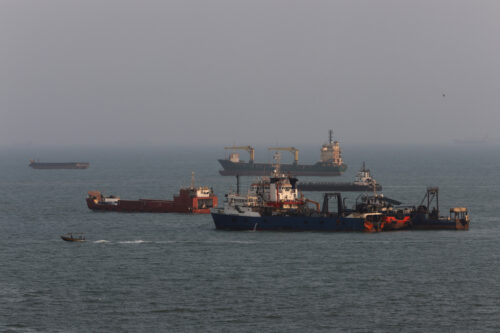
Top image: Ships are anchored in the Strait of Hormuz on August 10, 2026, off the coast of Bandar Abbas, Iran. Photo by Ali Saeedi/Getty Images.
The Middle East Institute (MEI) is an independent, non-partisan, not-for-profit, educational organization. It does not engage in advocacy and its scholars’ opinions are their own. MEI welcomes financial donations, but retains sole editorial control over its work and its publications reflect only the authors’ views. For a listing of MEI donors, please click here.