The MENA Energy Recap is a quarterly review of key energy developments that took place in the region from April through June of 2026 and what they signal in the months ahead. The Recap views these developments through the lens of policy and strategy, energy security, and markets.
Q2-26 in Brief
Energy market observers could be forgiven for thinking that the events of Q2 pointed toward a proverbial light at the end of the tunnel for the worst stages of the Hormuz crisis. Tanker traffic through the waterway had slowly grown even before the mid-June signing of the US-Iran Islamabad Memorandum of Understanding (MoU), which was meant to bring about an end to hostilities and a wider reopening of the strait.
Yet as it pertains to energy, the crisis is effectively back at square one. Hostilities have resumed and threaten to escalate. Traffic through the Strait of Hormuz is once again at a standstill. The “lessons” covered in the Q1 Recap remain fully in play, but as this crisis evolves, new factors continue to come to light. These are likely to endure alongside Q1’s lessons, forcing the region’s energy sector to revisit its long-term strategies in response to geopolitical change — much as the COVID-19 pandemic once did.
Yet unlike the pandemic, many of the challenges created by the Iran war, like the closure of the strait, have been anticipated for years. Regional players are largely aware of what can and must be done to mitigate exposure to future shocks, but the strategies designed to do that cannot be universally applied across the region. What this means for individual states is beginning to come into focus. Major questions remain over how some less-advantaged players will approach key issues like the resilience of oil operations, participation in multilateral energy organizations, and producer-consumer relations — all as the crisis reshapes the energy strategies of net-oil importers worldwide.
Policy and Strategy: Gulf Producers Seek to Define What Hormuz Resilience Looks Like
- As long as the Strait of Hormuz remains effectively shut, a key distinction in the fortunes of Gulf producers is immediately clear: access to export routes that bypass the strait is an economic lifeline for Saudi Arabia and the United Arab Emirates. For countries without that geographic advantage, this raises critical questions about how to mitigate future Hormuz risks.
- Initial discussions of these countries’ resilience to a second Hormuz crisis centered on their ability (or lack thereof) to build pipelines and related infrastructure that would route oil or gas flows through neighboring countries, bypassing the strait. However, pipelines are unlikely to remain the sole measure of resilience in the years ahead, and attacks on Saudi Arabia’s East-West pipeline as well as the UAE’s east coast terminals at Fujairah demonstrate that the view of pipelines as a holistic solution to the “Hormuz problem” is clearly misplaced.
- As a result, the conversation about Gulf resilience is likely to evolve beyond a singular focus on alternate export routes to include other measures to guard against conflict and Hormuz-style disruptions, each of which will look different from country to country.
Outlook: In May, Saad al-Kaabi, Qatar’s minister of energy and CEO of QatarEnergy, the world’s largest single producer of liquefied natural gas (LNG), told industry media that neither his country nor the national oil company (NOC) that he oversees is likely to build infrastructure that would allow its LNG exports to bypass the Strait of Hormuz in the event of another closure. While his comments largely concerned the complications around developing alternate export infrastructure for LNG — far harder to reroute than oil, as noted in the MENA Energy Recap for Q1-2026 — Kaabi’s view may not remain limited to the region’s largest LNG exporter.
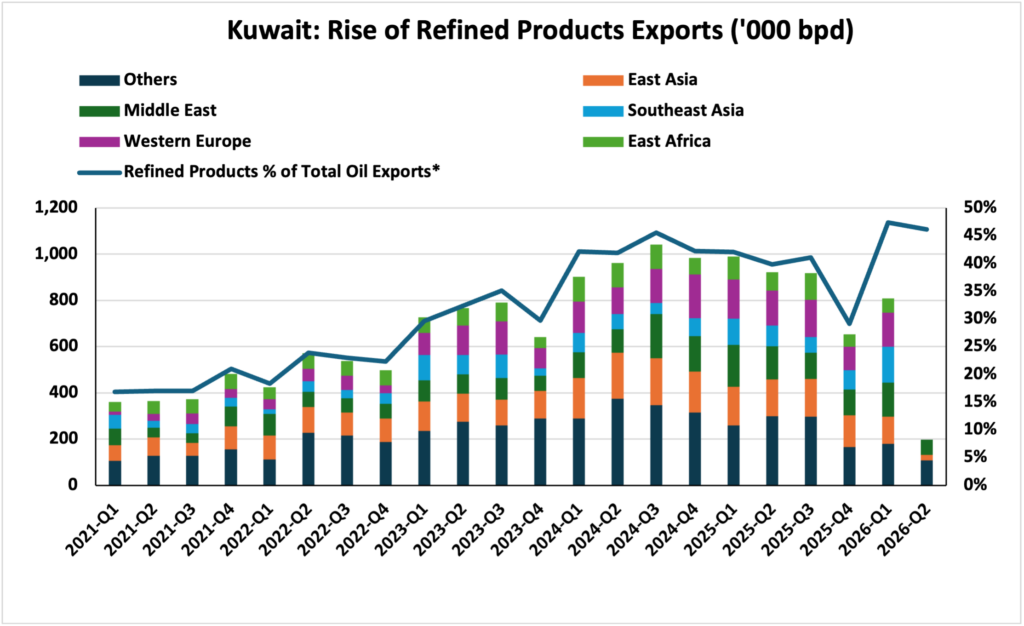
Kuwait shows what this means for other Gulf producers. Despite some technical challenges last year, the 2023 start of the long-delayed 615,000 barrels per day (bpd) al-Zour refinery has shifted its export mix toward refined products. Output from the new facility joins that from the Mina Abdullah and Mina al-Ahmadi refineries, which together have a capacity of 800,000 bpd. As a result, even if Kuwait were to establish an export route for crude oil through Saudi Arabia to the Red Sea, that would still leave nearly half of its oil exports exposed to another Hormuz disruption. Building separate pipelines for refined products is possible but would require costly redundant infrastructure. For Kuwait and Qatar, geography may make a “perfect” solution to Hormuz dependency impossible — because no such solution exists. Even Saudi Arabia and the UAE have not been able to redirect all exports through bypass routes during the conflict. Here, “resilience” means mitigating exposure, not avoiding it entirely.
What, then, does resilience look like for other Gulf states? The answer is unlikely to be straightforward. Kaabi’s May comments suggest QatarEnergy sees its international portfolio as part of its resilience strategy. Kuwait Petroleum Corporation (KPC) also has overseas arms: Kuwait Foreign Petroleum Exploration Company (KUFPEC), with upstream assets globally, and Kuwait Petroleum International (KPI), with downstream partnerships in Vietnam, Italy, and Oman. Yet KUFPEC was largely dormant until recent moves in Brazil and Egypt, while KPI’s activity remains far more limited than that of Gulf peers like Aramco or Abu Dhabi National Oil Company (ADNOC), which have built much larger overseas refining, petrochemical, and gas portfolios.
The growth of overseas portfolios was part of Gulf NOC strategy before the war, and while that will likely continue, it will increasingly be balanced against the need for other investments at home. A further pillar of resilience for Gulf states is expanding oil storage capacity in consumer countries. Many are already weighing such expansion as a result of the crisis, which should make it an easy sell for Gulf NOCs seeking to guarantee deliveries to buyers for at least a short period in the event of another disruption. Still, some producers will be better positioned than others, and competition to meet that demand is likely, with firms like ADNOC already moving into pole position.
Policy and Strategy, Markets: OPEC/OPEC+’s Near-Term Future is Reliant on a Hormuz Fix
- The dust has largely settled after the UAE’s May announcement that it would leave the Organization of the Petroleum Exporting Countries (OPEC). Still, the group’s longer-term issues are unlikely to be resolved before a permanent resolution to the Hormuz crisis is found.
- Crude flows from the Gulf account for about 60% of the total capacity of OPEC and its associated oil producers (OPEC+), and an even larger share of its spare capacity — at least before the conflict. The group has met regularly and adjusted its production schedule to signal that it plans to keep unwinding long-running voluntary cuts.
- Meanwhile, Iraqi Prime Minister Ali al-Zaidi stirred speculation about OPEC’s future when he suggested, in a late June interview, that Iraq could consider suspending its membership in the group.
Outlook: The long-term challenges facing OPEC+ typically relate to debates around when to expect peak oil demand and what to do about rising output from producers outside the group, such as the United States, Guyana, Brazil, and others. These producers, which now include the UAE, will remain a major focus for the group going forward as it looks to formulate new market-balancing strategies.
OPEC+ faces new challenges brought about by this war as well. Implementing group strategy will be impossible without a sustained reopening of the Strait of Hormuz. This is an indisputable near-term essential for the organization, but one that may also pose a number of long-term difficulties for members whose exports need to transit the strait. Saudi Arabia, Kuwait, and Iraq are three of the group’s largest producers, with the latter two almost entirely dependent on the strait to keep exports flowing. While new pipelines and expansions to existing routes are likely, they will take years to complete — and the status of the waterway may prove as volatile in the interim as it has over the past five months. Thus far, the group seems to have signaled strong internal cohesion, holding regular meetings and agreeing to several output increases — albeit largely symbolic ones — even as the conflict continues.
Yet there are already new challenges emerging. Iraq has repeatedly floated the idea of suspending its participation in OPEC if it is not given a quota that it sees as reflective of its actual production capacity. Ongoing capacity assessments, which will be used to determine quotas in 2027, should help the group address Baghdad’s concerns. It is also worth noting that Iraq likely has the worst record of quota compliance within the group in recent history, frequently overproducing and continually falling behind on compensation cuts intended to make up for its noncompliance.
Investment pressures are a key driver behind Baghdad’s statements, and they should be read in the context of the wider Gulf landscape, where other producers are also competing to attract upstream investment. Producers that depend on foreign capital may seek to accelerate capacity expansion in the coming years, partly to lock in commitments before investors view the Gulf as a less stable destination. Securing those commitments now would make it harder, though not impossible, for international firms to retreat later, while also helping producers limit stranded-asset risk and defend market share against non-OPEC+ competitors.
This brings existing members back to the same core problem that drove the UAE’s exit: many producers see investment in new capacity as increasingly at odds with participation in output cuts designed to balance oil markets. After the bloc lost the UAE as both a founding member and a producer capable of holding substantial spare capacity, these factors are set to be major considerations in OPEC+ strategy moving forward.
Policy and Strategy, Markets: Iran’s Uncertain Return to Market
- Iran is more practiced in sanctions evasion and the dark oil trade than any other producer — a small group that today mostly means Russia and, until recently, Venezuela. Direct military confrontation with the US may constrain its exports, depending on the conflict’s trajectory, but it is likely to face other hurdles as events unfold.
- Iran remains one of the most heavily sanctioned countries in the world, and although its economy is more diversified than that of many other oil producers, its oil sector is among the most severely sanctioned parts of it. With a final settlement between the US and Iran far from certain, the staying power of any sanctions relief is an open question.
- One particularly difficult issue is an oil export and marketing apparatus, forged under years of sanctions, that has placed Iran’s oil trade in the hands of some of its most heavily sanctioned entities. These players are unlikely to relinquish their roles if a new agreement is reached, complicating Tehran’s ability to bring its dark oil trade back into the open.
Outlook: The conflict between the US, Iran, and Israel has injected a high degree of uncertainty into Iran’s oil sector. Its impact is likely to be felt across three related areas: US sanctions policy, export channels, and Iran’s ability to re-enter the open market.
Of these three, US sanctions policy will be the most critical. This pertains not only to buyers having enough confidence to begin purchasing Iranian barrels, but also to the fact that decades of accumulated sanctions have shaped the operating environment of Iran’s oil sector. These measures include direct restrictions on Iranian crude exports, tankers, and the individuals and entities linked to the trade in sanctioned barrels. Over time, this has made Iran one of the world’s most adept players in the dark oil trade.
That experience has also narrowed Iran’s options; its primary outlet for oil sales is independent Chinese refiners that are largely disconnected from the international financial system and therefore more insulated from US sanctions. The Islamabad MoU appeared to offer a path back toward more open sales, but its collapse in early Q3 prompted Washington to revoke the waiver that would have allowed those exports to begin. Even before the waiver was withdrawn, prospective buyers in Asia were seeking stronger US assurances before resuming purchases, given the risk of falling afoul of Washington’s sanctions policy.
Looking ahead, the conflict could still take several unforeseen turns before it is resolved, making Iranian output and its impact on global markets extremely difficult to project. Renewed diplomatic progress will be all but impossible without some measure of sanctions relief allowing Iranian barrels to return to the open market, perhaps along the lines of the waiver under the Islamabad MoU. Even then, buyers are likely to require durable guarantees that any relief will survive shifting political and security conditions — an assurance that will be exceedingly difficult to give.
Energy Security, Markets: Consumer Nations’ Stockpiles Emerge as New Volatility Hedge
- Throughout the Hormuz crisis, which extended through Q2 despite a modest recovery in maritime traffic, analysts struggled to explain why oil prices were not higher considering the scale of the supply disruption.
- Consensus has emerged around major oil inventory releases as a significant source of downward price pressure. Chinese stocks expanded drastically prior to the war, enabling Beijing to play a largely unprecedented market role for a consumer nation.
- In the years ahead, this dynamic may have important implications for producer nations, particularly those in the Gulf.
Outlook: Gulf oil exporters, particularly those that remain in OPEC+, will face a post-conflict market in which major energy-consuming economies play an increasingly proactive role in shoring up energy security. That shift was already underway once the energy effects of the 2022 Russia-Ukraine conflict were truly felt, but it is now likely to accelerate. One form this may take is the development of greater oil storage capacity in consumer countries — a decades-old dynamic rooted in the oil supply shock of the 1970s.
However, producers can now expect this strategy to be revisited, with storage capacity likely to grow in the nations hardest hit by the Hormuz crisis, particularly in South and Southeast Asia. When markets stabilize, net-oil importers are likely to follow China’s example of bolstering storage capacity while prices are relatively low. Beijing’s ability to insulate itself from the supply shock has largely been attributed to this strategy, although its growing efforts to electrify the transportation sector certainly play a role as well. Still, Chinese inventories enabled one of the world’s largest importers of crude to cut its imports by over 7 million bpd during the crisis — down 40% from pre-war levels.
Yet this is not something that Gulf producers have to sit by and watch — they have every ability to make themselves an essential component of energy security outside the region. As mentioned earlier, Gulf NOCs may look to boost their resilience against future Hormuz shocks by investing in new oil storage facilities overseas, which almost all of them do already. Greater coordination with consumer countries is the more likely way forward. Gulf producers may rightly view China’s stockpiling as a harbinger of potential responses to an increasingly uncertain future.
Outlook for Q3-26
Developments in early Q3 underscored that control of the Strait of Hormuz is now central to the conflict. While wealthier Gulf states may pursue alternate transport routes for energy and other goods, this does nothing to diminish the near-term need for an arrangement to reopen Hormuz to maritime traffic. Additionally, while Iran may have slowed its attacks on regional energy infrastructure, its proxies have not, and there is no reason to expect that bypass routes would not represent likely targets in a future conflict. As the collapse of the Islamabad MoU shows how difficult this will be, support for regional resilience measures should be a key US policy focus. These projects will take years, but Washington should help accelerate them if it wants to shape the post-conflict economic order.
To that end, Washington has already shown some signs of responding. Iraqi Prime Minister Zaidi’s mid-July visit to Washington produced several energy deals, including an agreement to rehabilitate the Haditha-Baniyas pipeline. The project would give Iraq a major new crude export route and reduce its dependence on Hormuz, through which almost all of its exports currently move via Basra.
One issue that still appears underappreciated in Washington is the risk of a significant erosion in OPEC+’s ability to execute effective market-management strategies. The producer alliance has been written off prematurely before, and its collapse is not imminent. Still, despite the US’s difficult history with OPEC, its oil sector has often benefited from the group’s efforts to manage supply, even as it has suffered when the alliance opened the taps. Officials from OPEC+ member states have long argued that US shale received a “free ride” from OPEC+ production cuts.
The US therefore has more to gain from the durability of OPEC+ than from its demise. A collapse in market management could trigger a free-for-all among some of the world’s largest and lowest-cost producers, harming the US oil sector and the economic leverage that comes with America’s position as a leading oil and gas exporter.
Even if current disruptions help US producers gain market share in the near term, prolonged uncertainty over Gulf oil makes projecting the near-term supply and demand balance an ever-greater challenge, which may ultimately harm the US “energy dominance” agenda rather than support it. As the current administration’s policies have largely ceded any attempt at establishing US leadership in the low-carbon energy space to China, Washington would be wise not to leave its own energy leadership goals to chance.
Colby Connelly is a Senior Fellow at MEI. He is also Head of Middle East Content at Energy Intelligence, where he works with the firm’s research and editorial teams.
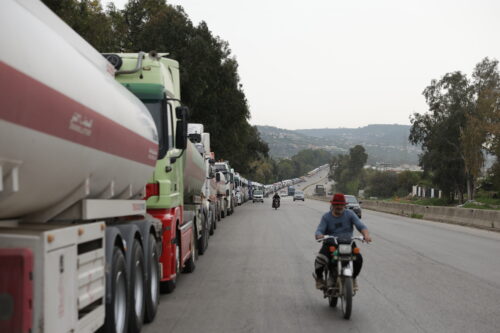
Top photo: Iraqi oil tankers line up on the Tartus-Latakia Highway, as Iraq resorted to exporting oil through Syria as a result of the closure of the Strait of Hormuz, on April 19, 2026. Source: Nabiaha Altaha/Anadolu via Getty Images.
Jordan’s Economy Weathers Iran War’s Shocks and Finds New Opportunities

Special Episode: Saudi Oil After the East-West Pipeline Attack