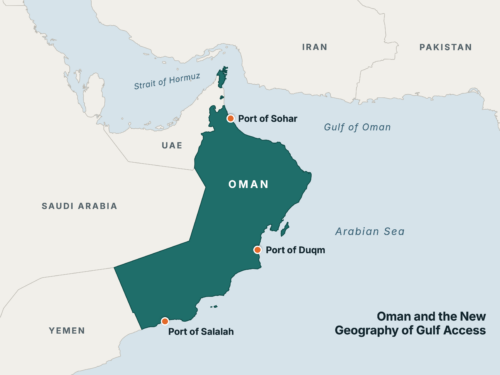
For decades, Oman’s location has been both an advantage and a liability. Its access to the Indian Ocean has given it a maritime reach beyond the Strait of Hormuz, while leaving it on the periphery of the Gulf’s economic boom, dominated by its larger neighbors.
Brian is joined by His Excellency Talal Al Rahbi, the ambassador of the Sultanate of Oman to the United States of America, to discuss what it means to represent the “Switzerland of the Middle East” and the role of Oman’s quiet diplomacy. He also reflects on growing up during Oman’s transformation, his time spent in the United States, and why the two nations’ long-standing partnership matters today.
Buying certainty: How Hormuz is redefining global shipping
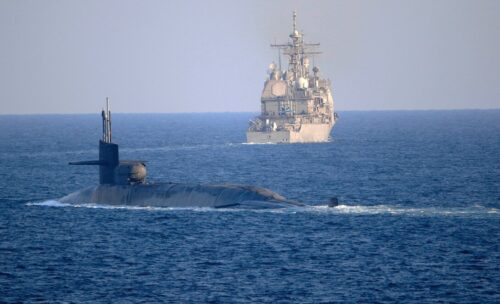
At the recent Lianhe Zaobao Singapore-China Forum 2026 in Singapore, Professor Joseph Liow, dean of the Lee Kuan Yew School of Public Policy and chairman of the Middle East Institute at the National University of Singapore, suggested that the Strait of Hormuz (SOH) may be entering a “new normal”, one in which Iran — and perhaps Oman — could justify charging vessels fees for transiting one of the world’s most important waterways.
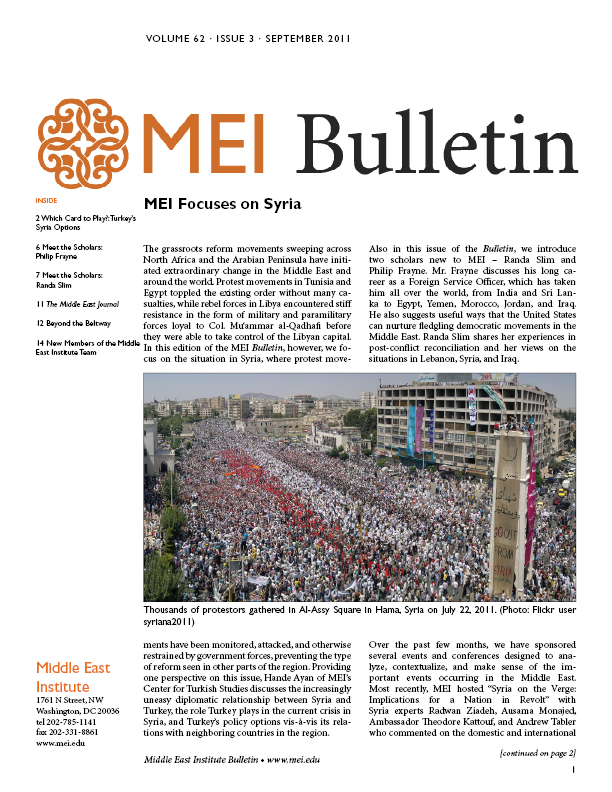
Amidst ongoing violence against protestors in Syria, Hande Ayan of the Center for Turkish Studies discusses the uneasy diplomatic relationship between Turkey and Syria and Turkey’s role in the political situation there. The September 2011 Bulletin also introduces MEI scholars Philip Frayne, who speaks on his Foreign Service career and offers his insights on how the US can support democratic transitions in the Middle East, and Randa Slim, who is interviewed on her experience in post-conflict reconciliation.
In the wake of the recent Nuclear Security Summit in Washington DC, Turkish-Iranian relations once again came under scrutiny. As the US and the EU have intensified their efforts to impose sanctions on Iran through the UN Security Council, Turkey’s role in this issue has come into question. Notwithstanding Turkish temporary membership in the Security Council, the Turkish position will be critical for any effective implementation of sanctions.
Soil and groundwater salinity has emerged as the most significant agricultural problem facing the Sultanate of Oman. Scant rainfall, coupled with high temperature, is always conducive to the accumulation of salts in soils. These conditions are predominant in Oman. Secondary soil salinity has increased at a very rapid rate due to the persistent use of saline groundwater, which, over time, has become more concentrated due to increased pumping by farmers in the Batinah region – the country’s most important agricultural area.
Low-Cost Methods to Treat Greywater: A Case Study from Oman
Oman is an arid country where the pressure on freshwater reserves is as severe as that of any other arid or semi-arid country in the world. Increasing water availability by treating and reusing wastewater, particularly for irrigation, is a government policy in Oman. Identification of alternative sources of water and development of appropriate technology to harness them in order to reduce pressure on freshwater reserves and production capacity in Oman is a priority.
*This article was first published in November 2010 by Jane's Islamic Affairs Analyst.
The second half of 2010 witnessed a flurry of interaction between Iranian diplomats and their African counterparts. Not all the buzz has been beneficial to Tehran, as was most recently demonstrated by the Republic of the Gambia’s 22 November decision to break its ties with Iran, but the overall activity nonetheless reflects the increasing emphasis Tehran is putting on closer relations with countries on the continent.
The Middle East Institute is pleased to host Dr. Thomas O'Donnell,
lecturer in Graduate International Affairs at the New School in New
York, for a discussion on China's perception of the Iranian nuclear
issue. Drawing on his expertise in the global energy system, Dr.
O'Donnell will examine why Beijing, which was initially and very
vocally opposed to UN sanctions, ended up voting in favor of them. He
will outline the energy-security nexus underlying China's interests in
The oldest peer-reviewed publication dedicated to the study of the modern Middle East, MEI’s flagship journal covers politics, society, and culture in the region.