This article is part of a collection of short essays written by the Fellows of the Middle East Institute to explore aspects of the ongoing war with Iran. The intent of the collection is to help readers see new and unexpected elements of the dynamics and impact of the ongoing hostilities and to think harder, deeper, and broader about the implications of the conflict.
Egypt: How the Iran War Has Affected Egypt’s Calculations
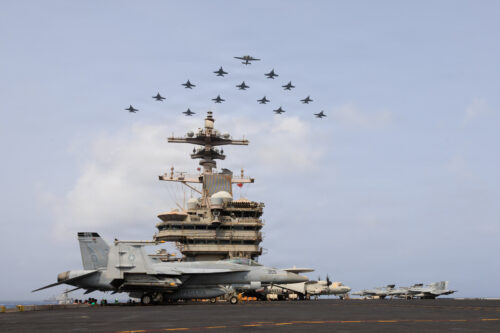
Egypt, which is not party to the war on Iran, has become a target as well as an intermediary in the conflict. As a result, the war has affected Egypt’s future calculations, particularly in three major areas: its economy, its security, and its regional alliances.
Algeria and Morocco have long been at odds, but recent diplomatic moves may signal a widening geopolitical split in North Africa. Hosts Alistair Taylor and Matthew Czekaj are joined by MEI Senior Fellow Intissar Fakir to unpack Algeria’s decision to sever diplomatic ties with the United Arab Emirates and Morocco’s warming relations with both the UAE and Israel. They also explore linkages between these diplomatic shifts and the Western Sahara conflict, Moroccan domestic concerns, particularly in light of this week’s elections, as well as broader regional stability.
Governments in the Middle East and North Africa have long relied on repression to intimidate, harass, and punish political opponents. During the Arab uprisings, dictators under threat have all ordered and used violence against peaceful protestors as a way to maintain power. But this repression has had widely divergent effects on the course of the different conflicts.
Building an Addiction Workforce in the Middle East: A Counselor Training Program Partnership Between Kasr Al-Ainy and UCLA
Drug and alcohol problems know no borders. Annually, the United Nations World Drug Report documents that heroin, methamphetamine, cocaine, alcohol, and prescription drugs negatively impact public health, public safety, and social institutions in countries around the world.[1] In many parts of the Middle East, there is limited data on the nature and extent of alcohol and drug problems.
The Lesson from Morocco and Jordan: Reform or Perish
The basic legitimization of political authority and the specific logics of domination that have for decades regulated Arabs’ behavior and subjugated their life patterns are under siege in much of the Arab world. Only those regimes that still enjoy the historical prestige of traditional authority have so far managed to weather the assaults on the legitimacy of their rule.
This Commentary was first published as an op-ed in the Washington Post on August 22, 2011
A relatively successful transition from the Gaddafi regime to a united, stable, more open and democratic Libya would be seen in the region, and more widely, as a credit to the NATO-led intervention. It would enable Libya to resume its oil and gas exports, demonstrate international community capacity to manage such transitions and encourage positive outcomes to other Arab Spring protests.
Supporting Democratic Movements in the Arab World: An Economist's Perspective
The global community was surprised by the suddenness and intensity of democratic movements in the Arab countries. While universally welcomed, the global response in support of these movements has so far been reactive, uncertain, and slow to build up. The only coherent rendering of such an initiative is the declaration of Deauville Partnership by the Group of 8 countries on May26-27, 2011.
Egypt's Revolutionary Elite and the Silent Majority
It was a small group that set out on January 25, marching on National Police Day to decry the quotidian indignities they suffered at the hands of Husni Mubarak’s abusive police. Public protest in Egypt had long been a minority practice, rarely mustering more than a few hundred, or at best a few thousand, core movement activists. The organizers of the January 25 march expected the same base of dedicated demonstrators, and were shocked when the crowd swelled to more than 10,000.
Looking across the Middle East and North Africa (MENA), there is a real fear that both reform movements and revolutions risk snatching defeat from the jaws of victory. The momentum that made so many inspirational gains a few months ago is slowing, and the forces of conservatism remain in control. The only hope is that stamina, vigilance, and strategy will lead to a complete transition to democracy in at least one of the region’s countries. Not one revolution has yet been completed. If such a success is to happen soon, I hope it will be in Egypt.
Two big misconceptions have been circulated about the Egyptian revolution in January 2011: first in the international media, research, and policy circles, and second inside Egypt itself through the Egyptian media. In the international sphere, the misconception was that the Egyptian revolution was a “cute” Facebook, social media, social network, or internet revolution (in which scrappy youths banded together over the internet to create change). Inside Egypt, the second misconception is that it was a pre-planned, organized, orchestrated, well-led revolution.
The recent uprisings in Bahrain, Egypt, Libya, Syria, Tunisia, and Yemen share associated economic grievances and a common call for responsive government and a more dignified way of life; however, their underlying social dynamics are the product of diverse encounters with the outside world and years of oppression under very different political regimes. This is particularly true in the Libyan case, where socioeconomic and political structures and institutions shaped before as well as during the Qadhafi years have combined to produce a unique political economy.
*This Commentary first appeared on neimanwatchdog.org on July 8, 2011
While political debate still roils over the legality of the American role in Libya, other questions have grown more pressing. Those questions include whether the European side of the NATO operation can be sustained and whether the Libyan opposition truly has the ability to achieve their goal of taking down the regime of Muammar Qaddhafi & Co.
These issues are critical for those favoring US participation in NATO operations as well as those opposed.
After the Arab Spring: Toward Political & Economic Inclusion in the Arab World
The Middle East Institute and the UNDP are proud to host a discussion with UNDP Administrator Helen Clark, Under Secretary for Economic, Energy and Agricultural Affairs Robert D. Hormats, and Middle East Institute Scholar Amb. Edward Walker about how best to address political, economic and human development needs in the Arab world today.
تُعد المجلة الرئيسية لمعهد الشرق الأوسط أقدم مطبوعة محكّمة مكرّسة لدراسة الشرق الأوسط الحديث، وتغطي المجلة الرئيسية في المعهد السياسة والمجتمع والثقافة في المنطقة.