Impunity and Instability: An Unbroken Cycle
Originally posted December 2012
Originally posted December 2009
Thirty years of war have taken an enormous toll on all aspects of Afghan society whose traditional social fabric has broken down, giving rise to a new generation of political and military elites. The cycles of violence over the past three decades have included massive human rights abuses by all parties, leaving a legacy of pent-up grievances and profound feelings of injustice.
Originally posted December 2009
Respect for Afghanistan’s sovereignty is a sine qua non condition to restoring the country to normalcy. The fact that a country expects and demands that its sovereignty be respected should not be misconstrued as a refusal to engage the outside world — as a sign that the country is drifting towards some type of chauvinistic nationalism.
Originally posted December 2012
Originally posted December 2009
The 2001 destruction of the two giant Buddhas in Bamiyan is, by far, the most spectacular attack against the historical and cultural heritage of Afghanistan committed during the country’s recent period of turmoil.
Originally posted December 2009
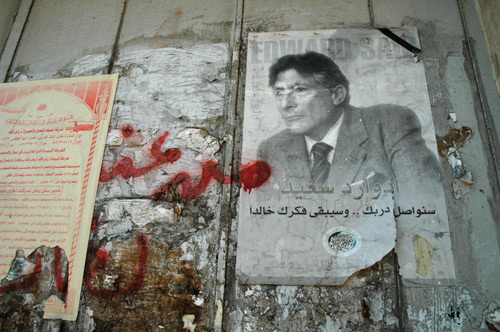
“I think one can say this almost without qualification,” writes Edward Said in Orientalism, as he reiterates some basic facts and moves toward a provisional conclusion (p. 204). Said had just explained that Orientalism is “a positive doctrine.” It is “an influential academic tradition,” as well as “an area of concern” (p. 203). As he implies here, and shows throughout his work, Orientalism is a great number of other things, too. It is the deployment of concepts regarded as always already universal such as race, religion, and fanaticism.
This infographic explains one facet of the argument posed in MEI Scholar Zubair Iqbal‘s recent article The Economic Determinants of Arab Democratization, posted March 13.
Click the image to enlarge
Originally posted December 2009
Nation-states, like their citizens, have life spans. Some are short. The bumptious Republic of Texas, for instance, lasted only nine years before being absorbed by a larger and even more energetic United States of America. Yugoslavia survived intact for two generations and then fragmented into six parts, seven including Kosovo.
The thirteen students in the class at the American University of Cairo were mid-career professionals working on graduate degrees in education. We had spent two hours discussing my book of case studies in education assistance when one student raised her hand: “Look, we intend to reform Egypt’s education system. Can you please just give us the steps we need to follow?”
This Opinion first appeared in Hurriyet on April 13, 2012
By Alex Vatanka and Soner Çağaptay
Originally posted April 2010