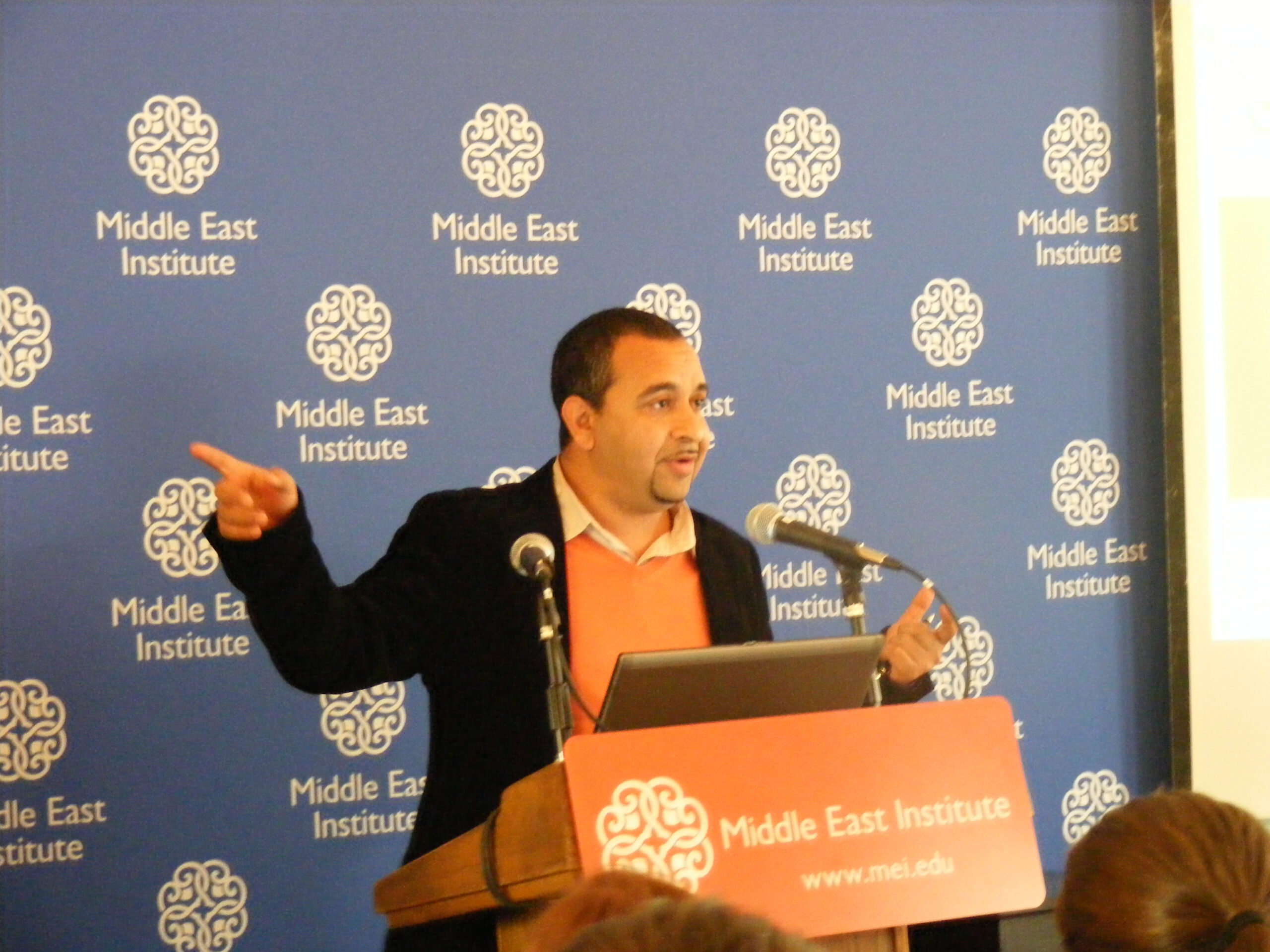
This individual is a guest contributor. MEI is not able to assist with contact requests.
Shahmahmood Miakhel is the Country Director in Afghanistan for the US Institute of Peace (USIP). Prior to that he was a Governance Advisor for the United Nations Assistance Mission in Afghanistan (UNAMA), and, from 2003–2005, a Deputy Minister of the Interior in the Government of Afghanistan. In 1994–1995 he worked for the United Nations Development Programme (UNDP) and United Nations Office for Project Services (UNOPS) in South and Southeast Afghanistan helping to establish District Rehabilitation Shuras (DRS). He also worked as a reporter for the Pashto service of the Voice of America from 1985–1990.
The Middle East Institute, in partnership with the Fondation pour la Recherche Stratégique, is proud to host two panel discussions on the refugee situation in Sudan. Funded by the European Commission, this event is part of a two year research project which aims to generate policy recommendations that will strengthen transatlantic cooperation to respond to the refugee and internally displaced persons crises in Sudan.
Various Track Two approaches to peacebuilding in the Middle East have been pursued through ecumenical dialogue and educational programs such as The University of the Middle East Project.[1] Yet the direct use of environmental conservation as a mutually agreeable way to approach territorial conflict resolution has thus far not been seriously deliberated. Some “realists” might be dismissive of such a prospect, but the concept of “peace parks” has shown practical promise in resolving territorial disputes.
Environmental Peacebuilding in the Eastern Mediterranean
Environmental peacebuilding is both the theory and practice of identifying environmental initiatives that promote a sustainable peace between those who have previously been adversaries, and implementing those initiatives. Environmental peacebuilding combines two elements.
Arava Institute for Environmental Studies: Teaching Environment as a Bridge to Peace & Understanding in the Middle East
The Arava Institute for Environmental Studies (AIES) is the premier environmental studies institute in the Middle East and is accredited under the auspices of the Ben Gurion University (BGU) of the Negev. Since 1996, the Institute has been teaching environmental studies to university students from the Middle East and other parts of the world. The unique approach of the Institute is to teach the environment, in which all share, as a bridge to cooperation and peacebuilding in the Middle East.
Local Initiatives Prepare the Ground for Sustainable Development in the Middle East: Preliminary Lessons from Egypt
Using Egypt as a case study, this essay argues that the pathway to sustainability in the Middle East is to gradually reconcile competing economic development and environmental agendas. However, broader economic and political forces are inimical to setting about such a sustainable development trajectory. An exception to this adverse trend is the existence of innovative local development initiatives, which connect the livelihoods of the poor and marginalized with their physical environment in a productive way.
This Burning Land: Lessons from the Front Lines of the Transformed Israeli-Palestinian Conflict
The Middle East Institute is proud to host Greg Myre and Jennifer Griffin for a discussion about the ongoing challenges in the Israeli-Palestinian conflict based on their knowledge and experiences recounted in their new book, This Burning Land: Lessons from the Front Lines of the Transformed Israeli-Palestinian Conflict. Myre and Griffin, journalists who are husband and wife, traveled to Jerusalem in 1999 in hopes of finally seeing Middle East peace. Instead, the pair watched as violence in the area escalated and the peace process disintegrated.
This Burning Land: Lessons from the Front Lines of the Transformed Israeli-Palestinian Conflict
The Middle East Institute is proud to host Greg Myre and Jennifer Griffin for a discussion about the ongoing challenges in the Israeli-Palestinian conflict based on their knowledge and experiences recounted in their new book, This Burning Land: Lessons from the Front Lines of the Transformed Israeli-Palestinian Conflict. Myre and Griffin, journalists who are husband and wife, traveled to Jerusalem in 1999 in hopes of finally seeing Middle East peace. Instead, the pair watched as violence in the area escalated and the peace process disintegrated.
Libyan Intervention: Justified By the Circumstances
It was absolutely predictable that Republicans would attack President Obama whatever he did in Libya, though Newt Gingrich, in his overeagerness, overreached by criticizing him for too explicitly opposite reasons. It was also likely that the anti-interventionist left, which sees (almost?) any use of American military power as imperialistic and unwarranted would likewise be opposed.
Cyberactivism and the Arab Revolt: Battles Waged Online and Lessons Learned
The Middle East Institute is proud to host digital media experts Adel Iskandar and Courtney Radsch for a discussion on the nature of the cyberactivism that is fueling the uprisings spreading throughout the Middle East. Iskandar will examine the battle in Egypt between the government and the protesters to control online discourse, analyzing the obstacles and the successes.
Cyberactivism and the Arab Revolt: Battles Waged Online and Lessons Learned
The Middle East Institute is proud to host digital media experts Adel Iskandar and Courtney Radsch for a discussion on the nature of the cyberactivism that is fueling the uprisings spreading throughout the Middle East. Iskandar will examine the battle in Egypt between the government and the protesters to control online discourse, analyzing the obstacles and the successes.