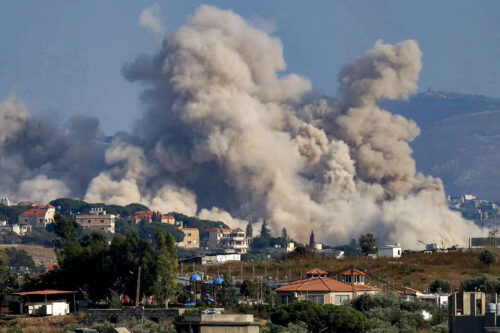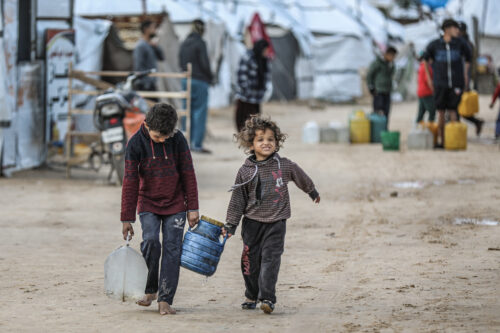
The United States plans to submit a resolution on Gaza to the United Nations Security Council (UNSC) by the end of November. Reportedly, the latest draft endorses President Donald Trump’s 20-point plan, recognizes the Board of Peace (BoP) as a “transitional governance administration,” and authorizes the BoP to establish an International Stabilization Force (ISF). The UN resolution is a first step to achieving buy-in from potential ISF contributors. In turn, a viable ISF will be one key to moving beyond the cease-fire to securing the 20-point plan’s envisioned Hamas disarmament, further Israeli military withdrawal, and a path to Palestinian governance. The US faces several dilemmas as it seeks to transition from cease-fire to stabilization and beyond.
Why It Matters for the US
- Sustainability of the cease-fire. The ability to stabilize the situation in Gaza relies on a security mechanism that can protect civilians, ensure access to humanitarian aid, and prevent Hamas and other armed groups from refilling the security vacuum.
- Keeping partners engaged. Implementation of the ambitious 20-point plan will require close coordination with partners in the Arab and Muslim world, who are central to its success. Ensuring that the terms and longer-term assumptions behind the ISF’s deployment are palatable to those countries is key to sustaining their engagement.
- Safeguarding a route to reconstruction. An effective “phase 2” of the 20-point plan, specifically including disarmament of Hamas and an IDF withdrawal, will be essential to securing Saudi and other Arab states’ robust contributions to post-war recovery and reconstruction.
Policy Considerations
- The dilemmas of disarmament as ISF mandate. Despite initial receptivity to the idea of a multinational stabilization mission, several Arab and Muslim states have registered concern over an enforcement rather than a peacekeeping role. Opposed to outsourcing its own security, Israel is likely to only cede that role to the US; but Washington has been clear it will not deploy US troops in Gaza. Leaving disarmament of Hamas solely to Israel simply means resumed combat. Determining a clear architecture for Hamas disarmament prior to ISF deployment could ease the path to ISF composition.
- Defining the ISF’s source of authority. The draft UNSC resolution is silent on whether the ISF and BoP have Palestinian consent. Legally, in the absence of such a mandate, ISF deployment could be considered coercive and require Chapter VII authority. Strategically, for Egypt and other Arab states, participation is contingent upon an official invitation from a representative Palestinian body, with the Palestinian Authority (PA) being the most viable candidate. The latest reported US draft resolution highlights the conditioned eventual assumption of control by the PA. Clear benchmarks for that goal and a mechanism for Palestinian consultation could prevent indefinite international control and increase the possibility of local buy-in.
- Reconciling competing interests on role of PA. Israel is loath to afford legitimacy to the PA, while key Arab and Muslim states require governance by a reformed PA as the explicit end goal. The PA would welcome being the presumptive governing body but has scant legitimacy in Gaza or capacity to fully assume control. With Israel primed to coordinate with the ISF in determining the achievement of security benchmarks, the PA fears replicating its reputation in the West Bank as a subcontractor for Israeli security needs. For the US, a PA disempowered out of the gate will undermine the success of its plan’s stated goal of eventual PA governance. A gradual ramp-up of PA responsibilities in areas where it has existing capacity — to include healthcare and utilities provision — would meet Gazans’ critical needs and set the PA up for longer- term success and legitimacy.
Photo by -/AFP via Getty Images
Israel/Palestine: What the Iran War Broke and What May Yet Be Salvaged