The Gulf’s New Information Battlefield: War, Technology, and the Reconfiguration of Security
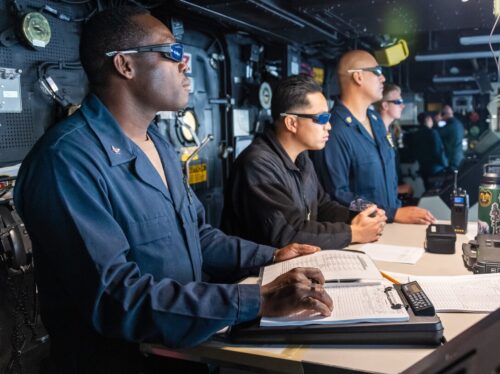
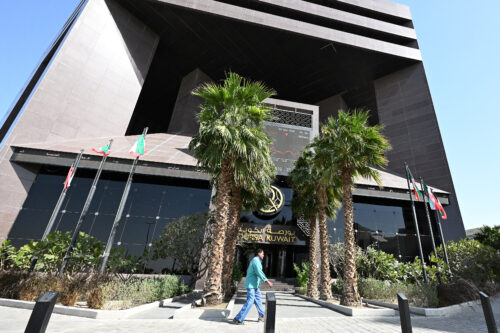
During the opening days of the 2025–2026 U.S.–Israel war with Iran, Kuwait’s military briefings highlighted intercepted Iranian missiles and drones while revealing little about strike locations or damage. The approach reflected a familiar wartime dilemma in which governments must reassure populations while limiting information that could aid adversaries or fuel uncertainty. Yet Kuwait’s response revealed a broader shift across the Gulf. Information was no longer simply a messaging tool; it had become part of the battlefield.
After the US-Israel-Iran war — and the strikes that followed the cease-fire — the Gulf states find themselves dangerously exposed. Host Alistair Taylor is joined by MEI Associate Fellow Gregory Gause to discuss the war’s impact on the Gulf, their partnership with the United States, and whether the turmoil of recent months will push Gulf leaders to reassess their alliances and international engagement.
The Gulf’s Strategic Paradox: Lost Confidence in the US Security Umbrella, Enduring Trust in the Dollar
This essay argues that the current debate about the future of the international monetary system is not really about Gulf currencies, oil pricing, or de-dollarization in the narrow technical sense. It is about something deeper and more important: whether institutional trust can survive when geopolitical certainty is eroding.
Since the 1970s oil boom, the Gulf region has been one of the principal destinations for workers from South Asia, with the result that today Indians constitute a large percentage of the non-nationals living in the region. Indeed, at five million out of an estimated 15 million people, the Indian community forms the largest expatriate group in each of the Gulf countries. Most Indian immigrants are from the south Indian state of Kerala, while many of the rest originate from Tamil Nadu, Punjab, Uttar Pradesh, and Bihar.
When the young Shaykh Tamim bin Hamad al-Thani became ruler of Qatar last month after his father stepped aside in a seamless transition, one of his first official acts was to seal the generational shift by appointing a new prime minister.
Introduction to Revolution and Political Transformation in the Middle East: Government Action and Response
Originally posted September 2011
On August 21, 2011, rebel forces in Libya rolled into the capital Tripoli, seemingly finishing off months of armed combat and foreign intervention and bringing down yet another Arab head of state. At the same time, sporadic but violent repression of protests in Syria continues, while other states remain calm or have seen their protest movements fizzle. We open this second volume of our series, Revolution and Political Transformation¸ at a time of uncertainty and transition for the region.
This Commentary was first published as an op-ed in the Daily Beast on September 7, 2011
The events of that day were so jarring that they are recorded in our memories as if they had taken place last week. But it has been a long decade, one in which we have made as many mistakes as we have had successes. Now, and not after we suffer another major terrorist attack, is good time to pause, look back, learn lessons, and begin to chart a path away from the past.
This Commentary was first published as an op-ed in the Washington Post on August 4, 2011
The political crisis in Bahrain appears to have subsided, even if the issues that provoked it remain unresolved. Now, the challenge before Washington is redefining the terms on which it deals with an important but seriously tarnished ally.
Supporting Democratic Movements in the Arab World: An Economist's Perspective
The global community was surprised by the suddenness and intensity of democratic movements in the Arab countries. While universally welcomed, the global response in support of these movements has so far been reactive, uncertain, and slow to build up. The only coherent rendering of such an initiative is the declaration of Deauville Partnership by the Group of 8 countries on May26-27, 2011.
This Commentary was first published as an op-ed in the Washington Post on July 29, 2011
With debt talks at an impasse, foreign policy is the last thing on many American minds. But how Congress and the president deal with the debt will affect US relations with other countries and our national security for years to come.
*This Commentary first appeared on neimanwatchdog.org on July 8, 2011
While political debate still roils over the legality of the American role in Libya, other questions have grown more pressing. Those questions include whether the European side of the NATO operation can be sustained and whether the Libyan opposition truly has the ability to achieve their goal of taking down the regime of Muammar Qaddhafi & Co.
These issues are critical for those favoring US participation in NATO operations as well as those opposed.