US Policy in the Middle East in the First Year of Trump 2.0: A Report Card
A Quarterly Assessment of the Trump Administration’s Regional Foreign Policy
February 6, 2026
Share
In the first year of his second term in office, US President Donald Trump focused considerable time and energy on the Middle East, but the results so far have been uneven. While the Trump administration signed major investment deals with Gulf partners and had notable tactical successes against adversaries like Iran as well as terrorist groups like the Islamic State (ISIS), it has not yet produced durable gains for regional peace and security. Moreover, Trump’s unpredictable decision-making style, along with long-standing questions about America’s commitment to the region, has motivated key partners to subtly hedge and diversify their relationships globally. The first year of Trump 2.0’s approach to the Middle East offers some important insights about how America is recasting its relationship with this key region of the world.
The following report assesses the US government’s actions over the past 12 months, from January 2025 through January 2026. It represents the independent analytical judgments of one analyst at the Middle East Institute based on his policy research and research support from key colleagues, as well as the independent feedback from colleagues in a peer-review process. It is part of a regular, quarterly assessment that includes a report card with grades on five key policy areas based on long-standing US national security interests in the Middle East and priorities set by the current US administration.
President Donald Trump’s second administration focused considerable time and energy on the Middle East in its first year in office, more than any other United States president during that same period since the Obama administration in 2009. Trump’s policies did significant damage to US adversaries like Iran and the Islamic State (ISIS), but the administration has not yet produced durable gains for regional security and peace.
The whirlwind of activity produced mixed outcomes at the end of the first year — tenuous cease-fires in Gaza and Lebanon, substantial damage to Iran’s nuclear and military infrastructure and economy, an uncertain transition in Syria, and a slew of bilateral deals with regional economic powers on technology, investment, and foreign military sales. Kinetic counterterrorism operations remained a top priority across the region. Trump’s personal engagement with key Middle Eastern leaders offered a degree of reassurance and produced some important progress, like the October 2025 Gaza cease-fire deal.
However, Trump’s unpredictable decision-making style, along with long-standing questions about America’s overall strategic reliability and predictability, motivated key partners to subtly hedge and diversify their relationships globally with countries like India, China, and Russia. Trump also took some steps to innovate and build alternative international structures like the “Board of Peace,” but it remains unclear what ultimate impact these initiatives will have on enhancing regional stability and prosperity.
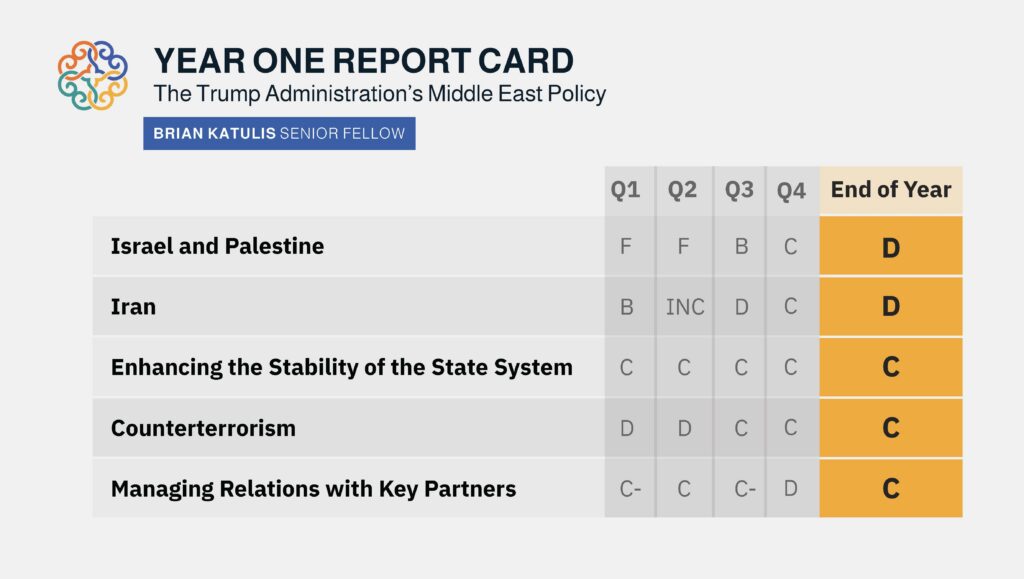
Overall Grades for the Year for Trump’s Middle East Policy
Israel-Palestine: D — Trump’s performance on the Israel-Palestine front improved in the second half of the year after a disastrous start. The October 2025 Gaza cease-fire, a leading achievement in Trump’s first year, was followed by months of missed opportunities and the announcement of various structures like the Board of Peace with an as-yet indeterminate impact beyond optics and public relations.
Iran: D — The second Trump administration started relatively strong on Iran by using both diplomacy and the threat of force, but the 12-day war in June produced inconclusive outcomes, and the administration’s approach to Iran suffered from strategic drift in the latter half of the year.
Enhancing the Stability of the State System: C — Efforts to support transitions in Syria and Lebanon in order to strengthen the overall regional state system were more focused throughout most of the year than they were in Yemen and Iraq.
Counterterrorism: C — The United States remained engaged in countering terrorist groups across the region, marking nearly a quarter century of deep and direct US military involvement in the Middle East on this front.
Managing Relations with Key Partners: C — Despite a heavy focus on the region, Trump’s engagement with close US partners, including two trips to the region, was complicated by his erratic and unpredictable approach and failed to meet America’s overall potential due to an unwillingness to exercise sufficient leverage over the Israeli government at several key junctures.
Note on grading. The grades offered in this report card reflect one analyst’s assessment based on his policy research and research support from key colleagues, as well as independent feedback from colleagues in a peer review process. A final grade for the first year signifies the overall performance of the administration from January 2025 to January 2026. The grades are based on outputs and impact, rather than inputs — meaning that the letter grade for each category represents the author’s assessment of how much US policy has advanced America’s strategic interests and values on this particular issue over the course of the entire year.
The two main objectives of the series of graded reports are:
To offer strategic markers over time within the context of a structured analytic framework; and
To generate lessons learned for US policy articulated in the final section of this report.
At a time of fast-moving developments, it is important to offer analysis that facilitates constructive strategic debates, rather than narrower and episodic discussions in reaction to specific events or moments in time. These letter grades and the analysis aim to provoke more thinking about the bigger picture and the longer-term implications and consequences of particular US actions.
II. Key Analytic Judgments
The first year of Trump 2.0’s foreign policy and his approach to the Middle East offer some important insights about how America is recasting its relationship with this region of the world. Ten key analytic judgments based on the review of the grades and record contained in the report include:
The Middle East is no longer center stage in US foreign policy and domestic politics in the way it was following the attacks of September 11 and the second Iraq war; the center of gravity now rests much closer to home. Despite dramatic changes and shifts in the Middle East and US actions like the June military strikes against Iran, which captured headlines in America’s attention-deficit-disordered media cycle, most Americans are not tracking events in the region as closely as they were during the 2000s, after the 9/11 attacks and the Iraq war, or the 2010s, with the Arab uprisings and the emergence of ISIS. This is partly due to the fact that America’s military is not as deeply engaged in the Middle East as it was in the first 20 years of this century; decreased focus on international affairs can be credited to a change in attention to issues more directly affecting the daily lives of average Americans, including complicated issues like economic uncertainty, immigration, and social and cultural wars that are dominating US politics these days.
The Middle East remains a key arena for geopolitical competition on the security, economic, and technological fronts. Trump’s opening months in office included a gambit to smooth ties with Russia and step up competition with China. The president ended the year with an incoherent approach to China and no deal with Russia to end its war against Ukraine. Given that Moscow and Beijing each has its own approach and set of relationships with the Middle East, Washington would be wise to manage the interlinkage between the wider geopolitical landscape and regional dynamics in a more coordinated and coherent way. Trump 2.0’s unpredictable zigzagging approach to the Middle East largely falls short in addressing the role that competitors like China and Russia are playing in the region — and how they are affected by its security, energy, and economic dynamics.
A fragile uncertainty permeates today’s Middle East at a time when America has its most unpredictable president.Regional uncertainty remains high as assertive countries and non-state actors in the Middle East adjust to the most unpredictable and unconventional US president in America’s history. Trump’s unpredictability exacerbates the regional uncertainties and does so in ways that make it difficult to achieve lasting outcomes on major issues facing the region. At the end of the first year of Trump’s second term, the region had arrived at a relative restive calm compared to the previous three years, but many issues remain fundamentally unresolved, particularly on Iran and the Israel-Palestine front.
Trump’s fondness for producing the image of success hinders real lasting progress. The Trump administration remains heavily reliant on strategic communications with bold statements and images aimed at making impactful impressions at home and abroad. But this focus often papers over considerable gaps in frameworks like the 20-point plan announced for Gaza in October. By touting understandings or agreements that lack full clarity, Trump raises not only expectations but also possibly the future costs of attaining those very deals — particularly in the absence of a steady, balanced diplomatic approach. The same can be said of Trump’s assertion that after one night of airstrikes against Iran, its nuclear program had been “obliterated,” a claim that was misleading and ignored the more complicated reality and the continued threats posed by Iran. The lack of organized follow-through on policy implementation hinders strategic progress.
Trump 2.0’s use of selective military operations has damaged adversaries without achieving clear strategic outcomes. Trump 2.0 engaged in targeted military operations in Iran, Iraq, Syria, Yemen, and Somalia, conducting limited strikes that weakened some of America’s adversaries; but persistent and chronic threats remain. The question of what will happen to Iran and its battered network of regional non-state partners continues to loom large.
Trump 2.0’s short-term transactional style of deal-making risks limiting the sustainability of long-term US cooperative ties with the region. President Trump and other top officials in his inner circle have used their positions to benefit their private family companies, raising concerns inside of the US political system from both Democrats and Republicans about violations of the US Constitution’s emolument clause as well as broader concerns about corruption and cronyism. A prime example of this was the controversy created by Qatar’s gifting of a luxury jetliner to the United States during Trump’s May trip to the Gulf. This operating mode risks delegitimizing overall US engagement in the region in ways that could limit how enduring Trump 2.0’s policies are after his term concludes.
A transactional approach to relations in the Middle East incentivizes countries to hedge in their relations with other countries. At the surface level, Trump 2.0 has warmly welcomed key leaders from partner countries in the region, and the Trump team has stepped up US engagement in new types of diplomacy on the commercial, technological, and energy fronts. But its highly transactional approach to global economic policy, including the erratic imposition of tariffs and threats of more tariffs, has left a negative impression about America’s overall reliability and produced incentives for some countries to seek support from other global competitors, like China and Russia.In addition, harsh immigration policies and restrictions on visas limit the potential for soft power cooperation in areas like education and the economy. Dramatic changes to visa policies, including outright bans on admission of certain categories of people and additional restrictions on students and workers, hinder America’s capacity to build lasting strategic partnerships. Trump’s transactional approach in the Middle East, usually grounded in a bilateral framework, may go against the grain of long-standing US efforts to build enduring regional coalitions, including in the military and security realm. That said, key Middle Eastern partners for now have no strong alternatives to the security and military relationship they have with America — China and Russia are incapable of providing the sort of defense the US was able to offer to a wide range of countries during the 12-day war between Iran and Israel.
America’s unrestricted support to Israel at a time when Israel has made controversial moves limits the potential for wider openings for regional integration, stability, and peace. During the past year, impressions that Israel had become more unpredictable than in the past and had conducted operations that risk the security and interests of other key US partners in the Middle East, like its September 9 attack on Hamas targets in Doha, have limited the potential for broader regional peace. President Trump’s hopes for normalization between Israel and Saudi Arabia will likely remain unrealized without a major shift in Israel’s approach to the Palestinian question.
Trump’s campaign against US national security institutions along with his management style will limit the durability of US policy shifts initiated under his administration. Trump 2.0 relies on a narrow circle of advisors, whose qualifications are mainly based on personal loyalty to Trump and willingness to unquestionably carry out his directives. This creates a grave risk of “group think” and sub-optimal decision-making processes. This also means that there is little US infrastructure in place to carry on the administration’s efforts after it leaves office in 2029. In addition, the gutting and complete elimination of key US institutions of diplomacy and development aid create gaps for other countries to fill and risk diminishing America’s influence in the long run. The lack of an organized staff structure could ultimately hinder the Trump administration’s capacity to handle several complicated Middle East files at a time when the United States is preoccupied with significant challenges at home as well as major national security challenges on other fronts, like Russia and China.
The lack of lasting coalitions at home and in the region to support Trump’s current policies will likely give them a short shelf life. Trump’s political standing and support at home plummeted rapidly in the first few months of his first year, in part because he largely relies on politics of division and subtraction — pitting different groups against each other, usually in an effort to rally his core base. Domestic pressures may weaken the administration’s ability to implement the president’s national security agenda at home and abroad. A more effective approach to produce more enduring results would be to build coalitions both domestically and internationally that support efforts to advance stability, peace, and prosperity in the Middle East.
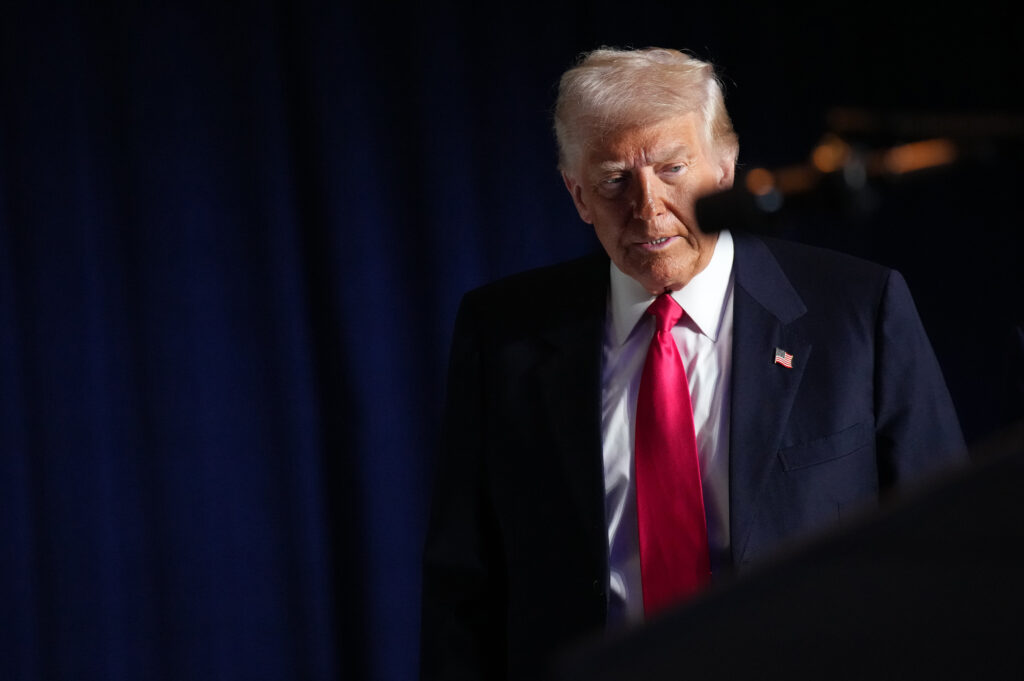
Photo above: President Trump address the Fellowship Foundation at the Washington Hilton on February 6, 2025. Photo by Andrew Harnik, Getty Images.
III. Trump 2.0’s Overall Foreign Policy in the First Year
A useful starting point for analyzing the second Trump administration’s Middle East policy in its first year is to examine its overall foreign policy approach. Analyzing the wider landscape offers important context about both the broader geopolitical environment and Trump 2.0’s efforts to reshape America’s relations with the rest of the world.
President Trump rewrote the playbook of US foreign policy in his first year in office, taking America and the world into uncharted territory with seven major policy shifts:
Prioritizing the Western Hemisphere. The president’s harsh immigration approach at home combined with military strikes against alleged drug traffickers and the January raid capturing Venezuela’s leader marked a major shift toward America’s neighborhood. Trump’s National Security Strategy, National Defense Strategy, and State Department Strategy for 2026-2030 all have a common theme of focusing more resources closer to America’s homeland and immediate region. The pressure tactics and various US engagements in Trump’s first year on Greenland, Canada, Mexico, Colombia, and Cuba all point to a possible longer-term trajectory that will lead America to pull back policy resources from places like the Middle East.
Deploying a new form of economic nationalism. Trump 2.0 introduced or increased tariffs in an effort to gain leverage with competitors and partners globally. These tariffs, along with a steady stream of threatened additional tariffs, disrupted America’s economic ties with countries around the world, including those that the United States depends on as it positions itself in the competition with other global powers like China. The tariffs appear to have decreased the US trade deficit, according to data available as of late 2025, but also reduced the overall volume of trade while lowering productivity and raising prices domestically. It is uncertain whether the Supreme Court will deem the tariff measures constitutional.
Pursuing “quick win” diplomatic deals. The Trump administration sought to resolve conflicts around the world and announced with great fanfare several deals in Africa, Asia, and the Middle East, using assertive media and branding campaigns to promote them. But it remains unclear whether these deals will produce lasting results given numerous unanswered questions and gaps in Trump’s diplomatic approach. Several of these deals have already collapsed, and an examination of the details suggests there is less than meets the eye on some of the others. There is also a strong focus on critical minerals extraction in some of these deals. The year-long, as-yet unsuccessful effort to produce peace in Ukraine within 24 hours of taking office is the biggest example of Trump’s strategic communications getting ahead of reality.
De-prioritizing international and multilateral institutions and advancing a highly transactional selective bilateralism with certain partners. The Trump administration remained strongly critical of international institutions like the United Nations and multilateral alliances such as the North Atlantic Treaty Organization (NATO). Although NATO members committed to increase their defense and security spending contributions to 5% of GDP by 2035 at the June 2025 summit in The Hague, Trump has questioned whether European allies would come to the aid of the US, belittled their military contributions in Afghanistan, and got into an international dispute with Europe over control of Greenland.
Trump cut US funding for the United Nations and ended US involvement with some key UN bodies. As of January 2026, the Trump administration had withdrawn from 66 international organizations it viewed as “wasteful, ineffective, and harmful” and launched the Board of Peace for Gaza — an organization that has been billed as a possible rival or even replacement for the UN. In backing away from multilateralism, the president has adopted a selective bilateralism that is highly personalized and transactional, like with El Salvador, which emerged as a willing enabler and supporter of the US president’s harsh mass deportation policies. Trump’s national security template in his second term is to find partners who help him get results.
Cutting traditional tools of US national security. Trump embarked on an aggressive effort to cut and eliminate key agencies of US national security, including those working in development and diplomacy. Combined with a heavy reliance on special envoys, this approach emphasized loyalty to Trump’s instincts and sought to produce fast outcomes.
Downgrading democracy and human rights in US foreign policy.Trump 2.0 mounted aggressive efforts to dismantle key US institutions, and its actions that raise concerns about the rule of law at home suggest that US support for freedom, democracy, and human rights in its foreign relations is no longer a priority.
Pursuing an incoherent approach on China.One year on, the Trump administration has not yet put forward a coherent strategic approach to China, America’s leading competitor. Key questions about military and economic ties remain unanswered. Trump has threatened to impose tariffs on China but, at the same time, lifted restrictions on high-tech trade. He has taken steps to erode China’s global monopoly on critical minerals but also placed US tariffs on dozens of countries that were previously more closely aligned with the United States in the competition with China, including a 20% tariff rate — later lowered to 15% — on Taiwan. The administration has also pressured partners into avoiding doing business with China but then turned around and signed its own business deal with Beijing, while signaling that Trump is ready to reach an even bigger agreement with Chinese President Xi Jinping perhaps later this year.In December 2025, the Trump administration announced $10 billion in arms sales to Taiwan, signaling a commitment to long-standing US support for the island’s defense against China’s aggression; yet the recently released National Defense Strategy avoids directly referencing any American defense pledge vis-à-vis Taiwan, and the president and his top officials have since reverted to coy or highly ambiguous comments regarding Taipei.
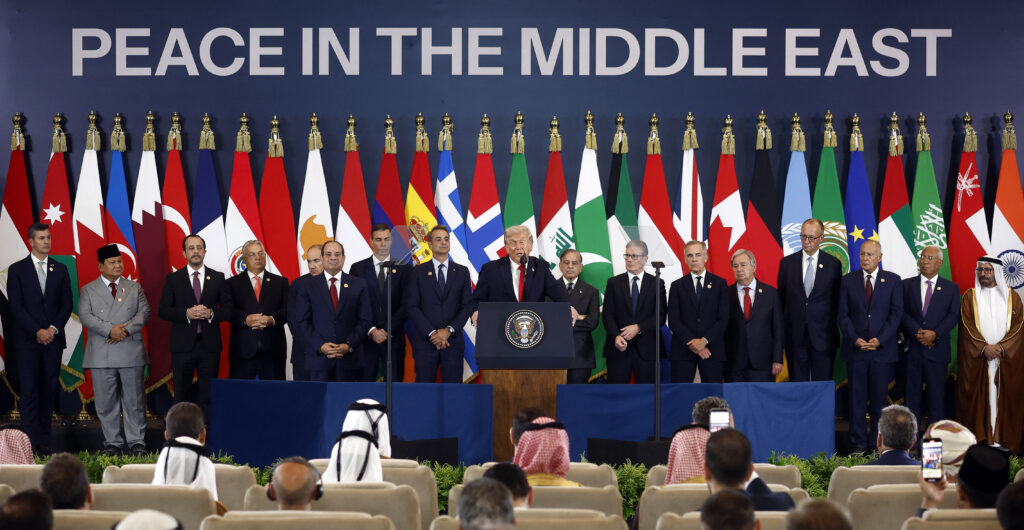
Photo above: President Trump delivers a statement during a summit on Gaza in Sharm el-Sheikh, Egypt, on October 13, 2025. Photo by Yoan Valat/Pool/AFP via Getty Images.
IV. Israel and Palestine
End-of-Year Grade: D
Core US interests: To advance a lasting and just peace within a two-state solution framework, stabilize the region’s state system to facilitate wider integration and prosperity, and enhance the security of close regional allies and partners like Israel, Jordan, Egypt, and the Gulf states.
Trump’s year one performance: The realization of a cease-fire and hostage-release deal in October represented an important step forward, but it occurred after Washington did little to maintain a previous cease-fire that was already in place when the Trump administration came into office. The United States did not take up a comprehensive plan offered by Arab states at a conference in Cairo in early March, and Israel restarted combat operations that same month, imposing a siege on Gaza aimed at pressuring Hamas to give up hostages, its weapons, and its control of power.
The failing grade for US policy on Israel and Palestine in the first two quarters reflects the policy mistakes made during this period, including the promotion of a “Gaza Riviera” plan suggesting, improbably, that all Palestinians would leave Gaza “voluntarily” — a proposal that would be illegal under international law and tantamount to forced displacement — and the creation of the ill-conceived Gaza Humanitarian Foundation that not only did little to alleviate the suffering of millions of Palestinians in Gaza but also resulted in the killing of nearly 1,400 people seeking food. This seven-month period of war resulted in a devastating humanitarian crisis in Gaza and widespread physical ruin, dramatically increasing the eventual cost of reconstruction. In addition, US policy inaction in the face of an escalating crisis in the West Bank and East Jerusalem contributed to low grades.
Trump 2.0’s grades improved in the third quarter because of the October cease-fire and hostage release accompanied by the president’s 20-point plan that has been used as a template for managing the post-war situation. Trump’s active personal engagement in September with key regional leaders was a main reason for this success. However, the October cease-fire has been followed by a period of missed opportunities and the creation of structures like the Board of Peace that have not yet resolved key questions.
During the entire year, the second Trump administration offered strong support to the current Israeli government’s goals, but it did so in a way that limited the openings for a wider regional normalization and integration of the country. Trump 2.0 did not support a push by key regional powers, including Saudi Arabia, to recognize a state of Palestine at the United Nations in September, and it did little practical diplomatic work to forge a consensus on the longer-term end state to this conflict.
What is missing from US policy: US policy continues to underperform in large part because of the unrelenting human costs of the Gaza conflict, the absence of a robust policy component on the Palestinian front, and the lack of meaningful measures to support Palestinian self-governance and autonomy. The commitments from other countries to longer-term elements of the 20-point plan, like the International Stabilization Force, remain vague.
What to watch for next: Daunting challenges remain, including: whether Hamas will disarm; how the various elements outlined, such as the Board of Peace and the National Committee for the Administration of Gaza, will be coordinated; whether the envisioned International Stabilization Force will become a reality; what a sustainable governance structure for millions of Palestinians in Gaza, the West Bank, and East Jerusalem will look like; whether actual financial commitments from countries nominally part of the Board of Peace will be secured; and what the outcomes of Israel’s election later this year will mean for peace.
Most Arab states have aligned behind a consensus in favor of a two-state solution, something currently opposed by Israel. It remains unclear whether key Arab states will deliver on proposals to provide financial assistance and security forces to support post-war Gaza’s recovery without a clearer pathway on Palestinian statehood.
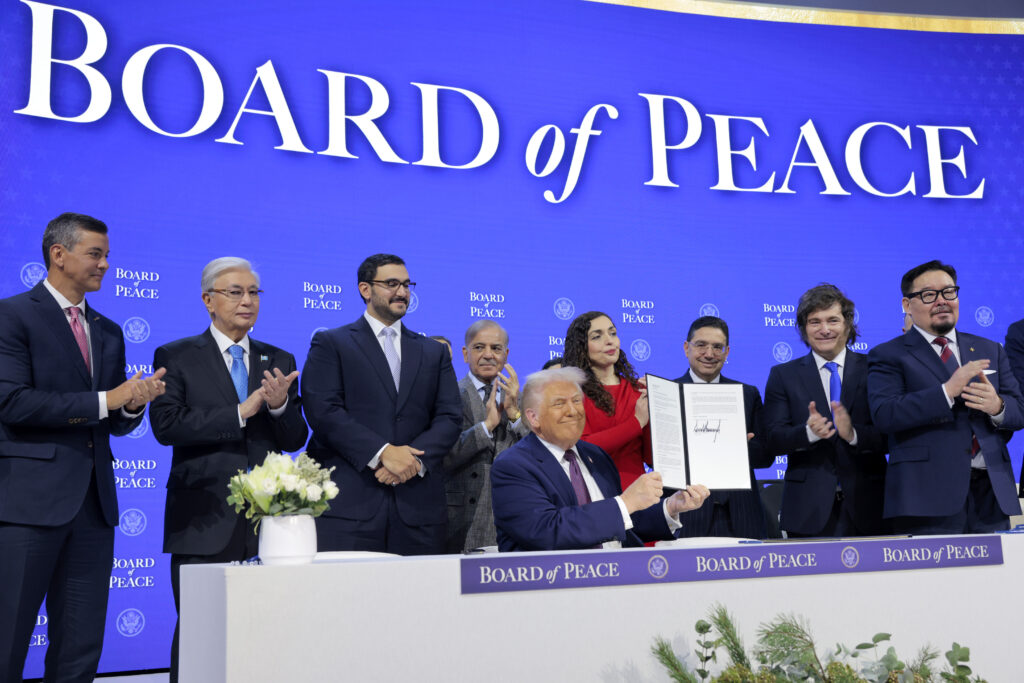
Photo above: President Trump holds up his signature at the signing ceremony for the “Board of Peace” at the World Economic Forum in Davos, Switzerland, on January 22, 2026. Photo by Chip Somodevilla/ Getty Images.
V. Iran
End-of-Year Grade: D
Core US interests: To prevent the Islamic Republic of Iran from obtaining a nuclear weapon and deter its destabilizing actions, including its support for terrorism at home against its own people as well as in the region and wider world.
Trump’s year one performance: Trump 2.0 began its first year in office by engaging Iran directly in five rounds of talks — a sixth round was canceled when Israel began its war in June. During the first quarter, the administration’s grades were higher than the rest of the year because it engaged in diplomacy backed by the threat of force — a message of deterrence delivered in the opening months by dispatching additional warships and planes to the region. The combination of credible military threats and warnings from the United States and Israel, along with key Arab partners advising Iran to take this moment seriously, may have helped produce some diplomatic momentum last spring that the previous US administration was unable to achieve.
Israel’s 12-day war against Iran along with one night of US military strikes in June did extensive damage to the Islamic Republic’s nuclear program and military capabilities. However, the strategic results were inconclusive and numerous questions remain unanswered about the war’s overall impact on the regime’s capacities, will, and future intent.
The grade for US policy on Iran declined throughout the year due to strategic drift after the 12-day war in June. The Trump administration doubled down on its previous “maximum pressure” tactics of economic sanctions and diplomatic isolation, and Europeans imposed snapback sanctions in the fall. Widespread protests broke out inside of Iran once again, at the close of 2025, due to economic hardship, and they continued into early 2026 before being brutally put down by regime security forces. But this pressure was not accompanied by a pathway to a lasting diplomatic resolution.
What is missing from US policy: The lack of a clearly stated end goal has plagued US policy on Iran for decades — and despite Trump 2.0’s increased focus on Iran in its first year, the administration has not articulated a coherent formula to its Iran policy akin to what it did during Trump’s first term.
What to watch for next: The central question at the end of the first year was how stable Iran’s regime will prove going forward, after its brutal crackdown against popular protests in January 2026. But additional questions remain about Iran’s nuclear program, ballistic missile arsenal, and capacities to undercut regional and global security with its vast terror network, cyberattacks, and regional proxies, including the Houthis in Yemen and Hizballah in Lebanon. The Trump administration is once more escalating pressure on Iran’s regime. A key dynamic to watch is whether the US takes military action and how this might be coordinated with the positions and views of key regional partners, particularly Arab Gulf countries that are wary of another round of conflict.
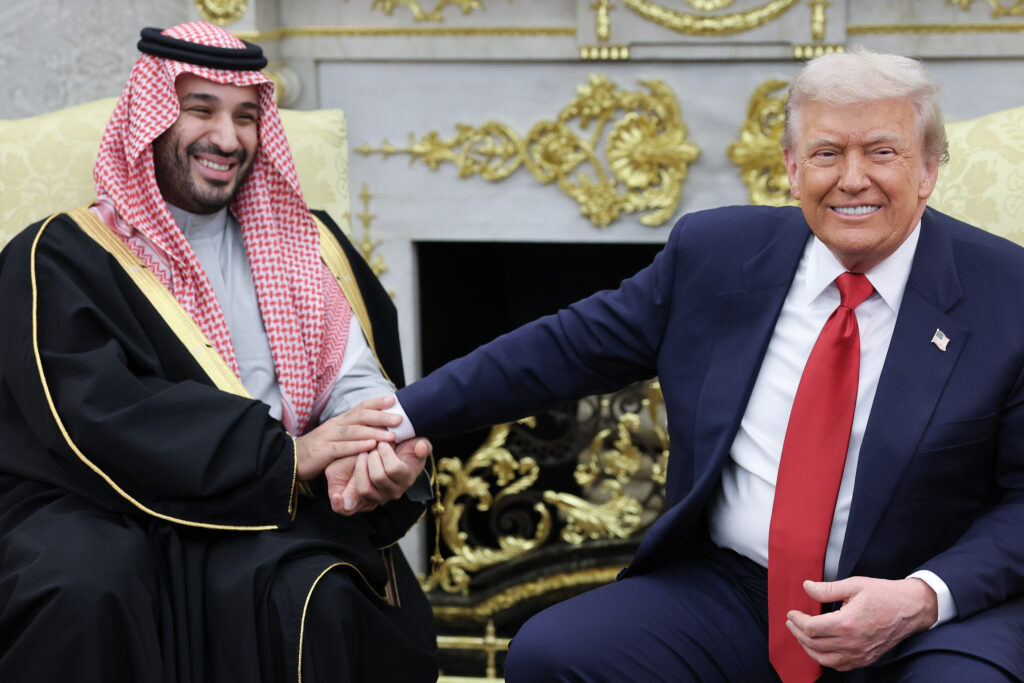
Photo above: President Trump meets with Crown Prince Mohammed bin Salman of Saudi Arabia during a bilateral meeting in the Oval Office of the White House in Washington, DC, on November 18, 2025. Photo by Win McNamee/Getty Images.
VI. Enhancing the Stability of the State System
Overall End-of-Year Grade: C
Core US interests: To produce a more secure regional state system, including governments capable of addressing pressing security threats and maintaining law and order in cooperation with each other. This would reduce the burden on the US military presence in the Middle East.
Trump’s year one performance: The overall grade for US government efforts to bolster the Middle East’s state system remained steady, with US initiatives to support transitions in Syria and Lebanon outperforming US policy in Yemen and Iraq.
Syria End-of-Year Grade: B
The Trump administration initially adopted a mostly “hands off” approach to Syria in the early months of the first year, but then it stepped up engagement after a major shift in policy following Trump’s meeting with Syrian President Ahmed al-Sharaa in Saudi Arabia in May. The United States moved to lift sanctions against Syria, and it deepened cooperation with the Syrian government through measures like bringing it into the anti-ISIS coalition and maintaining a troop presence in the country. Serious questions about the nascent Syrian government’s willingness and capacity to rule inclusively and protect all of its citizens equally were present throughout the year.
Lebanon Grade: B The tenuous cease-fire signed in November 2024 remains largely in place, but progress has proven elusive as Israel maintains a military presence inside of southern Lebanon and conducts regular strikes in the country. The Lebanese government pledged to disarm Hizballah, but advancement toward that goal remains slow. The Trump administration continued to send support to the Lebanese Armed Forces, even on the eve of a fall 2025 government shutdown in America triggered by a budget dispute in Congress.
Yemen Grade: F The Trump administration re-designated the Houthis as a foreign terrorist organization when it entered office and initiated a military campaign against the group in March. That campaign ended in May despite continued threats from the Houthis to Red Sea shipping and Israel, including with ballistic missile and drone strikes. A split between Saudi Arabia and the United Arab Emirates inside of southern Yemen became more pronounced at the end of 2025 and produced an episode of violence and tensions that threatened to roil wider regional dynamics.
Iraq Grade: D The United States was not as actively engaged in Iraq as it had been in the past. US forces withdrew from Iraqi military bases at the end of 2025, maintaining only a limited presence in Kurdistan, and facilitated the transfer of ISIS suspects held in northeast Syria to Iraq in response to the deteriorating security environment in January 2026. US policy did not prioritize other forms of engagement with Baghdad as the country held national elections in November. Trump 2.0 became more vocal in expressing its preferences once post-election negotiations over who would lead Iraq spun up.
What is missing from US policy: US foreign policy efforts are hampered by the lack of a more comprehensive approach that involves fully staffed teams working on complicated questions related to governance, anti-corruption, and economic reform necessary for success in places like Syria and Lebanon. The heavy reliance on senior special envoys with limited bandwidth who mostly work without much input from America’s national security institutions limits the full potential of US policy to advance stability in the region.
What to watch for next: Syria, Lebanon, Iraq, and Yemen remain key areas for competition among regional and global forces. A successful transition and consolidation of power in Syria and Lebanon would benefit US security overall, and Trump 2.0 has moved pragmatically to offer direct support and marshal assistance from others in the region. The outcome of the elections in Iraq remains unclear for US interests, and Washington’s involvement in the country has declined compared to previous decades. Yemen is the weakest link in the Middle East, posing a security threat to the entire region and remaining one of the thorniest and most acute humanitarian challenges outside of Gaza and the West Bank. Yet despite Yemen’s location next to a key strategic chokepoint for global shipping, the Trump administration has largely adopted a “hands off” approach toward the country and has not developed policy tools to produce lasting stability there.
VII. Counterterrorism
End-of-Year Grade: C
Core US interests: To prevent an attack on the homeland and protect key Middle Eastern partners from violent terrorist networks by degrading these groups’ capabilities.
Trump’s year one performance: The United States continued to stay engaged throughout the year in military operations against terrorist networks such as ISIS. The strikes by Israel backed by the United States against terrorist groups like Hizballah and state sponsors of terrorism like Iran have weakened some of these networks. However, Trump reallocated limited federal resources to challenges closer to home, like drug cartels in the Western Hemisphere, and deployed military and intelligence assets in places like Venezuela to the detriment of the fight against terrorist networks in the Middle East. In addition, the Trump administration has shifted important law enforcement, intelligence, and homeland security assets away from global terrorist threats and toward implementing a harsh immigration crackdown at home.
The Middle East continues to see persistent threats from terrorist groups like ISIS and al-Qaeda affiliates, including al-Qaeda in the Arabian Peninsula, as recent threat assessments by the US intelligence community and the Center for Strategic and International Studies have highlighted.
What is missing from US policy: While US counterterrorism efforts continued to eliminate key leaders and undermine the capabilities of these groups, the administration lacks a broader strategy to support lasting solutions. The massive cuts that the Trump administration implemented to State Department efforts to counter disinformation and the initial attempts to shutter the Voice of America, Radio Free Europe/Radio Liberty, and the Middle East Broadcasting Networks amount to unilateral disarmament in the information battlespace against extremist ideologies.
What to watch for next: As with the efforts to enhance the stability of the regional state system, the US approach to counterterrorism is weakened by the Trump administration’s overreliance on military tactics and gutting of the other tools of US foreign policy needed to produce lasting results. Other tools include building stable diplomatic and military partnerships with key countries and groups aligned with the United States as well as investing in diplomatic, economic, and strategic communications mechanisms to counter and compete against terrorist groups.
A key country to watch in both the stability of the state system and the fight against terrorism is Syria, particularly given that some of the key leaders of the de facto government rose to power as leaders in terrorist movements.
The unresolved situation with Palestinians in Gaza, the West Bank, and East Jerusalem also continues to fuel propaganda campaigns by terrorist adversaries.
VIII. Managing Relations with Key Partners
End-of-Year Grade: C
Core US interests: To support a network of partners capable of sharing the burdens of securing the region and working together to reach its maximum potential to produce greater prosperity through increased cooperation and connectivity.
Trump’s year one performance: The second Trump administration has prioritized relations with key Middle Eastern leaders in ways that the last several US presidents have not. Trump spent considerable time meeting with a wide range of heads of state and officials from the Middle East in his first year, and he traveled to the region twice — once in May to Saudi Arabia, Qatar, and the UAE on a visit spotlighting economic deals, and then in October to Israel and Egypt to mark the Gaza cease-fire and hostage-release deal.
The Trump administration’s approach with key US Middle Eastern partners remained relatively steady compared to the way it has dealt with countries in Europe and parts of Asia, like India. Trump 2.0 reinforced US military support for Israel and its current government’s actions throughout the year. The Trump administration also prioritized economic and energy ties with key partners in the Middle East. It secured commitments from regional economic powers like Saudi Arabia and the UAE to make hundreds of billions of dollars of investments in the United States.
At the same time, the uncertainty of Trump’s overall engagement produced unease beneath the photo-op diplomacy that he conducted throughout the year. For instance, President Trump sent mixed messages to close partners like Jordan and Egypt, calling in his early weeks for these countries to accept millions of Palestinians from Gaza and threatening to cut US assistance if they did not. In addition, the moves to reduce or eliminate certain types of visas for people living in key Middle Eastern countries also undercut the decades-long efforts to build lasting partnerships.
Israel’s strike against senior Hamas officials engaged in negotiations in Qatar in September raised additional concerns about the reliability of America’s security umbrella in the region, but the Trump administration sought to address those concerns by offering bilateral security deals to some partners like Qatar and Saudi Arabia. These security deals were in the form of executive orders, which may have less durability and legal authority than a formal treaty.
Trump did little to engage with the March 2025 plan on Gaza released by Arab states, but he personally got involved with key countries in September to produce the second cease-fire. The unrestricted support the Trump administration provided to the current Israeli government throughout the year limited the potential for wider openings for regional integration and normalization.
What is missing from US policy: The United States did not and in some cases could not restrain the destabilizing actions of some of its partners. Trump 2.0 has shied away from building formal coalitions, like the multinational effort to defeat ISIS, and instead has turned to more superficial and less widely supported approaches like the Board of Peace announced in January.
What to watch for next: How the sum of Trump 2.0’s broader foreign policy and geo-economic agenda, including the impact of tariffs and trade wars, changes the overall nature and quality of relations with key Middle East partners merits watching. A subtle slide toward even greater multipolarity where America’s sway and influence gradually diminish over time could be one result of this transactional approach.
Over the past year, Saudi Arabia and Pakistan on the one hand and India and the UAE on the other signed new bilateral defense pacts. These developments might represent the start of a new era in which partnerships are reshuffled because of changing dynamics in the region combined with local powers’ efforts to hedge against the perceptions of a less reliable and predictable United States.
Brian Katulis is Senior Fellow at the Middle East Institute.
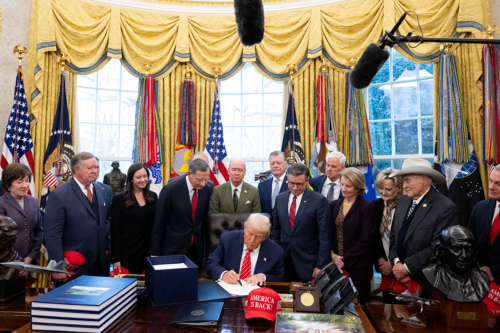
Top photo: US President Donald Trump signs a funding bill to end a partial government shutdown in the Oval Office of the White House in Washington, DC, on February 3, 2026. Photo by Saul Loeb/AFP via Getty Images.
Appendix I: Ongoing Strategic Assessments of US Policy
The three quarterly reports on the second Trump administration’s approach to the Middle East along with analysis on its overall foreign policy approach can be found here:
These reports are part of an ongoing effort to systematically analyze and evaluate US foreign policy in the Middle East. It began in 2023 and includes regular assessments, Making Sense of US Foreign Policy, as well as four reports produced during President Joe Biden’s administration:
This report represents the independent analytical judgments of one scholar, based on his policy research and feedback from colleagues and peers, with essential research support from Athena Masthoff.
The author would like to thank colleagues and peers who took time to review a draft of this report and offer comments, including Hamad Alshamlan, Naomi Banner, Jason Campbell, Matthew Czekaj, Bailey Dressner, Eryn Gold, Taylor Issa, Iulia-Sabina Joja, Eleanor Knapman, Lucy Kurtzer-Ellenbogen, Ben Lefkowitz, Yael Lempert, Mirette Mabrouk, Kenneth Pollack, Natan Sachs, Alistair Taylor, Gönül Tol, Alex Vatanka, Marvin G. Weinbaum, and Rebekah Wharton.